The Encyclopaedia of New Zealand says that the rate of union membership dropped sharply to under 20% when the Employment Contracts Act was passed in 1991 using the chart below.
Figure 1: Percentage of union members

The OECD union density data, which allows international comparisons back to 1970, tells a different story. OECD data on union membership in New Zealand started in 1970.
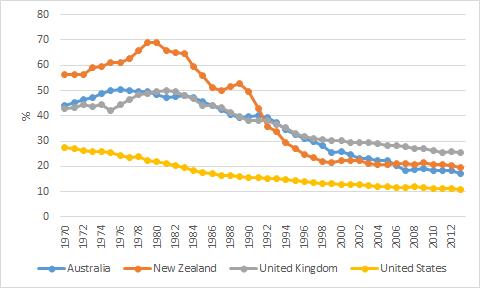
Figure 2: Union density,New Zealand, Australia, the UK and USA 1970-2013
Source: OECD Stats Extract
Note: Trade union density corresponds to the ratio of wage and salary earners that are trade union members, divided by the total number of wage and salary earners (OECD Labour Force Statistics).
Figure 2 above shows that union membership has been in a long slow decline in New Zealand since the mid-1970s. This is been pretty much the pattern all round the world.
The much hated Employment Contracts Act 1991, much hated by the Left over Left, doesn’t really show up in the union density figures in figure 2. There is no sudden break in trend obvious in figure 2.
The longer time series in union membership in figure 1 compiled by the Encyclopaedia of New Zealand has long gaps between the data observations. Because of this, the sharp decline in union membership from the late 1970s, which it actually show up in its start-up , is not sufficiently distinguished from subsequent events because of the long gaps between observations reported in the figure 1.
If anything, union membership stopped declining in New Zealand in the late 1990s. Stabilising at about 20% of wage and salary earners.
Union membership continued to decline slowly in Australia, the UK and the USA subsequent to 1998. Union membership stabilised in New Zealand by contrast. Perhaps the Employment Contracts act should be able to claim credit for that?
 Utopia, you are standing in it!
Recent Comments