Marianne Bertrand, laureate of the Jean-Jacques Laffont Prize 2019
08 Oct 2026 Leave a comment
in applied price theory, discrimination, econometerics, economic history, economics of education, gender, human capital, labour economics, labour supply, occupational choice, poverty and inequality Tags: gender wage gap
Labour is reneging on its pay equity promise
07 Oct 2026 Leave a comment
in discrimination, gender, labour economics, labour supply, politics - New Zealand, poverty and inequality, Public Choice, rentseeking, unions Tags: 2026 general election, gender wage gap
Bryce Edwards writes – Chris Hipkins has described the coalition’s decision to cancel pay equity claims under urgency as “probably the most reprehensible thing I have seen in my time as a member of Parliament”. He accused ministers of “robbing Paula to pay Paul” and of “sacrificing equal pay for women in order to balance […]
Labour is reneging on its pay equity promise
The gender wage gap is fading away
13 Sep 2026 Leave a comment
in applied price theory, discrimination, economic history, economics of education, gender, human capital, labour economics, labour supply, occupational choice, politics - New Zealand, poverty and inequality Tags: feminism, gender, gender wage gap, history, politics, sex discrimination, women
The gender wage gap has dropped by two-thirds in the last 30 years. It has halved since the first pay equity claim was filed 14 years ago. The gender wage gap is now barely 5.5% in June 2026 according to the recently released Statistics New Zealand data. It is a stretch to file pay equity claims asking for 30% more when the gender wage gap struggles to stay above 5%.
The gender wage gap data released by Statistics New Zealand recently is the raw data. There are no adjustments to that pay gap for differences in educational backgrounds, continuity of employment and dedication to demanding careers, unsocial hours, risk of injury, and the greater desire of women for work-life balance and jobs with more working from home options.
It is not mischievous to say that the gender wage gap may round down to zero once these factors are considered.
From time-to-time, detailed datasets become available on male and female workers that show that the gender wage gap goes down or close to zero. There are even detailed datasets where hiring and job assignments are made without any management intervention or possible bias.
There is a large gender wage gap driven by work-life balance under a bus and train drivers’ collective agreement in Massachusetts. The work-force was one-third female with hiring via a lottery among applicants with a clean record. Shifts are chosen by drivers strictly according to their seniority at each depot.
There was still a 11% gender wage gap because women drivers elected to work less overtime, they avoided overtime shifts on short notice, and they worked fewer shifts at nights and weekends. This gender wage gap among bus and train drivers cannot be the fault of their sexist employer because work was allocated by an exceptionally detailed union contract.
A 7% gender wage gap emerged even when a computer algorithm is allocating the work first come, first served.
A study of Uber drivers found a gender pay gap of zero once account is taken for male Uber drivers driving more at nights, weekends and in the more dodgy neighbourhoods with drinking establishments. Male Uber drivers also worked more hours per year which meant they had much more work experience than female Uber drivers. These additional hours meant men became more skilled in deciding when and where to best cruise for the best paying jobs. The fact that men drive faster explained the last two percentage points of the gender pay gap at Uber. Speed meant men were available for the next Uber job quicker.
The gender wage gap is just into the double digits for the top 10% of female earners in New Zealand in 2025 (see OECD graphic). This is because their chosen careers are often not family friendly. But even at the top end of town the gender pay gap has halved in the last 20 years.
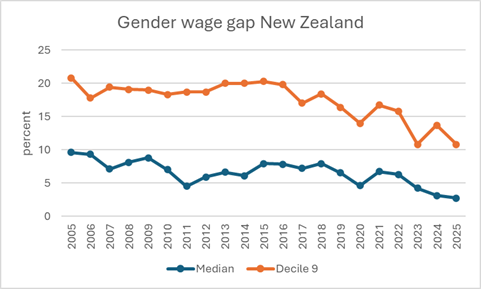
OECD data explorer
Women’s willingness to trade work-life balance for lower wages and fewer promotions is a big driver of the gender wage gap and the channelling of women into family friendly occupations. The wages of men and women at all levels are similar in the years leading up to motherhood then everything changes.
Top American labour economist Claudia Goldin found that some careers severely penalise any time off such as for motherhood or working less than punishingly long or rigid hours. Goldin refers to these jobs as greedy jobs. Women’s preference for family friendly occupations that can pay less and a tendency to avoid greedy jobs will mean that the gender wage gap may always be with us at least at the big end of town.
The effects of remote work on the disability employment gap
17 Aug 2026 Leave a comment
in discrimination, gender, human capital, labour economics, labour supply, transport economics, urban economics Tags: gender wage gap, sex discrimination
A rise in work from home explains most of the postpandemic gain in full-time employment among people with physical disabilitiesBy Tyler Smith. “Employment among people with disabilities has remained well below that of the broader population, with an average disability employment gap of 27 percentage points across OECD countries. In the United States, this low disability…
The effects of remote work on the disability employment gap
Alex Tabarrok: Britain’s equal pay madness
16 Aug 2026 Leave a comment
in applied price theory, Austrian economics, discrimination, economics of education, gender, health and safety, human capital, industrial organisation, labour economics, labour supply, occupational choice, poverty and inequality Tags: affirmative action, gender wage gap, pay equity, sex discrimination
New Zealand shows how to solve the equal pay crisis
07 Aug 2026 Leave a comment
in applied price theory, discrimination, economic history, economics of regulation, gender, human capital, labour economics, labour supply, occupational choice, poverty and inequality Tags: gender wage gap
Outgoing governments often try to craft a legacy for themselves by introducing policy traps that incoming governments find hard to undo, such as Rishi Sunak’s National Insurance cuts in 2024 or Gordon Brown’s introduction of the 50p top rate of income tax in 2010. Keir Starmer just did something similar by initiating a huge expansion in the […]
New Zealand shows how to solve the equal pay crisis
The Apples and Oranges Tribunal
28 Jul 2026 Leave a comment
in applied price theory, discrimination, economics of education, economics of regulation, gender, labour economics, labour supply, law and economics, liberalism, Marxist economics, poverty and inequality, property rights Tags: gender wage gap, sex discrimination
Suppose that apples sell for more than oranges and Parliament in it’s wisdom decides that, at last, apples and oranges must be compared. Not by shoppers — shoppers are biased, they merely reveal what they are willing to pay — but by a tribunal, which will determine whether apples and oranges are of truly equal…
The Apples and Oranges Tribunal
The Equal Pay Madness Just Got Madder
17 Jul 2026 1 Comment
in applied price theory, discrimination, economics of regulation, gender, human capital, labour economics, labour supply, occupational choice Tags: gender wage gap
In my post Equality Act 2010 I discussed the UK’s absolutely insane wage policy: In short, supply and demand have been replaced by judges and labor boards with the authority to deem which jobs are “equal” and therefore should be paid equally….No one is alleging that male and female warehouse workers were paid unequally or…
The Equal Pay Madness Just Got Madder
Claudia Goldin and the WNBA
30 Mar 2026 Leave a comment
in applied price theory, discrimination, gender, human capital, labour economics, labour supply, managerial economics, occupational choice, organisational economics, personnel economics, sports economics Tags: gender wage gap
After Claudia Goldin became the first woman to win a solo Nobel in economics in 2023, she received hundreds of invitations and requests. She accepted just three. One of them was advising the WNBA players union as the women prepared to negotiate a new labor deal with the league. When Goldin replied via email to Terri Carmichael Jackson,…
Claudia Goldin and the WNBA
Changes in the Gender Wage Gap for Business Professionals
14 Feb 2026 1 Comment
in applied price theory, discrimination, economics of education, gender, human capital, labour economics, labour supply, managerial economics, occupational choice, organisational economics, personnel economics Tags: gender wage gap
In the United States, much of the gap in earnings between men and women is due to the persistent gap for high wage earners. This paper explores changes in the gender wage gap for MBAs graduating from a large public university over 30 years. We document large gender wage gaps on average, which grow in…
Changes in the Gender Wage Gap for Business Professionals
My first AI op-ed summary
21 Dec 2025 Leave a comment
in applied price theory, discrimination, economics of education, economics of information, entrepreneurship, gender, human capital, labour economics, labour supply, politics - New Zealand Tags: gender wage gap
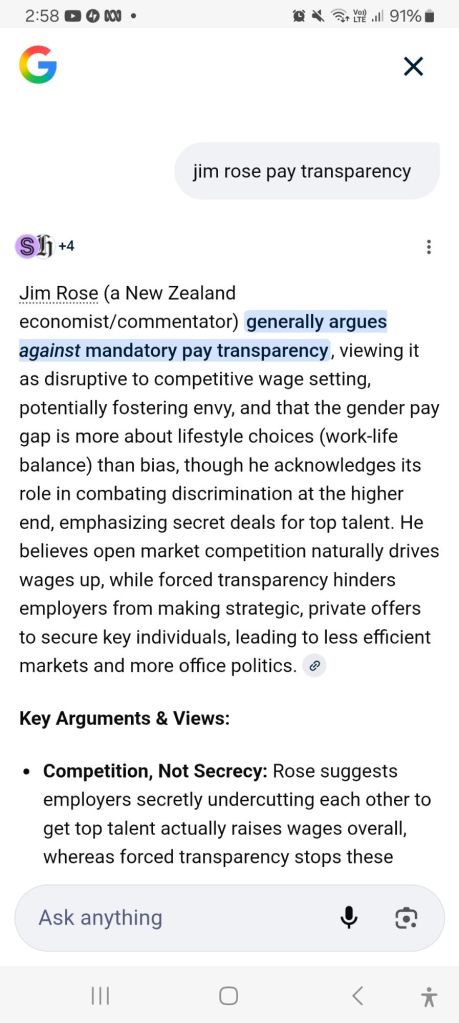
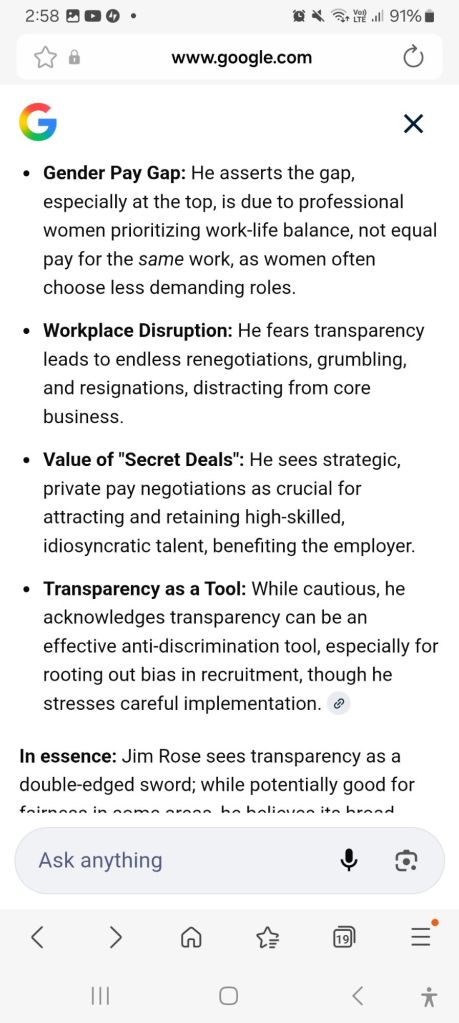

Ten Modest Proposals to End the Gender Pay Gap
17 Oct 2025 Leave a comment
in applied price theory, discrimination, economics of crime, economics of education, gender, human capital, labour economics, labour supply, law and economics, occupational choice, politics - USA Tags: gender wage gap

An anonymous Swiftian guest essay
Ten Modest Proposals to End the Gender Pay Gap
The smallest gender pay gap in history
28 Aug 2025 Leave a comment
in applied price theory, discrimination, econometerics, economic history, gender, human capital, labour economics, labour supply, occupational choice, politics - New Zealand, poverty and inequality Tags: gender wage gap, sex discrimination
Stats NZ reports: The gender pay gap was 5.2 percent in the June 2025 quarter, down from 8.2 percent in the June 2024 quarter, according to figures released by Stats NZ today. “The June 2025 quarter gender pay gap of 5.2 percent is the lowest since the series began in 1998,” labour market spokesperson Abby […]
The smallest gender pay gap in history
Woman of the day
18 Jul 2025 Leave a comment
in defence economics, discrimination, economic history, gender, labour economics, labour supply Tags: France, gender wage gap, sex discrimination
OTD in 1965, France changed the law to allow married women the right to work without their husbands’ permission. Yes, really. To mark the occasion, Woman of the Day is journalist Madeleine Riffaud, French Resistance, who didn’t need any man’s permission to fight for her country.… pic.twitter.com/nlp3f2GIsK — The Attagirls (@TheAttagirls) July 13, 2025
Woman of the day
Govt fiscal constraints are the elephant in the pay equity room
11 Jul 2025 Leave a comment
in applied price theory, discrimination, fiscal policy, gender, human capital, income redistribution, labour economics, labour supply, occupational choice, politics - New Zealand, Public Choice, public economics, rentseeking Tags: gender wage gap, pay equity, sex discrimination
Michael Johnston writes – The way the government went about rolling back 33 pay equity claims lodged under the last government’s Pay Equity legislation was clumsy at best. The changes were made under urgency and applied retrospectively. It was not a good look. Predictable howls of rage and furious accusations ensued. Critics say the government […]
Govt fiscal constraints are the elephant in the pay equity room


Recent Comments