TweetMegan McArdle writes insightfully about California’s pending proposal to soak the rich. Three slices: These days, legislators generally don’t enact tax hikes so confiscatory that they trigger an immediate, obvious response. They adjust income tax rates by a few percentage points, fiddle with the deductions or impose new levies on some tiny portion of the…
Some Links
Some Links
26 Oct 2026 Leave a comment
in applied price theory, entrepreneurship, fiscal policy, human capital, income redistribution, labour economics, labour supply, macroeconomics, politics - USA, poverty and inequality, Public Choice Tags: California, taxation and entrepreneurship, taxation and investment
Brazil’s economic problems, in a nutshell
26 Oct 2026 Leave a comment
in budget deficits, development economics, economic growth, economic history, fiscal policy, growth disasters, labour economics, macroeconomics, welfare reform Tags: Brazil
It would take true Milei-like ardour to slice through Brazil’s economic troubles. These are caused by a gnarly mix of high public spending, stubborn inflation and low saving. The result is a crippling cost of capital. Some analysts put Brazil’s real interest rate, the BCB’s policy rate adjusted for next year’s expected inflation, at 9% or…
Brazil’s economic problems, in a nutshell
Mariana Mortágua on why crypto-assets are not money
26 Oct 2026 Leave a comment
in applied price theory, financial economics, history of economic thought, macroeconomics, monetary economics
Economists typically identify money by the extent to which an asset satisfies three functions. First, it needs to be a medium of exchange, meaning that you give it up when you buy goods or services, and you can receive it when you sell goods or services. Second, it needs to be a unit of account, meaning that you…
Mariana Mortágua on why crypto-assets are not money
Will bystander economies be able to finance their governments?
24 Oct 2026 Leave a comment
in applied price theory, budget deficits, economic growth, entrepreneurship, fiscal policy, macroeconomics, Public Choice, public economics Tags: creative destruction
From Jesús Fernández-Villaverde: Will AI poison the public finances of many modern states? There is a real risk that it will. Yesterday, I circulated a new paper, “Saving for the Machines,” which makes a simple point. Building the AI transformation will require enormous investment. The only way to induce agents to save for that investment…
Will bystander economies be able to finance their governments?
The Economic Consequences of Different Ways of Propping Up Social Security
24 Oct 2026 Leave a comment
in fiscal policy, income redistribution, macroeconomics, politics - USA, Public Choice, public economics Tags: social insurance
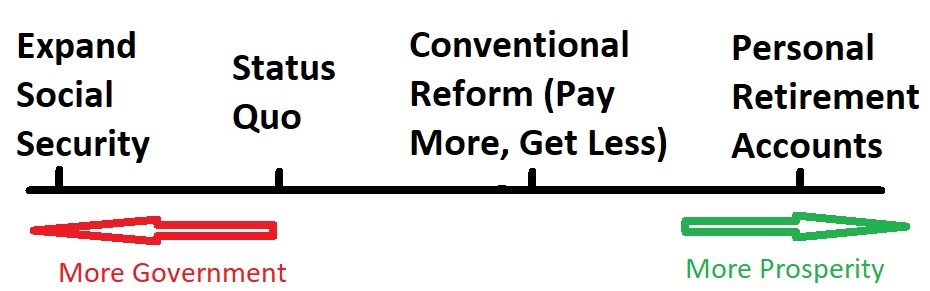
My Ph.D. dissertation last century was about Australia’s system of personal retirement accounts, so I have a long-time interest in how to fix America’s Social Security system. Which leads me to a good news-bad news situation. The good news is that politicians will probably be forced to deal with Social Security at some point in […]
The Economic Consequences of Different Ways of Propping Up Social Security
Quotation of the Day…
23 Oct 2026 Leave a comment
in business cycles, history of economic thought, macroeconomics, monetarism, monetary economics
Tweet… is from page 129 of my late, great teacher Fritz Machlup’s May 1960 Review of Economics and Statistics paper, “Another View of Cost-Push and Demand-Pull Inflation“: It is clear that an inflation of effective demand is a necessary condition not only for a demand-pull inflation of consumer prices but also for a cost-push inflation.…
Quotation of the Day…
Are Banking Systems Inherently Unstable? | @GeorgeSelgin | Hayek Program…
22 Oct 2026 Leave a comment
in applied price theory, Austrian economics, business cycles, economic history, economics of regulation, great depression, great recession, history of economic thought, law and economics, macroeconomics, monetary economics, property rights, Public Choice, rentseeking Tags: monetary policy
SIEPR Economic Summit 2026 | California Wealth Tax
22 Oct 2026 Leave a comment
in applied price theory, economic growth, economic history, entrepreneurship, fiscal policy, history of economic thought, human capital, income redistribution, labour economics, labour supply, macroeconomics, Public Choice, public economics Tags: California, taxation and entrepreneurship, taxation and investment
Defining the Unemployment Rate
22 Oct 2026 Leave a comment
in business cycles, history of economic thought, labour economics, labour supply, macroeconomics, unemployment
An updated version of our Marginal Revolution University (MRU) video on defining the unemployment rate. Free to use for anyone but goes best, of course, with Modern Principles of Economics, the best principles of economics textbook. The post Defining the Unemployment Rate appeared first on Marginal REVOLUTION.
Defining the Unemployment Rate
“Why Was the Fed Created?” with @GeorgeSelgin
20 Oct 2026 Leave a comment
in business cycles, economic history, financial economics, great depression, history of economic thought, macroeconomics, monetary economics, politics - USA, Public Choice, rentseeking Tags: monetary policy
California in-migration and out-migration
14 Oct 2026 Leave a comment
in applied price theory, econometerics, entrepreneurship, fiscal policy, human capital, labour economics, labour supply, macroeconomics, politics - USA, poverty and inequality, public economics Tags: California, taxation and entrepreneurship, taxation and investment, taxation and labour supply, top 1%
Long-run U.S. population movements have been driven more by natural amenities than by jobs, and California, rich in both uniform and complementary climates, should be a persistent net gainer of domestic migrants. It has instead lost residents to other states every year since about 1990. This paper argues that its amenities are unchanged and that…
California in-migration and out-migration
On the microeconomic foundations of macro stabilisation: The Hall-Woodford prize in historical perspective
13 Oct 2026 Leave a comment
in business cycles, history of economic thought, inflation targeting, macroeconomics, monetarism, monetary economics

“This year’s prize is about stabilization” was the sentence with which Ellen Moons, Secretary General of the Royal Swedish Academy of Sciences, introduced the not-true-Nobel-but-Nobel-still prize for economics this morning (a physicist, she is the first woman to hold the position since the Academy’s creation in 1739). It went to Stanford’s Bob Hall and Columbia’s […]
On the microeconomic foundations of macro stabilisation: The Hall-Woodford prize in historical perspective
Michael Woodford, Nobel Laureate
13 Oct 2026 Leave a comment
in labour economics, macroeconomics, history of economic thought, monetarism, business cycles, unemployment, monetary economics
I think of Michael Woodford as the kind of economist who studies something very specific very intensively and tries to get it just right. But in his case he is not studying something small and irrelevant, he is studying “monetary policy.” I think of him as the economist who put monetary policy and “monetarism” —…
Michael Woodford, Nobel Laureate


Recent Comments