We recently discussed how Yale faculty reached academic nirvana after years of purging departments of conservatives and Republicans. The university…
The Purge: Princeton Faculty Reach Perfect Zero Support for Republicans
The Purge: Princeton Faculty Reach Perfect Zero Support for Republicans
12 Oct 2026 Leave a comment
in economics of education, politics - USA Tags: academic bias
Selfish Reasons to Have More Kids: 15th-Anniversary Edition
08 Oct 2026 Leave a comment
in economics of education, human capital, labour economics, poverty and inequality Tags: behavioral genetics
Greetings from Yellowstone!Selfish Reasons to Have More Kids is the only book I ever wrote that definitely improved the world a lot. A lower-bound estimate is that several hundred extra babies were born as a result — a social value of over a billion dollars. Now a new edition of the book, shipping November 17,…
Selfish Reasons to Have More Kids: 15th-Anniversary Edition
Marianne Bertrand, laureate of the Jean-Jacques Laffont Prize 2019
08 Oct 2026 Leave a comment
in applied price theory, discrimination, econometerics, economic history, economics of education, gender, human capital, labour economics, labour supply, occupational choice, poverty and inequality Tags: gender wage gap
Is mathematics discovered or invented?
05 Oct 2026 Leave a comment
in economics of education Tags: philosophy of science
That is one of the oldest and deepest questions in the philosophy of mathematics. The short answer is: we invent the formal systems, but we may discover the consequences that follow from them. There are three main positions. Mathematical realism or Platonism: mathematical truths exist independently of us, and mathematicians discover them. On this view, the Pythagorean […]
Is mathematics discovered or invented?
Some basics on incidence of student loan relief
05 Oct 2026 Leave a comment
in applied price theory, economics of education, labour economics, labour supply, occupational choice, poverty and inequality, Public Choice, public economics, rentseeking
Labour proposes wiping 10% off of outstanding student loan balances for domestic borrowers that are not in arrears and who have not benefitted from fees-free study. That write-down will happen on 1 April.It proposes doing it again in 2031, and each year afterwards, for borrowers in good standing who have been NZ-based over the prior…
Some basics on incidence of student loan relief
Why George Orwell was a great writer
03 Oct 2026 Leave a comment
in defence economics, economics of education, liberalism, Marxist economics, war and peace
George Orwell is widely regarded as a great writer because he combined unusual clarity of prose with intellectual seriousness, moral urgency and a remarkable ability to turn political ideas into memorable literature. His style is one of the main reasons. Orwell worked hard to make difficult ideas seem simple without making them simplistic. His prose is […]
Why George Orwell was a great writer
Quotation of the Day…
28 Sep 2026 Leave a comment
in development economics, economics of education, Thomas Sowell
Tweet… is from page 12 of Thomas Sowell’s 1993 book, Inside American Education (footnotes deleted): An international look at per-pupil expenditures likewise gives the lie to claims that more money produces better education. Despite claims that money is needed to hire more teachers to relieve “overcrowded classrooms,” the United States already has a smaller average…
Quotation of the Day…
The Tragedy of Nikole Hannah-Jones
21 Sep 2026 Leave a comment
in economics of education, politics - USA
Nikole Hannah-Jones famously sent her child to a predominantly black/lower-income public school in New York City. Now her child says she shouldn’t have been used as political fodder. The essay makes for hard reading and I acknowledge NHJ’s courage in writing about her mistakes and the cost to her child. The piece is raw and…
The Tragedy of Nikole Hannah-Jones
The gender wage gap is fading away
13 Sep 2026 Leave a comment
in applied price theory, discrimination, economic history, economics of education, gender, human capital, labour economics, labour supply, occupational choice, politics - New Zealand, poverty and inequality Tags: feminism, gender, gender wage gap, history, politics, sex discrimination, women
The gender wage gap has dropped by two-thirds in the last 30 years. It has halved since the first pay equity claim was filed 14 years ago. The gender wage gap is now barely 5.5% in June 2026 according to the recently released Statistics New Zealand data. It is a stretch to file pay equity claims asking for 30% more when the gender wage gap struggles to stay above 5%.
The gender wage gap data released by Statistics New Zealand recently is the raw data. There are no adjustments to that pay gap for differences in educational backgrounds, continuity of employment and dedication to demanding careers, unsocial hours, risk of injury, and the greater desire of women for work-life balance and jobs with more working from home options.
It is not mischievous to say that the gender wage gap may round down to zero once these factors are considered.
From time-to-time, detailed datasets become available on male and female workers that show that the gender wage gap goes down or close to zero. There are even detailed datasets where hiring and job assignments are made without any management intervention or possible bias.
There is a large gender wage gap driven by work-life balance under a bus and train drivers’ collective agreement in Massachusetts. The work-force was one-third female with hiring via a lottery among applicants with a clean record. Shifts are chosen by drivers strictly according to their seniority at each depot.
There was still a 11% gender wage gap because women drivers elected to work less overtime, they avoided overtime shifts on short notice, and they worked fewer shifts at nights and weekends. This gender wage gap among bus and train drivers cannot be the fault of their sexist employer because work was allocated by an exceptionally detailed union contract.
A 7% gender wage gap emerged even when a computer algorithm is allocating the work first come, first served.
A study of Uber drivers found a gender pay gap of zero once account is taken for male Uber drivers driving more at nights, weekends and in the more dodgy neighbourhoods with drinking establishments. Male Uber drivers also worked more hours per year which meant they had much more work experience than female Uber drivers. These additional hours meant men became more skilled in deciding when and where to best cruise for the best paying jobs. The fact that men drive faster explained the last two percentage points of the gender pay gap at Uber. Speed meant men were available for the next Uber job quicker.
The gender wage gap is just into the double digits for the top 10% of female earners in New Zealand in 2025 (see OECD graphic). This is because their chosen careers are often not family friendly. But even at the top end of town the gender pay gap has halved in the last 20 years.
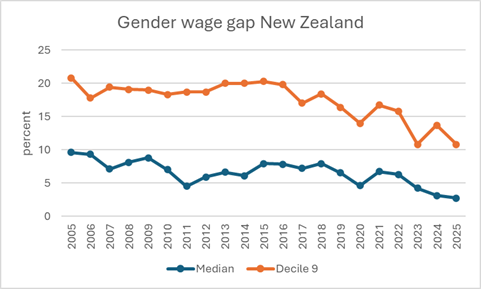
OECD data explorer
Women’s willingness to trade work-life balance for lower wages and fewer promotions is a big driver of the gender wage gap and the channelling of women into family friendly occupations. The wages of men and women at all levels are similar in the years leading up to motherhood then everything changes.
Top American labour economist Claudia Goldin found that some careers severely penalise any time off such as for motherhood or working less than punishingly long or rigid hours. Goldin refers to these jobs as greedy jobs. Women’s preference for family friendly occupations that can pay less and a tendency to avoid greedy jobs will mean that the gender wage gap may always be with us at least at the big end of town.
Did the Sewing Machine Reduce the Workload for Women?
10 Sep 2026 1 Comment
in discrimination, economic growth, economic history, economics of education, gender, history of economic thought, human capital, industrial organisation, labour economics, labour supply, macroeconomics, occupational choice, poverty and inequality, technological progress Tags: creative destruction, The Great Enrichment
Is new technology that replaces a worker a good thing? We have a tendency, it seems to me, to believe that most previous inventions turned out to have overall net social benefits, but to be worried that all future inventions will instead have overall net social costs. Philipp Ager and Davide Coluccia tackle the question of…
Did the Sewing Machine Reduce the Workload for Women?
“To Write Well is to Think Clearly”: David McCullough
08 Sep 2026 Leave a comment
in economic history, economics of education, politics - USA
The great historian David McCullough (1933-2022) won the Pulitzer prize for biography twice, for his books on Truman and John Adams, but he also wrote best-selling books on the Panama Canal, the Johnstown Flood, the Brooklyn Bridge, the Wright brothers, and others. Here are his comments in a 2002 interview with Bruce Cole on the…
“To Write Well is to Think Clearly”: David McCullough
America is still poised for a data center boom
07 Sep 2026 Leave a comment
in economics of education, economics of information, energy economics, entrepreneurship, industrial organisation
Eric Levitz, via Matt Yglesias. The post America is still poised for a data center boom appeared first on Marginal REVOLUTION.
America is still poised for a data center boom
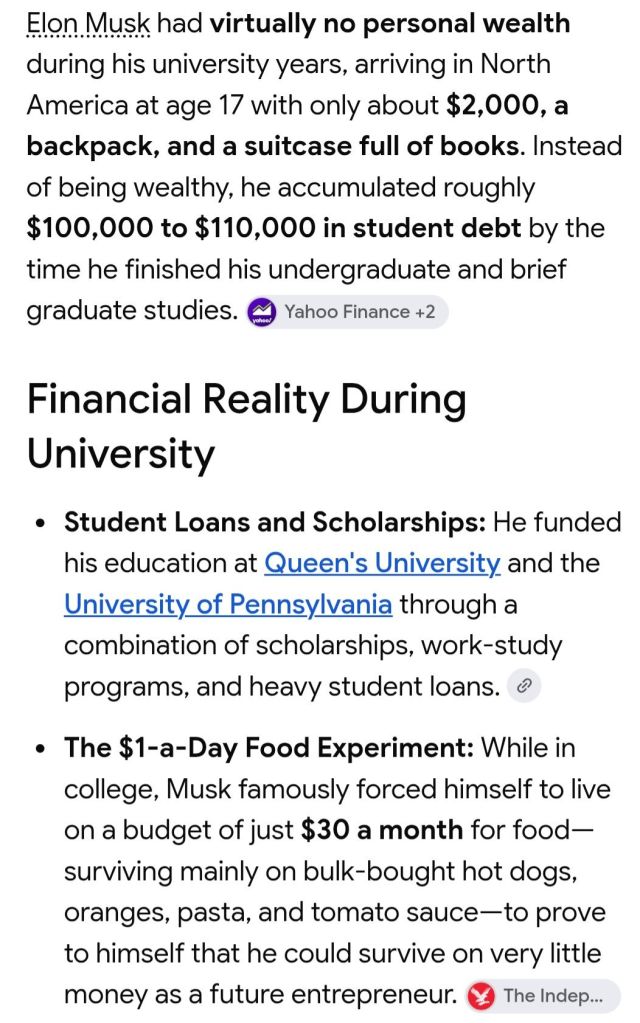
Elon Musk did well for a penniless immigrant
31 Aug 2026 Leave a comment
in economics of education, energy economics, human capital, labour supply, poverty and inequality
The Future of Climate Science with Roger Pielke, Jr.
26 Aug 2026 Leave a comment
in economics of climate change, economics of education, economics of natural disasters, energy economics, environmental economics, environmentalism, global warming Tags: climate alarmism
This week we cover unemployment data, stadium subsidies, and how Americans feel about the U.S. economy right now. Our interview is with climate scientist and American Enterprise Institute senior fellow Roger Pielke, Jr. We talk about climate science, academic politics, fossil fuels vs. renewables, and the future of energy policy. The post The Future of…
The Future of Climate Science with Roger Pielke, Jr.
West Point Professor Challenges Ban on “Un-American, Divisive…Radical, Extremist, and Irrational Theories.”
23 Aug 2026 Leave a comment
in economics of education, economics of regulation, law and economics, politics - USA, property rights Tags: free speech
There is an important lawsuit being litigated in the Southern District of New York over the limits of free speech…
West Point Professor Challenges Ban on “Un-American, Divisive…Radical, Extremist, and Irrational Theories.”


Recent Comments