An excellent piece today by Jesse Singal in The Dispatch; the whole thing is worth reading, but here are some… The post “The Cascade of Dysfunction That Helped Doom Jason Arday” appeared first on Reason.com.
“The Cascade of Dysfunction That Helped Doom Jason Arday”
“The Cascade of Dysfunction That Helped Doom Jason Arday”
21 Aug 2026 1 Comment
in economics of crime, economics of education, law and economics, liberalism, Marxist economics Tags: British politics, free speech, political correctness, regressive left
Opportunity Party on when you’re a child
17 Aug 2026 Leave a comment
in economics of crime, economics of education, health economics, law and economics, liberalism, Marxist economics, politics - New Zealand Tags: 2026 general election, crime and punishment, criminal deterrence, law and order
The Opportunity Party policy is or was that any criminal offender aged under 25 should be sent to the Youth Court for a family group conference, rather than go to an adult court. They say this is because 24 year old brains are not fully developed, so they should not be held fully accountable for…
Opportunity Party on when you’re a child
Alex Tabarrok: Britain’s equal pay madness
16 Aug 2026 Leave a comment
in applied price theory, Austrian economics, discrimination, economics of education, gender, health and safety, human capital, industrial organisation, labour economics, labour supply, occupational choice, poverty and inequality Tags: affirmative action, gender wage gap, pay equity, sex discrimination
The Taliban, Women and the Far Left
15 Aug 2026 1 Comment
in defence economics, discrimination, economics of education, economics of religion, gender, human capital, labour economics, labour supply, war and peace Tags: Afghanistan
It is five years today since the Taliban took control of Afghanistan. On 15 August 2021, its forces entered Kabul as the Afghan government collapsed and the long Western intervention came to an ignominious end. Five years later, the consequences for Afghan women are appalling. The Taliban has issued more than 100 decrees restricting the […]
The Taliban, Women and the Far Left
SST lashes crazy TOP policy
11 Aug 2026 Leave a comment
in economics of crime, economics of education, health economics, law and economics, politics - New Zealand Tags: 2026 general election
Chris Lynch reports: The Sensible Sentencing Trust has launched a blistering attack on The Opportunity Party’s policy to raise the age of Youth Court jurisdiction, describing it as one of the craziest ideas it has seen in years. Opportunity’s “Smart on Crime” policy promised until recently to “raise the age of the youth court jurisdiction…
SST lashes crazy TOP policy
The New McCarthys: Forty Percent of Professors Would Vote Against Hiring a Trump Voter
06 Aug 2026 Leave a comment
in discrimination, economics of education, human capital, labour economics, politics - USA Tags: free speech, political correctness, regressive left
According to a new survey, roughly 40 percent of college faculty would “oppose hiring a Trump supporter.” The results of…
The New McCarthys: Forty Percent of Professors Would Vote Against Hiring a Trump Voter
My Quillette review of Steve Stewart-Williams’s new book on sex differences in humans
02 Aug 2026 Leave a comment
in discrimination, economics of education, gender, liberalism, Marxist economics Tags: political correctness, regressive left

Steve Stewart-Williams has recently published an informative and readable new book (link at the screenshot just below), and my 4000-word review of it for Quillette just appeared (click second screenshot below for the review): As I implied, my review is laudatory, with only a few (really one) reservations, which is minor. It’s not a “page…
My Quillette review of Steve Stewart-Williams’s new book on sex differences in humans
Trump is Right to Take On the Climate Litigation Complex
29 Jul 2026 1 Comment
in applied welfare economics, development economics, economics of bureaucracy, economics of climate change, economics of education, energy economics, environmental economics, environmentalism, global warming, politics - USA, Public Choice, rentseeking Tags: climate alarmism
Whatever one makes of President Trump’s chosen words, the underlying demand – that a body claiming the authority of disinterested science should actually be disinterested – is one any serious defender of scientific integrity ought to be able to endorse. Surely the most litigated-against President in US history is right in ensuring that judges overseeing…
Trump is Right to Take On the Climate Litigation Complex
The Apples and Oranges Tribunal
28 Jul 2026 Leave a comment
in applied price theory, discrimination, economics of education, economics of regulation, gender, labour economics, labour supply, law and economics, liberalism, Marxist economics, poverty and inequality, property rights Tags: gender wage gap, sex discrimination
Suppose that apples sell for more than oranges and Parliament in it’s wisdom decides that, at last, apples and oranges must be compared. Not by shoppers — shoppers are biased, they merely reveal what they are willing to pay — but by a tribunal, which will determine whether apples and oranges are of truly equal…
The Apples and Oranges Tribunal
The law school at the U of C bans devices in the classroom
28 Jul 2026 1 Comment
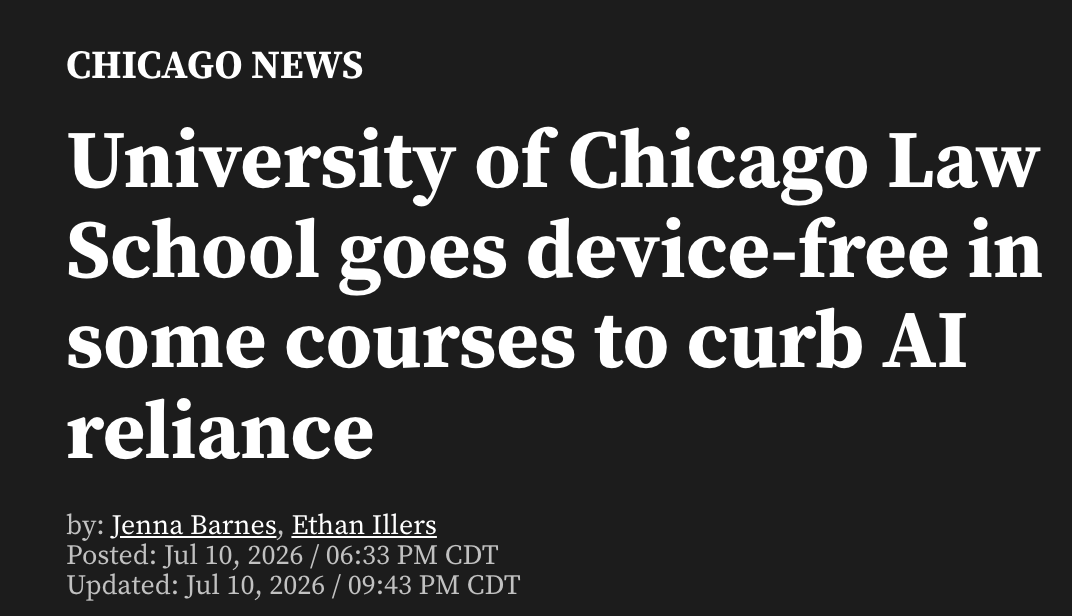
Speaking of AI, I wish the rest of the University of Chicago would adhere to our Law School’s new dictum, reported in the article below from WGN9 (click to read): An excerpt: Some students at the University of Chicago will have to learn how to do their work the old fashioned way, without their phones…
The law school at the U of C bans devices in the classroom
Book review: Econometrics for Dummies
19 Jul 2026 1 Comment
in econometerics, economics of education
I just finished reading Roberto Pedace’s 2013 book Econometrics for Dummies. As you might expect from a book written as part of Wiley’s ‘Dummies’ series, the book is written as a basic introduction to its topic, starting from the basics of probability distributions, and ending with a brief primer on how to conduct an econometrics…
Book review: Econometrics for Dummies
Why is the PPTA not worried about far-left extremism?
15 Jul 2026 Leave a comment
in economics of bureaucracy, economics of education, Marxist economics, politics - New Zealand, Public Choice
The Press reports: A secondary teachers’ union is hiring an expert to develop guidelines for dealing with the rise in far-right extremism in the classroom. The successful applicant will be paid $10,000 to write “specific advice and guidelines for the membership on dealing with extremism in the classroom”. Do they mean Marxist extremists? I suspect…
Why is the PPTA not worried about far-left extremism?
Dr Ruth—Holocaust Survivor, Sex Therapist and Sniper
13 Jun 2026 Leave a comment
in economic history, economics of education

Ruth Westheimer (June 4, 1928 – July 12, 2024), widely known as Dr. Ruth, was an American sex therapist, media personality, and author. The New York Times described her as a “Sorbonne-trained psychologist who became a cultural icon in the 1980s,” noting that she “ushered in a new age of freer, franker talk about sex […]
Dr Ruth—Holocaust Survivor, Sex Therapist and Sniper
A weird way of slicing the stats
12 Jun 2026 Leave a comment
in applied price theory, discrimination, econometerics, economic history, economics of education, human capital, labour economics, labour supply, occupational choice
Ages ago I supervised a superb Honours thesis, which turned into a Masters, looking at the lesbian wage premium. It showed up regularly in the US data: homosexual women earned more than heterosexual women – the opposite of the pattern that obtains for men. I was curious whether the difference could in part be due to…
A weird way of slicing the stats
How well does current AI find errors in economics papers?
10 Jun 2026 Leave a comment
Can artificial intelligence (AI) refute economic theory? I document experiments in which I asked several AI models (Gemini, Refine, Claude, and ChatGPT) to check the correctness of four published papers in economic theory, each containing an error that I helped identify or correct. ChatGPT Pro performed best, occasionally constructing counterexamples and corrected proofs, while other…
How well does current AI find errors in economics papers?


Recent Comments