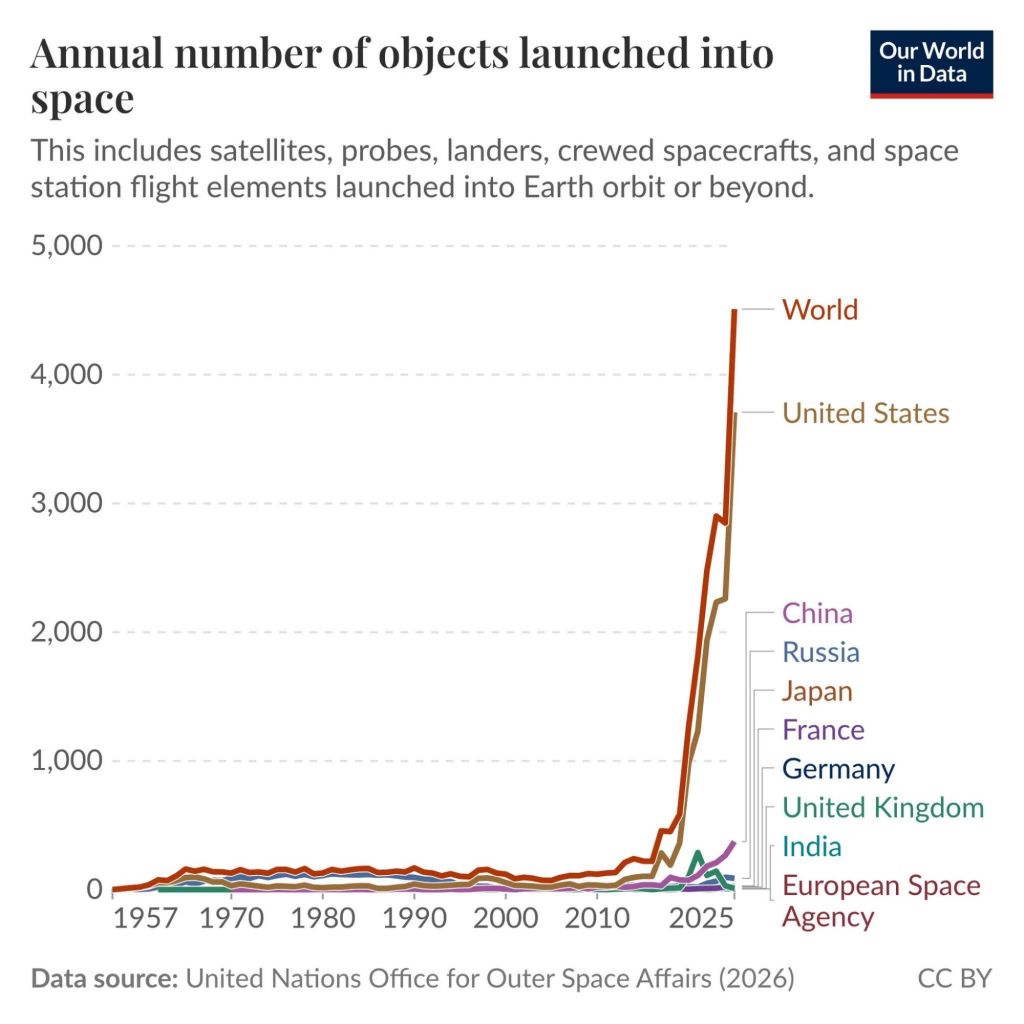
If our country is serious about returning to the Moon, reaching Mars, and maintaining its leadership in the new space race, it cannot allow launch pads, range scheduling, and reentry capacity to become the bottlenecks. The post Trump Space Policy Targets 1,000 U.S. Launches, Reentries Annually by 2030 appeared first on Watts Up With That?.
Trump Space Policy Targets 1,000 U.S. Launches, Reentries Annually by 2030
Trump Space Policy Targets 1,000 U.S. Launches, Reentries Annually by 2030
30 Aug 2026 Leave a comment
in economics of regulation, politics - USA, transport economics Tags: space
FAA Moves to Exempt Commercial Rocket Launches From Key Environmental Reviews
27 Aug 2026 Leave a comment
in economics of regulation, entrepreneurship, environmental economics, environmentalism, industrial organisation, law and economics, politics - USA, property rights, transport economics Tags: space
FAA moves to ensure regulatory processes serve genuine environmental interests rather than becoming a legal mechanism for undermining American space competitiveness. The post FAA Moves to Exempt Commercial Rocket Launches From Key Environmental Reviews appeared first on Watts Up With That?.
FAA Moves to Exempt Commercial Rocket Launches From Key Environmental Reviews
The Cost of Going to Space
18 Aug 2026 Leave a comment
in applied price theory, econometerics, economic history, entrepreneurship, industrial organisation Tags: space
Terzi & Nicoli have a fascinating new paper analyzing over 4,400 orbital launches since 1960 to estimate “Wright’s Law.” This law states that a new technology’s unit costs fall in proportion to cumulative experience. Essentially, it is an expression of learning-by-doing. They show:… that the average cost of sending a kilogram to orbit has dropped…
The Cost of Going to Space
A Close Call with Asteroid Apophis
17 Aug 2026 Leave a comment
in economics of media and culture Tags: space
It was quite a scare when first discovered in 2004, but thousands of observations later, we now know that the asteroid known as Apophis will miss Earth when it makes its closest approach in April 2029. However, in the grand scheme of things in our vast universe, this will be a close call, and it’ll…
A Close Call with Asteroid Apophis
China’s Spent Rockets Are Turning Low Earth Orbit Into a Debris Minefield
04 Jul 2026 1 Comment
in law and economics, property rights, transport economics Tags: space
China’s pattern of treating low Earth orbit like a dumping ground at the same time it is expanding potential military space capabilities should raise serious concerns for anyone relying on satellite infrastructure — which, at this point, is pretty much everyone. The post China’s Spent Rockets Are Turning Low Earth Orbit Into a Debris Minefield…
China’s Spent Rockets Are Turning Low Earth Orbit Into a Debris Minefield
U.S. colonies on the Moon and Mars are a waste of money: a guest post
08 Jun 2026 Leave a comment
in economic history, transport economics Tags: Mars, moon, space

From PCC(E): After watching the explosion of Jeff Bezos’s Blue Origin rocket last week, a rocket that is designed to help create the first human colony on the Moon, I thought to myself, “What is all this mishigass? Why do we need a human colony on the Moon? What will it tell us that unmanned…
U.S. colonies on the Moon and Mars are a waste of money: a guest post
Must be getting crowded up there
11 Mar 2026 Leave a comment
in international economic law, International law, transport economics Tags: space
Why the US is Struggling to Land on the Moon
27 Jun 2025 Leave a comment
in economics of media and culture Tags: moon landings, space
The Royal Society Moves to Expel Musk Over His Political Views
21 Feb 2025 Leave a comment
in economics of education, entrepreneurship, law and economics, liberalism, Marxist economics, property rights, transport economics Tags: free speech, political correctness, regressive left, space

Founded in 1660, the Royal Society is one of the most prominent scientific organizations in the world with associations to such luminaries as Sir Isaac Newton and Charles Darwin. Despite that proud history, British scientists are pushing to politicize the society and expel Elon Musk because they disagree with his political views. It is not […]
The Royal Society Moves to Expel Musk Over His Political Views
Protection against asteriod strikes
13 Feb 2025 Leave a comment
in defence economics, economics of natural disasters Tags: space
I have some bad news, fellow Earthlings: There is a newly discovered asteroid, called 2024 YR4, headed for our planet. Fortunately, the risk is neither great nor urgent. The chance of impact, which would happen on Dec. 22, 2032, is estimated at only about 2.3%. The worst-case scenario, though not world-ending, is still horrific. The asteroid is estimated […]
Protection against asteriod strikes
Get To Many Moons, Not Just One
17 Jan 2025 Leave a comment
in economics of media and culture Tags: space

Over at Behind The Black, the blog of space enthusiast Robert Zimmerman, he has some suggestions for the US space industry and in particular NASA’s Artemis program to land humans on the Moon. The advice is directed at Trump’s nomination for the head of NASA, Jacob Isaacman, a billionaire who has already flown in space […]
Get To Many Moons, Not Just One
The End of the ISS is Coming but Why and What Will Replace it?
12 Sep 2024 Leave a comment
in transport economics Tags: space
Why Does SpaceX Use 33 Engines While NASA Used Just 5?
20 Jun 2024 Leave a comment
in economics of media and culture Tags: space


Recent Comments