The Commerce Commission goes rafting
20 Sep 2026 Leave a comment
in applied price theory, industrial organisation, law and economics Tags: competition law, merger law enforcement
Back in June, the Commerce Commission ruled on the case of a proposed merger between three commercial rafting operators in Rotorua. As the New Zealand Herald reported (in August):The Commerce Commission has approved the merger of Rotorua’s three commercial rafting operators, much to the pleasant surprise of those behind the bid.The ruling, finalised in June, came…
The Commerce Commission goes rafting
Do labour markets behave like competitive markets?
01 Sep 2026 Leave a comment
in applied price theory, econometerics, history of economic thought, industrial organisation, labour economics, labour supply Tags: competition law, monopsony
The American evidence is that they frequently do not. For over a century there was a separate Department of Labour, which was amalgamated into that vast miscellaneous department, the Ministry of Business, Innovation and Employment. Today there is no Minister of Labour, while the portfolios of workplace relations and safety and of immigration are held […]
Do labour markets behave like competitive markets?
The Austrian Approach to Competition | Israel M. Kirzner
27 Aug 2026 Leave a comment
in applied price theory, Austrian economics, history of economic thought, industrial organisation Tags: competition law
Dr. Israel M. Kirzner — “Economics and Entrepreneurship”
19 Aug 2026 Leave a comment
in applied price theory, Austrian economics, economic history, economics of regulation, entrepreneurship, history of economic thought, industrial organisation, law and economics, Public Choice, regulation, rentseeking Tags: competition law
The Crime of Winning: How Europe’s DMA Punishes Google for Competing
09 Aug 2026 Leave a comment
in applied price theory, economics of regulation, entrepreneurship, industrial organisation Tags: competition law

Brussels has found a new way to punish success. Today, the European Commission fined Google €890 million under the Digital Markets Act (DMA) for two familiar business practices—featuring its own products and charging for customers its platform helps attract. The Commission imposed €460 million for “self-preferencing,” or giving Google’s services prominent placement in search results,…
The Crime of Winning: How Europe’s DMA Punishes Google for Competing
A Pac-Man Defense Against Predatory Pricing?
08 Aug 2026 Leave a comment
in applied price theory, economic history, history of economic thought, industrial organisation Tags: competition law
After the story of how Southwest Airlines broke an attempt at predatory pricing with booze, I learned of the Dow vs. Die Deutsche Bromkonvention episode. See here for an interesting narrative of events. To summarize, at the turn of the twentieth century, the German chemical industry was dominant and the various producers there had a comfortable cartel selling bromine…
A Pac-Man Defense Against Predatory Pricing?
‘Market Power in Antitrust: Economic Analysis after Kodak,’ by Benjamin Klein
01 Aug 2026 Leave a comment
in applied price theory, economics of regulation, entrepreneurship, industrial organisation Tags: competition law
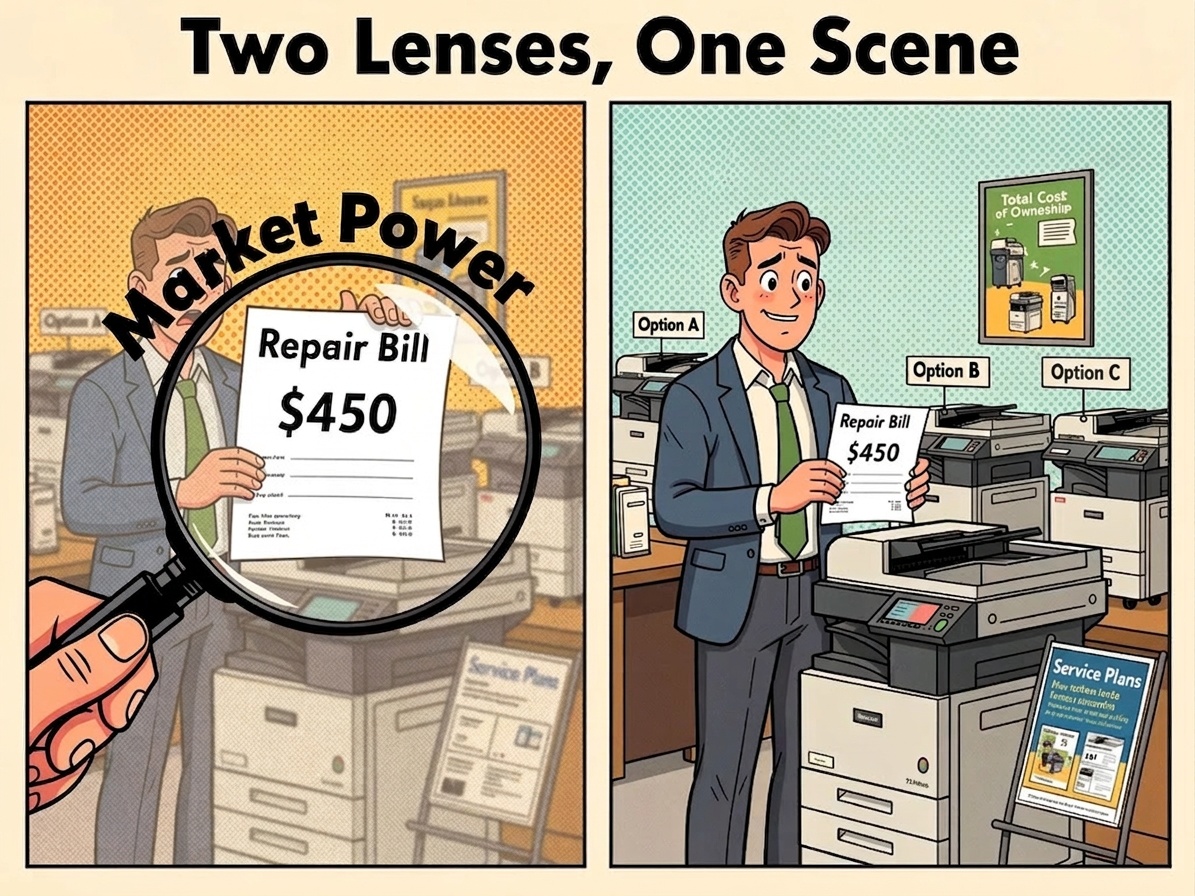
In 1992, the U.S. Supreme Court held in Eastman Kodak Co. v. Image Technical Services that a firm without market power in photocopiers might still possess market power in photocopier parts and service. The Court’s logic turned on opportunistic hold-up: Kodak could profit by trading short-run exploitation of locked-in customers for long-run losses in equipment…
‘Market Power in Antitrust: Economic Analysis after Kodak,’ by Benjamin Klein
Brazil’s Google News Case and the Art of Not Letting Go
01 Jun 2026 Leave a comment
in economic history, economics of regulation, law and economics, politics - USA Tags: competition law

Some legal cases age like wine. Others age like browser tabs left open too long. Brazil’s Google News inquiry belongs firmly in the latter category. On April 3, Brazil’s Administrative Council for Economic Defense (CADE) announced that its Tribunal had unanimously decided to send a seven-year-old administrative inquiry concerning Google’s use of journalistic content—whether for…
Brazil’s Google News Case and the Art of Not Letting Go
The Regulator has confirmed the NZ economy is rigged
18 May 2026 Leave a comment
in applied price theory, economics of regulation, industrial organisation, politics - New Zealand Tags: competition law

The Commerce Commission’s “State of Competition in New Zealand” report landed on Tuesday. It is arguably the most important economic document of the political year. It names four sectors as the country’s least competitive: electricity, gas, water and waste services; financial and insurance services; information media and telecommunications; and mining. The night before the report […]
The Regulator has confirmed the NZ economy is rigged
A good idea for supermarket competition
14 May 2026 Leave a comment
in applied price theory, economics of regulation, entrepreneurship, industrial organisation, politics - New Zealand, urban economics Tags: competition law, land supply, zoning
The Spinoff reports: Both Labour and National governments have considered the idea of breaking up the big two but ultimately decided against it. A 2023 analysis by MBIE suggested forcibly breaking up the supermarkets could cost as much as $3.8 billion over 20 years, mostly due to the loss of economies of scale. It could make wholesale and distribution…
A good idea for supermarket competition
‘Market Power in Antitrust: Economic Analysis after Kodak,’ by Benjamin Klein
17 Apr 2026 Leave a comment
in applied price theory, economics of regulation, history of economic thought, industrial organisation, law and economics, politics - USA Tags: competition law
In 1992, the U.S. Supreme Court held in Eastman Kodak Co. v. Image Technical Services that a firm without market power in photocopiers might still possess market power in photocopier parts and service. The Court’s logic turned on opportunistic hold-up: Kodak could profit by trading short-run exploitation of locked-in customers for long-run losses in equipment…
‘Market Power in Antitrust: Economic Analysis after Kodak,’ by Benjamin Klein
The Paramount Question Isn’t Paramount
17 Apr 2026 Leave a comment
in applied price theory, economics of media and culture, economics of regulation, entrepreneurship, industrial organisation, law and economics, managerial economics, market efficiency, movies, organisational economics, politics - USA, television Tags: competition law, creative destruction, merger law enforcement

Big mergers make headlines. They don’t always make antitrust problems. In a previous commentary, I explored the antitrust implications of a potential acquisition of Warner Bros. Discovery (WBD). That uncertainty is now resolved. On Feb. 27, Paramount Skydance Corp. agreed to acquire WBD for roughly $110 billion in enterprise value—$31 per share, all cash. The…
The Paramount Question Isn’t Paramount
COMESA, WhatsApp Business, and Antitrust in Search of a Theory
17 Mar 2026 Leave a comment
in applied price theory, economics of regulation, industrial organisation, law and economics, property rights Tags: competition law

Meta’s decision to limit third-party AI access to WhatsApp Business has quickly drawn antitrust scrutiny across multiple jurisdictions. The Common Market for Eastern and Southern Africa (COMESA) Competition and Consumer Commission (CCCC) is the latest authority to open an investigation. But before the case can answer whether Meta’s conduct harms competition, a more basic question…
COMESA, WhatsApp Business, and Antitrust in Search of a Theory
Dismantling the competition myth
06 Mar 2026 Leave a comment
in Austrian economics, comparative institutional analysis, economic history, economics of regulation, entrepreneurship, history of economic thought, industrial organisation, law and economics, organisational economics, politics - Australia, technological progress, theory of the firm Tags: competition law, creative destruction
Ask anyone in Australia’s competition law community what transformed the economy, and you will hear a familiar story. Australia was once a cartelised, complacent place where businesses divided up markets and consumers paid the price. Then came the Trade Practices Act in 1974, and competition law forced firms to compete. This is not a fringe […]
Dismantling the competition myth


Recent Comments