My ears pricked up a week back when ZB reported on recently released 2025/2026 suicide stats. Like many NZers, people taking their own lives has had an impact on me. My birth father took his own life when I was sixteen and close to meeting him for the first time. I have also been in…
Another, very significant, example of why Māori privilege is a myth.
Another, very significant, example of why Māori privilege is a myth.
10 Oct 2026 Leave a comment
in discrimination, gender, health economics, law and economics, politics - USA Tags: economics of mental illness
Marianne Bertrand, laureate of the Jean-Jacques Laffont Prize 2019
08 Oct 2026 Leave a comment
in applied price theory, discrimination, econometerics, economic history, economics of education, gender, human capital, labour economics, labour supply, occupational choice, poverty and inequality Tags: gender wage gap
Labour is reneging on its pay equity promise
07 Oct 2026 Leave a comment
in discrimination, gender, labour economics, labour supply, politics - New Zealand, poverty and inequality, Public Choice, rentseeking, unions Tags: 2026 general election, gender wage gap
Bryce Edwards writes – Chris Hipkins has described the coalition’s decision to cancel pay equity claims under urgency as “probably the most reprehensible thing I have seen in my time as a member of Parliament”. He accused ministers of “robbing Paula to pay Paul” and of “sacrificing equal pay for women in order to balance […]
Labour is reneging on its pay equity promise
So sad for the woman
04 Oct 2026 Leave a comment
in discrimination, economics of crime, gender, law and economics, politics - New Zealand Tags: crime and punishment, criminal deterrence, law and order
The Herald reports: A protection order was supposed to keep a woman safe. Instead, a judge said it proved “no better than a piece of soiled toilet paper” as her partner hunted her down, beat her, threatened her life and raped her during a sustained attack that left her fearing she would die. Now the…
So sad for the woman
Rainbow requirements and Treaty obligations: the HR issues that impede productivity but enhance diversity
03 Oct 2026 Leave a comment
in discrimination, economics of regulation, gender, human capital, labour economics, labour supply, law and economics, poverty and inequality, property rights Tags: employment law
Bob Edlin writes – PoO noted a Newsroom report headed Major export and construction firms warn against legal definition of women. The report draws attention to objections raised to the Legislation (Definitions of Woman and Man) Amendment Bill, which aims to amend the Legislation Act to define “woman” as “an adult human biological female” and […]
Rainbow requirements and Treaty obligations: the HR issues that impede productivity but enhance diversity
Woman of the day
28 Sep 2026 Leave a comment
in discrimination, economics of crime, economics of religion, gender, law and economics Tags: Iran
The judiciary system in Iran has confirmed 74 lashes for Parastoo Ahmadi for the “crime” of singing. She sang without compulsory hijab. She hurt no one. She simply used her voice. Now she faces 74 lashes, a two-year travel ban, and a two-year ban from audiovisual activities.… pic.twitter.com/3re8kboPIR — Masih Alinejad (@AlinejadMasih) September 26, 2026
Woman of the day
Post article overlooks REINZ chief’s thought about the REA’s treatment of Janet Dickson and the role of Maori culture
15 Sep 2026 Leave a comment
in discrimination, economics of regulation, human capital, labour economics, labour supply, occupational choice, occupational regulation, politics - USA Tags: racial discrimination
Bob Edlin writes – After a year in the job as chief executive of the Real Estate Institute of New Zealand, Lizzy Fyley discussed a range of industry issues with The Post. One matter that was not addressed was the governance role of the Real Estate Authority in the light of its cancellation of Auckland […]
Post article overlooks REINZ chief’s thought about the REA’s treatment of Janet Dickson and the role of Maori culture
The gender wage gap is fading away
13 Sep 2026 Leave a comment
in applied price theory, discrimination, economic history, economics of education, gender, human capital, labour economics, labour supply, occupational choice, politics - New Zealand, poverty and inequality Tags: feminism, gender, gender wage gap, history, politics, sex discrimination, women
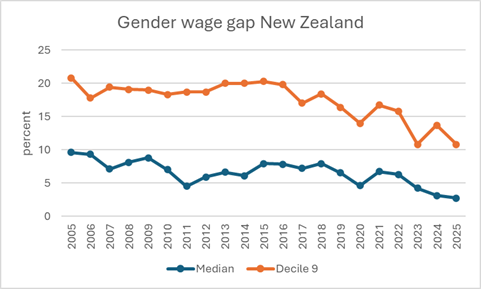
The gender wage gap has dropped by two-thirds in the last 30 years. It has halved since the first pay equity claim was filed 14 years ago. The gender wage gap is now barely 5.5% in June 2026 according to the recently released Statistics New Zealand data. It is a stretch to file pay equity claims asking for 30% more when the gender wage gap struggles to stay above 5%.
The gender wage gap data released by Statistics New Zealand recently is the raw data. There are no adjustments to that pay gap for differences in educational backgrounds, continuity of employment and dedication to demanding careers, unsocial hours, risk of injury, and the greater desire of women for work-life balance and jobs with more working from home options.
It is not mischievous to say that the gender wage gap may round down to zero once these factors are considered.
From time-to-time, detailed datasets become available on male and female workers that show that the gender wage gap goes down or close to zero. There are even detailed datasets where hiring and job assignments are made without any management intervention or possible bias.
There is a large gender wage gap driven by work-life balance under a bus and train drivers’ collective agreement in Massachusetts. The work-force was one-third female with hiring via a lottery among applicants with a clean record. Shifts are chosen by drivers strictly according to their seniority at each depot.
There was still a 11% gender wage gap because women drivers elected to work less overtime, they avoided overtime shifts on short notice, and they worked fewer shifts at nights and weekends. This gender wage gap among bus and train drivers cannot be the fault of their sexist employer because work was allocated by an exceptionally detailed union contract.
A 7% gender wage gap emerged even when a computer algorithm is allocating the work first come, first served.
A study of Uber drivers found a gender pay gap of zero once account is taken for male Uber drivers driving more at nights, weekends and in the more dodgy neighbourhoods with drinking establishments. Male Uber drivers also worked more hours per year which meant they had much more work experience than female Uber drivers. These additional hours meant men became more skilled in deciding when and where to best cruise for the best paying jobs. The fact that men drive faster explained the last two percentage points of the gender pay gap at Uber. Speed meant men were available for the next Uber job quicker.
The gender wage gap is just into the double digits for the top 10% of female earners in New Zealand in 2025 (see OECD graphic). This is because their chosen careers are often not family friendly. But even at the top end of town the gender pay gap has halved in the last 20 years.
OECD data explorer
Women’s willingness to trade work-life balance for lower wages and fewer promotions is a big driver of the gender wage gap and the channelling of women into family friendly occupations. The wages of men and women at all levels are similar in the years leading up to motherhood then everything changes.
Top American labour economist Claudia Goldin found that some careers severely penalise any time off such as for motherhood or working less than punishingly long or rigid hours. Goldin refers to these jobs as greedy jobs. Women’s preference for family friendly occupations that can pay less and a tendency to avoid greedy jobs will mean that the gender wage gap may always be with us at least at the big end of town.
Did the Sewing Machine Reduce the Workload for Women?
10 Sep 2026 1 Comment
in discrimination, economic growth, economic history, economics of education, gender, history of economic thought, human capital, industrial organisation, labour economics, labour supply, macroeconomics, occupational choice, poverty and inequality, technological progress Tags: creative destruction, The Great Enrichment
Is new technology that replaces a worker a good thing? We have a tendency, it seems to me, to believe that most previous inventions turned out to have overall net social benefits, but to be worried that all future inventions will instead have overall net social costs. Philipp Ager and Davide Coluccia tackle the question of…
Did the Sewing Machine Reduce the Workload for Women?
Audrey on Te Pati Maori’s bottom line
04 Sep 2026 Leave a comment
in constitutional political economy, discrimination, law and economics, liberalism, politics - New Zealand, Public Choice, rentseeking Tags: 2026 general election, constitutional, law, racial discrimination
Audrey Young writes: Te Pāti Māori not only released a radical Treaty of Waitangi policy this week that would upend New Zealand’s democracy as we know it, co-leader Debbie Ngarewa-Packer said the whole policy was a bottom line, meaning it was non-negotiable. That means Te Pāti Māori would not sign up to a centre-left Government unless it…
Audrey on Te Pati Maori’s bottom line
Gloria Steinem died
04 Sep 2026 Leave a comment
in discrimination, gender, politics - USA
I guess I’m at the time of life when all my heroes are dying off, because of course they were older than I and I’m no spring chicken. The latest to leave the planet is Gloria Steinem, who died yesterday at 92. Activist, feminist, one of the big figures of “second wave feminism” that promoted…
Gloria Steinem died
Abdul El-Sayed and the Piker Problem
29 Aug 2026 Leave a comment
in discrimination, economics of crime, law and economics, liberalism, Marxist economics, politics - USA Tags: free speech, Israel, Middle-East politics, political correctness, racial discrimination, regressive left, war against terror
There was a curious moment this week when Michigan Senate nominee Abdul El-Sayed expressed shock that people were asking him…
Abdul El-Sayed and the Piker Problem
Opportunity knocks
27 Aug 2026 Leave a comment
in discrimination, gender, politics - New Zealand Tags: 2026 general election
Good vibes all round – unless you’re a woman. It’s fair to say that the leader of the revamped Opportunity Party Quilae Wong is the best looking of all the political leaders contesting the 2026 New Zealand election.
Opportunity knocks
College-educated women have maintained stable marriage rates by partnering with high-earning non-college men, shrinking the pool of economically viable partners available to non-college women
24 Aug 2026 Leave a comment
in applied price theory, discrimination, econometerics, economics of love and marriage, gender, human capital, labour economics, labour supply, law and economics, occupational choice, population economics, poverty and inequality
See Gender Disparities in College Enrollment and Marriage Patterns by Clara Chambers, Benjamin Goldman & Joseph Winkelmann.”Over the past half-century, the gender composition of American college campuses has shifted from predominantly male to predominantly female. Today, 1.6 million more women than men attend four-year colleges in the US. Over the same time period, the economic status…
College-educated women have maintained stable marriage rates by partnering with high-earning non-college men, shrinking the pool of economically viable partners available to non-college women
The effects of remote work on the disability employment gap
17 Aug 2026 Leave a comment
in discrimination, gender, human capital, labour economics, labour supply, transport economics, urban economics Tags: gender wage gap, sex discrimination
A rise in work from home explains most of the postpandemic gain in full-time employment among people with physical disabilitiesBy Tyler Smith. “Employment among people with disabilities has remained well below that of the broader population, with an average disability employment gap of 27 percentage points across OECD countries. In the United States, this low disability…
The effects of remote work on the disability employment gap


Recent Comments