TweetMegan McArdle writes insightfully about California’s pending proposal to soak the rich. Three slices: These days, legislators generally don’t enact tax hikes so confiscatory that they trigger an immediate, obvious response. They adjust income tax rates by a few percentage points, fiddle with the deductions or impose new levies on some tiny portion of the…
Some Links
Some Links
26 Oct 2026 Leave a comment
in applied price theory, entrepreneurship, fiscal policy, human capital, income redistribution, labour economics, labour supply, macroeconomics, politics - USA, poverty and inequality, Public Choice Tags: California, taxation and entrepreneurship, taxation and investment
SIEPR Economic Summit 2026 | California Wealth Tax
22 Oct 2026 Leave a comment
in applied price theory, economic growth, economic history, entrepreneurship, fiscal policy, history of economic thought, human capital, income redistribution, labour economics, labour supply, macroeconomics, Public Choice, public economics Tags: California, taxation and entrepreneurship, taxation and investment
California in-migration and out-migration
14 Oct 2026 Leave a comment
in applied price theory, econometerics, entrepreneurship, fiscal policy, human capital, labour economics, labour supply, macroeconomics, politics - USA, poverty and inequality, public economics Tags: California, taxation and entrepreneurship, taxation and investment, taxation and labour supply, top 1%
Long-run U.S. population movements have been driven more by natural amenities than by jobs, and California, rich in both uniform and complementary climates, should be a persistent net gainer of domestic migrants. It has instead lost residents to other states every year since about 1990. This paper argues that its amenities are unchanged and that…
California in-migration and out-migration
The U.K. Version of the Laffer Curve Strikes Again
29 Sep 2026 Leave a comment
in applied price theory, economic growth, economic history, entrepreneurship, financial economics, fiscal policy, history of economic thought, labour economics, labour supply, macroeconomics Tags: British politics, taxation and investment, taxation and labour supply

There are two reasons why I periodically write about the Laffer Curve. I want my left-leaning friends to understand to understand that higher tax rates on productive behavior will lead to less taxable income and some foregone tax revenue. I want my right-leaning friends to understand that tax cuts are only self-financing in rare cases […]
The U.K. Version of the Laffer Curve Strikes Again
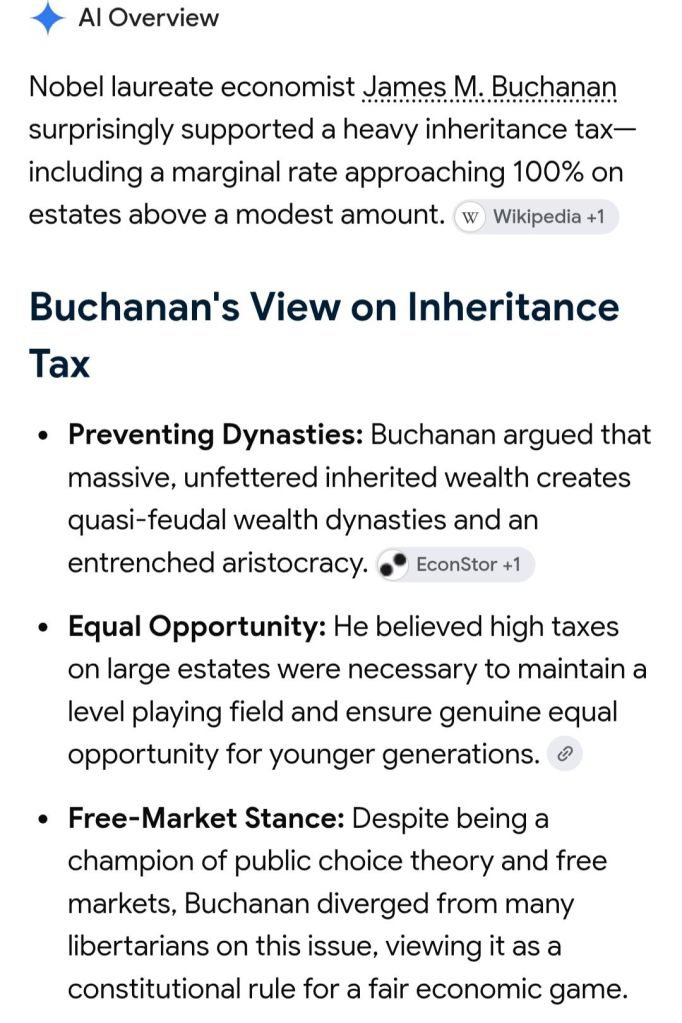
James Buchanan was an unusual neoliberal
26 Sep 2026 Leave a comment
in applied price theory, entrepreneurship, history of economic thought, human capital, income redistribution, James Buchanan, James Buchanan, labour economics, labour supply, Milton Friedman, poverty and inequality, Public Choice, public economics Tags: inheritance tax, taxation and entrepreneurship, taxation and investment

Canada Reduces the Tax Burden on New Investment
21 Sep 2026 Leave a comment
in economic growth, fiscal policy, macroeconomics, public economics Tags: Canada, taxation and investment

Until about 10 years ago, I often wrote positive columns about Canadian policy. I praised our northern neighbors for spending restraint, corporate tax reform, bank bailout policy, regulatory budgeting, the tax treatment of saving, and private air traffic control. Unfortunately, Canada then became more statist under Pierre Trudeau Justin Trudeau (understandable mistake on my part). And I […]
Canada Reduces the Tax Burden on New Investment
Report: California’s Proposed ‘Billionaire Tax’ Is Based on Bad Research
19 Sep 2026 Leave a comment
in fiscal policy, macroeconomics, Marxist economics, politics - USA, public economics Tags: California, taxation and entrepreneurship, taxation and investment

The planned wealth tax leads slightly in the polls and is already driving capital flight.
Report: California’s Proposed ‘Billionaire Tax’ Is Based on Bad Research
New Research Further Confirms Anti-Growth Impact of Wealth Taxation
30 Jul 2026 1 Comment
in applied price theory, economic growth, entrepreneurship, fiscal policy, human capital, income redistribution, labour economics, liberalism, macroeconomics, Marxist economics, poverty and inequality, Public Choice, public economics Tags: taxation and entrepreneurship, taxation and investment, taxation and labour supply

I’ve shared multiple studies about the harmful impact of wealth taxes (see here, here, here, here, and here). Today, let’s add to the body of evidence. I’ll start by calling attention to a column I wrote in 2019 that warned how wealth taxes mean very high – even confiscatory – taxes on saving and investment. […]
New Research Further Confirms Anti-Growth Impact of Wealth Taxation
Capital Gains Can Be Labor Income
10 Jul 2026 Leave a comment
in applied price theory, fiscal policy, macroeconomics, Public Choice, public economics Tags: taxation and entrepreneurship, taxation and investment, top 1%
Zwick and Zidar argue that a substantial share of the decline in labor share can be accounted for by changing forms of pay, including pass-throughs and equtiy compensation. In particular, if an employee is paid in stock and that stock increases in value then the tax rules tend to count some of that as capital…
Capital Gains Can Be Labor Income
A Nordic Nightmare for AOC
19 Jun 2026 Leave a comment
in applied price theory, economic growth, economic history, labour economics, labour supply, macroeconomics, Marxist economics, politics - USA Tags: taxation and entrepreneurship, taxation and investment, taxation and labour supply

In 2015, I wrote a column entitled “A Nordic Nightmare for Bernie Sanders.” Today, let’s do something similar, but this time I’ll explain why economic data from northernmost Europe is bad news for Alexandria Ocasio-Cortez. I’m motivated to address the issue because I just saw this tweet about how Scandinavian-Americans are much richer than their […]
A Nordic Nightmare for AOC
Watermelon Economics
16 Jun 2026 Leave a comment
in development economics, fiscal policy, human capital, income redistribution, labour economics, labour supply, macroeconomics, poverty and inequality, Public Choice Tags: development aid, regressive left, taxation and entrepreneurship, taxation and investment, top 1%

Remember Thomas Piketty, the pro-class-warfare economist who is infamous for shoddy analysis and who also made a fool of himself by asserting back in 2023 that Javier Milei’s election in Argentina would lead to economic disaster? Yes, that Thomas Piketty. It turns out he’s also a “watermelon,” which is the derisive term for leftists who […]
Watermelon Economics
Professors Behind the California Wealth Tax Threaten Possible Legal Action Against Critic
11 Jun 2026 Leave a comment
in income redistribution, law and economics, politics - USA, Public Choice, public economics Tags: taxation and entrepreneurship, taxation and investment

There is an interesting controversy brewing in California after four California university professors threatened a political candidate, Richard Lucas, for…
Professors Behind the California Wealth Tax Threaten Possible Legal Action Against Critic
The corporate tax rate really matters
26 May 2026 Leave a comment
in applied price theory, econometerics, economic growth, economic history, entrepreneurship, fiscal policy, macroeconomics Tags: taxation and entrepreneurship, taxation and investment
Three findings emerge. First, improvements in aggregate tax competitiveness are positively and significantly associated with real GDP per capita growth, robust to a wide range of controls. Second, this aggregate effect is driven entirely by the corporate tax pillar; no other component displays a significant growth effect. Third, the corporate tax effect materializes contemporaneously and…
The corporate tax rate really matters
The (Amusingly) Destructive Economics of Wealth Taxation
24 May 2026 Leave a comment
in applied price theory, economic growth, entrepreneurship, fiscal policy, human capital, income redistribution, labour economics, labour supply, macroeconomics, poverty and inequality, Public Choice, public economics Tags: taxation and entrepreneurship, taxation and investment, taxation and labour supply
I’ve shared several columns (here, here, here, here, and here) reviewing scholarly research on the harmful economic impact of wealth taxation. From now on, however, I think I’ll simply share this clever video from the folks at Reason. The video uses humor to make very important points about how a wealth tax would diminish incentives […]
The (Amusingly) Destructive Economics of Wealth Taxation
The Washington Post vs Elizabeth Warren
25 Apr 2026 Leave a comment
in applied price theory, economics of media and culture, fiscal policy, human capital, income redistribution, labour economics, labour supply, macroeconomics, politics - USA, Public Choice, public economics Tags: taxation and entrepreneurship, taxation and investment, taxation and labour supply
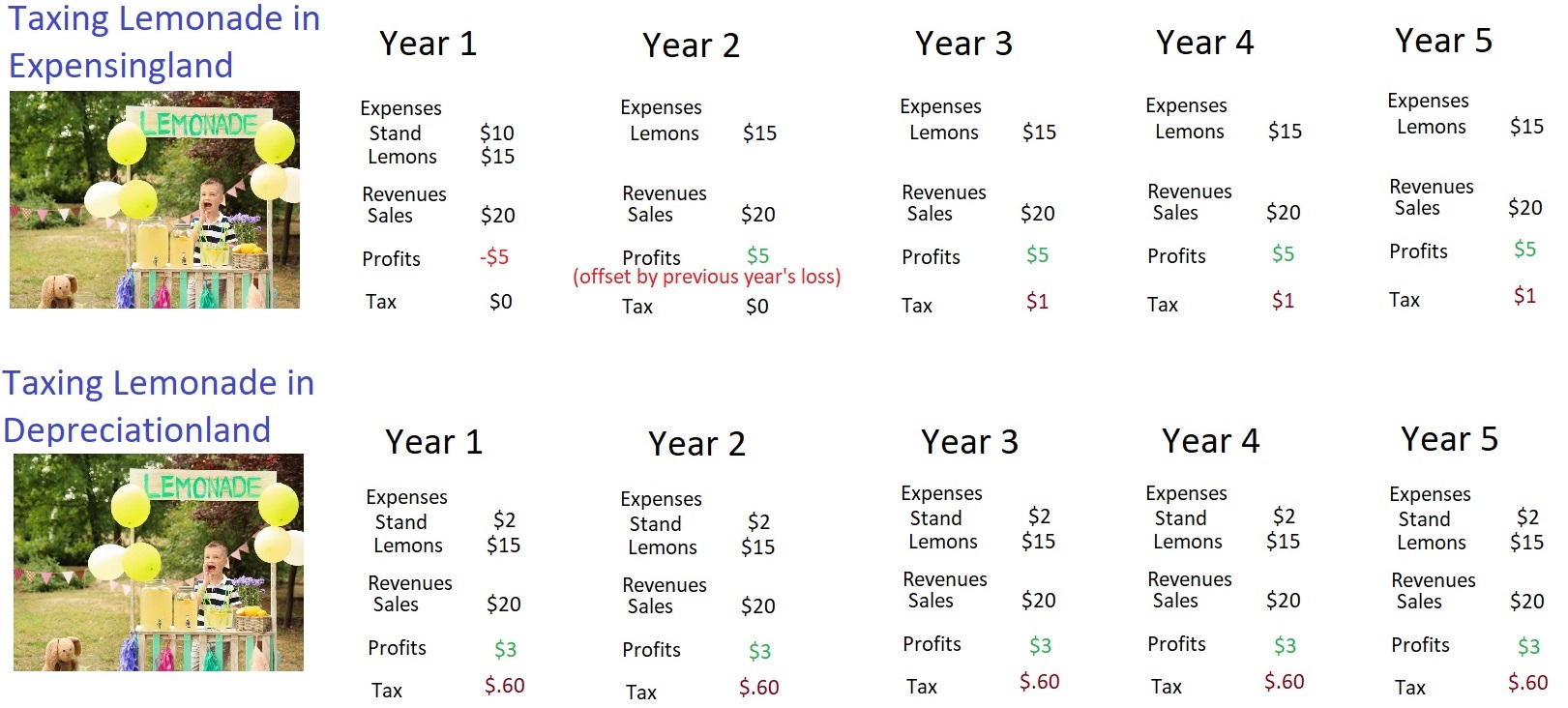
People sometimes will get excited about big-picture tax fights – whether politicians should raise taxes, whether they should add a VAT, or whether they should scrap the IRS for a flat tax. On the other had, there are a handful of tax issues that induce drowsiness but are nonetheless very important for purposes of tax […]
The Washington Post vs Elizabeth Warren


Recent Comments