The great tactical victory of environmentalists is keeping the debate on the science going because even if the science is right, the economic costs are small.
Richard Tol on the scientific consensus about human-caused global warming skepticalscience.com/graphics.php?g… http://t.co/OpdRtsY1tx—
John Cook (@skepticscience) March 24, 2015
Let the climate science be settled. How much will global warming cost is the correct question for policy debate.
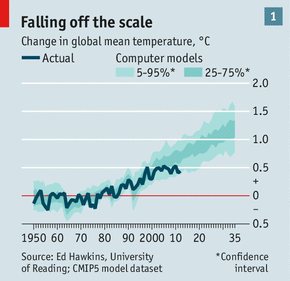
Global warming, although real, is not apt to be severe. It will lower the level of GDP by maybe 2%. The loss of one year’s income growth! Courtesy of David Friedman’s reading of the report, this is what the IPCC said this week:
With these recognized limitations, the incomplete estimates of global annual economic losses for additional temperature increases of ~2°C are between 0.2 and 2.0% of income (±1 standard deviation around the mean)
Many of the consequences of global warming will be beneficial – warmer in some places, colder in others; wetter in some places and drier in others. The sea level rises will mean local problems, not a planetary crisis.
New Zealand will have a more reliable power supply because of increased winter rainfall as well as warmer winters. Most of New Zealand’s power supply is from lakes that rely on the Spring melting of the winter snow rather than winter rainfall.
The chances of India, China and the rest of the Third World agreeing to forego or even slow their economic development to fight global warming is zero even before you consider the international collective action, verification and free rider problems.
Climate changes have a greater impact in the most under-developed countries that are yet to embrace capitalism. Agriculture provides the livelihoods of 30 per cent or more of their populations, many of whom still practice subsistence agriculture.
Yet the trend in developing countries is to be much less dependent on agriculture as a source of employment and family incomes. If per capita income in the poor countries grows in the next forty years as rapidly as it has in the forty years just past, their vulnerability to climate change should diminish.
Adaptation and richer is safer are the only games in town for both the developed and the developing worlds.
The only case for even a token carbon tax is to avoid green tariffs in the EU and USA on exports. We may as well collect the revenue for ourselves rather than let the EU and USA pocket it.
p.s The report of the IPCC yesterday was a one-day media wonder in the country where I live. I could not find a single story today in the Dominion Post, which is the paper for the political capital for New Zealand.
 Utopia, you are standing in it!
Jun 22, 2014 @ 14:59:13
Reblogged this on P R S and commented:
A topic that I decided to explore more in future.
The great tactical victory of environmentalists is keeping the debate on the science going because even if the science is right, the economic costs are small.
Let the climate science be settled. How much will global warming cost is the correct question for policy debate.
Global warming, although real, is not apt to be severe. It will lower the level of GDP by maybe 2%. The loss of one year’s income growth! Courtesy of David Friedman’s reading of the report, this is what the IPCC said this week:
With these recognized limitations, the incomplete estimates of global annual economic losses for additional temperature increases of ~2°C are between 0.2 and 2.0% of income (±1 standard deviation around the mean)
Many of the consequences of global warming will be beneficial – warmer in some places, colder in others; wetter in some places and drier in others. The sea level rises will mean local problems, not a planetary crisis.
New Zealand will have a more reliable power supply because of increased winter rainfall as well as warmer winters. Most of New Zealand’s power supply is from lakes that rely on the Spring melting of the winter snow rather than winter rainfall.
The chances of India, China and the rest of the Third World agreeing to forego or even slow their economic development to fight global warming is zero even before you consider the international collective action, verification and free rider problems.
Climate changes have a greater impact in the most under-developed countries that are yet to embrace capitalism. Agriculture provides the livelihoods of 30 per cent or more of their populations, many of whom still practice subsistence agriculture.
Yet the trend in developing countries is to be much less dependent on agriculture as a source of employment and family incomes. If per capita income in the poor countries grows in the next forty years as rapidly as it has in the forty years just past, their vulnerability to climate change should diminish.
Adaptation and richer is safer are the only games in town for both the developed and the developing worlds.
The only case for even a token carbon tax is to avoid green tariffs in the EU and USA on exports. We may as well collect the revenue for ourselves rather than let the EU and USA pocket it.
p.s The report of the IPCC yesterday was a one-day media wonder in the country where I live. I could not find a single story today in the Dominion Post, which is the paper for the political capital for New Zealand.
LikeLiked by 1 person
Oct 16, 2014 @ 16:25:06
Reblogged this on Utopia – you are standing in it! and commented:
The economics of global warming is back in the news again, so I am blogging this.
LikeLike