Was the global economic crisis unforeseen?

Plenty of people warned of dark days ahead. An essay anyone can read with profit is Ross Levine’s "An Autopsy of the U.S. Financial System: Accident, Suicide, or Negligent Homicide?"

The paper studies five important policies:

  • Securities and Exchange Commission (SEC) policies toward credit rating agencies,
  • Federal Reserve policies concerning bank capital and credit default swaps,
  • SEC and Federal Reserve policies about over-the-counter derivatives,
  • SEC policies toward the consolidated supervision of major investment banks, and government policies toward Fannie Mae and Freddie Mac.

Levine concludes that

  • The evidence is inconsistent with the view that the collapse of the financial system was caused only by the popping of the housing bubble ("accident") and the herding behaviour of financiers rushing to create and market increasingly complex and questionable financial products ("suicide").
  • Rather, the evidence indicates that senior policymakers repeatedly designed, implemented, and maintained policies that destabilized the global financial system in the decade before the crisis.
  • Moreover, although the major regulatory agencies were aware of the growing fragility of the financial system due to their policies, they chose not to modify those policies, suggesting that "negligent homicide" contributed to the financial system’s collapse
  • Although influential policymakers presumed that international capital flows, euphoric traders, and insufficient regulatory power caused the crisis, the paper shows that these factors played only a partial role.
  • Current reforms represent only a partial and incomplete step in establishing a stable and well-functioning financial system.
  • Since systemic institutional failures helped cause the crisis, systemic institutional reforms must be a part of a comprehensively effective response.

The most interesting morsels are:

  • The New York Times warned in 1999 that Fannie Mae was taking on so much risk that an economic downturn could trigger a “rescue similar to that of the savings and loan industry in the 1980s,” and again emphasized this point in 2003; and
  • Alan Greenspan testified before the Senate Banking Committee in 2004 that the increasingly large and risky GSE portfolios could have enormously adverse ramifications! A rare occasion on which Greenspan did not talk in riddles.
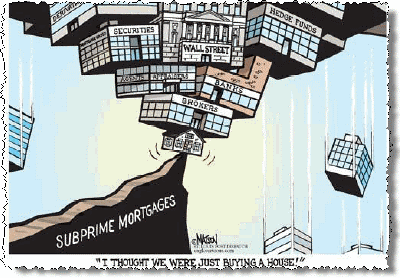
 

Stern and Feldman’s Too Big to Fail in 2004 used insights gleaned from the formal economic literature to frame warnings in 2004 about the time bomb for a financial crisis set by current regulations and government promises.

The prediction of the Kareken and Wallace moral hazard model of deposit insurance is if a government sets up deposit insurance and doesn’t regulate bank portfolios to prevent them from taking too much risk, the government is setting the stage for a financial crisis. If financial intermediaries do not bear the full consequences of their actions (because they are insured) then profit maximising portfolios will be too risky. The Kareken-Wallace model makes you very cautious about lender-of-last-resort facilities and very sensitive to the risk-taking activities of banks.

Tom Sargent said that Jose Scheinkman made a list of the ten academic papers that the Reagan administration should have looked at. Number one on his list was Kareken and Wallace.

The idea that deposit insurance leads to more financial crises even troubled FDR before he signed the 1934 U.S. bill to introduce deposit insurance.

Leave a comment

This site uses Akismet to reduce spam. Learn how your comment data is processed.

Bassett, Brash & Hide

Celebrating humanity's flourishing through the spread of capitalism and the rule of law

Truth on the Market

Scholarly commentary on law, economics, and more

The Undercover Historian

Beatrice Cherrier's blog

Matua Kahurangi

Celebrating humanity's flourishing through the spread of capitalism and the rule of law

Temple of Sociology

Celebrating humanity's flourishing through the spread of capitalism and the rule of law

Velvet Glove, Iron Fist

Celebrating humanity's flourishing through the spread of capitalism and the rule of law

Why Evolution Is True

Why Evolution is True is a blog written by Jerry Coyne, centered on evolution and biology but also dealing with diverse topics like politics, culture, and cats.

Down to Earth Kiwi

Celebrating humanity's flourishing through the spread of capitalism and the rule of law

NoTricksZone

Celebrating humanity's flourishing through the spread of capitalism and the rule of law

Homepaddock

A rural perspective with a blue tint by Ele Ludemann

Kiwiblog

DPF's Kiwiblog - Fomenting Happy Mischief since 2003

The Dangerous Economist

Celebrating humanity's flourishing through the spread of capitalism and the rule of law

Watts Up With That?

The world's most viewed site on global warming and climate change

The Logical Place

Tim Harding's writings on rationality, informal logic and skepticism

Doc's Books

A window into Doc Freiberger's library

The Risk-Monger

Let's examine hard decisions!

Uneasy Money

Commentary on monetary policy in the spirit of R. G. Hawtrey

Barrie Saunders

Thoughts on public policy and the media

Liberty Scott

Celebrating humanity's flourishing through the spread of capitalism and the rule of law

Point of Order

Politics and the economy

James Bowden's Blog

A blog (primarily) on Canadian and Commonwealth political history and institutions

Science Matters

Reading between the lines, and underneath the hype.

Peter Winsley

Economics, and such stuff as dreams are made on

A Venerable Puzzle

"The British constitution has always been puzzling, and always will be." --Queen Elizabeth II

The Antiplanner

Celebrating humanity's flourishing through the spread of capitalism and the rule of law

Bet On It

Celebrating humanity's flourishing through the spread of capitalism and the rule of law

History of Sorts

WORLD WAR II, MUSIC, HISTORY, HOLOCAUST

Roger Pielke Jr.

Undisciplined scholar, recovering academic

Offsetting Behaviour

Celebrating humanity's flourishing through the spread of capitalism and the rule of law

JONATHAN TURLEY

Res ipsa loquitur - The thing itself speaks

Conversable Economist

Celebrating humanity's flourishing through the spread of capitalism and the rule of law

The Victorian Commons

Researching the House of Commons, 1832-1868

The History of Parliament

Articles and research from the History of Parliament Trust

Books & Boots

Reflections on books and art

Legal History Miscellany

Posts on the History of Law, Crime, and Justice

Sex, Drugs and Economics

Celebrating humanity's flourishing through the spread of capitalism and the rule of law

European Royal History

Exploring the Monarchs of Europe

Tallbloke's Talkshop

Cutting edge science you can dice with

Marginal REVOLUTION

Small Steps Toward A Much Better World

NOT A LOT OF PEOPLE KNOW THAT

“We do not believe any group of men adequate enough or wise enough to operate without scrutiny or without criticism. We know that the only way to avoid error is to detect it, that the only way to detect it is to be free to inquire. We know that in secrecy error undetected will flourish and subvert”. - J Robert Oppenheimer.

STOP THESE THINGS

The truth about the great wind power fraud - we're not here to debate the wind industry, we're here to destroy it.

Lindsay Mitchell

Celebrating humanity's flourishing through the spread of capitalism and the rule of law

Alt-M

Celebrating humanity's flourishing through the spread of capitalism and the rule of law

croaking cassandra

Economics, public policy, monetary policy, financial regulation, with a New Zealand perspective

The Grumpy Economist

Celebrating humanity's flourishing through the spread of capitalism and the rule of law

International Liberty

Restraining Government in America and Around the World