Previously the precautionary principle was used to introduce doubt when there was no doubt. But when climate science turned in their favour, environmentalists wanted public policy to be based on the latest science.
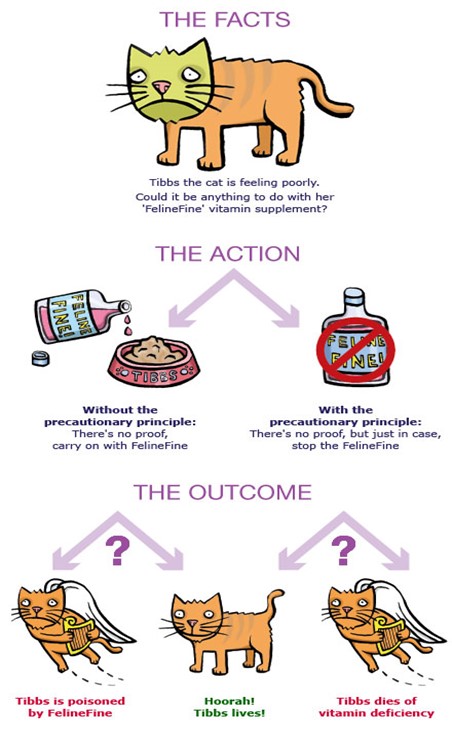
The precautionary principle is deeply incoherent. We should take precautions but there are always risks on both sides of a decision; inaction can bring danger, but so can action. Precautions themselves create risks so the precautionary principle bans what it simultaneously requires.
There is never perfect certainty about the nature and causes of health and environmental threats, so environmental and health regulations are almost always adopted despite some residual uncertainty.
We live in a Schumpeterian world where new risks replace old risks.
The obvious question is it safer or more precautionary to focus on the potential harms of new activities or technologies without reference to the activities or technologies they might displace? Jonathan Alder explains
In any policy decision, policy makers can make two potential errors regarding risk.
On the one hand, policy makers may err by failing to adopt measures to address a health or environmental risk that exists.
On the other hand, policy makers may adopt regulatory measures to control a health or environmental risk that does not exist.
Both types of error can increase risks to public health.
Consider the overwhelming consensus among researchers that biotech crops are safe for humans and the environment
This is a conclusion that is rejected by the very environmentalist organisations that loudly insist on the policy relevance of the scientific consensus on global warming.
In his 2012 Dimbleby lecture, Sir Paul Nurse calls for a re-opening the debate about GM crops based on scientific facts and analysis:
We need to consider what the science has to say about risks and benefits, uncoloured by commercial interests and ideological opinion. It is not acceptable if we deny the world’s poorest access to ways that could help their food security, if that denial is based on fashion and ill-informed opinion rather than good science.
Cass Sunstein wrote that in its strongest and most distinctive forms, the precautionary principle imposes a burden of proof on those who create potential risks, and requires regulation of activities even if it cannot be shown that those activities are likely to produce significant harms:
…apparently sensible questions have culminated in an influential doctrine, known as the precautionary principle.
The central idea is simple: Avoid steps that will create a risk of harm.
Until safety is established, be cautious; do not require unambiguous evidence.
Yet the precautionary principle, for all its rhetorical appeal, is deeply incoherent.
It is of course true that we should take precautions against some speculative dangers.
But there are always risks on both sides of a decision; inaction can bring danger, but so can action.
Precautions, in other words, themselves create risks – and hence the principle bans what it simultaneously requires.
Sunstein is a Democrat whose White House appointment to the head the White House Office of Information and Regulatory Affairs under Obama was opposed by the Left of the Democrat Party because of his views on the precautionary principle and his support of cost-benefit analysis as a primary tool for assessing regulations. Sunstein again:
The simplest problem with the precautionary principle is that regulation might well deprive society of significant benefits, and even produce a large number of deaths that would otherwise not occur.
Genetic modification holds out the promise of producing food that is both cheaper and healthier – resulting, for example, in products that might have large benefits in developing countries.
The point is not that genetic modification will definitely have those benefits, or that the benefits of genetic modification outweigh the risks.
The point is that the precautionary principle provides no guidance
The epitome of anti-science is support for the precautionary principle and opposition to cost-benefit analysis in assessing regulations. Which side of politics is guilty of this?
Environmentalists accept the views of scientists when its suits their anti-progress agenda. In other cases, the precautionary principle is used to delay judgment, reject science such as on GMOs and demand ever more evidence.
Environmentalists are all for the precautionary principle except when applied to natural medicines, organic food and marijuana.
 Utopia, you are standing in it!
Recent Comments