A demonstration explosion would have signalled to the Japanese oligarchy that the new president is weak and reluctant to spill blood.
The Japanese leadership had already interpreted the terms of the Potsdam declaration was a sign of weakness. They hoped that by making the invasion of Japan as bloody as possible, they could extract even better terms in light of this sign of weakness at Potsdam.
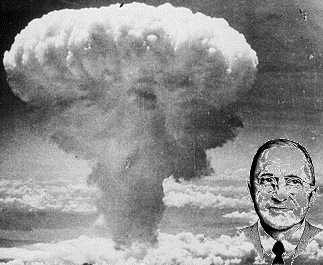
The willingness of the Japanese oligarchy to waste the blood of their own people and spill the blood of others without limit was central to their strategy of avoiding occupation and the dismantling of the old order.
Japan was governed largely by a consensus among an oligarchy of military and civilian factions. No major decisions of national policy could be reached until such a consensus had been obtained:
Japan’s governmental structure was such that in practice the Emperor merely approved the decisions of his advisers.
A consensus among the oligarchy of ruling factions at the top was required before any major question of national policy could be decided.
These factions, each of which had a different point of view, included the group around the Emperor of whom Marquis Kido, the Lord Keeper of the Privy Seal, was the most important, the ex-premiers constituting the Jushin or body of senior statesmen, and the cabinet.
The Army and Navy named their own cabinet ministers, who, together with the two chiefs of staff, had direct access to the Emperor.
The cabinet could perpetuate itself only so long as it was able to absorb or modify the views of the Army and Navy ministers, who, until the end, were strongly influenced by the fanaticism of the Army officers and many of the younger Navy officers.
The ruling oligarchy considered the opinions of the Japanese people as only one among the many factors to be taken into consideration in determining national policy and in no sense as controlling.
This process inevitably took time and involved complicated struggles of will among those of differing opinions. Assassinations and the threat of the same often greased the wheels.
The Japanese oligarchy felt in the spring of 1944 that Japan was facing certain defeat or at least that the time had come for positive steps to end the war. Prime Minister Tojo was forced to resign to make way for those more skilled at extracting the best possible terms to end the war.
Japan always anticipated a negotiated end of the war in the Pacific.
- The Japanese elite considered that the weakness of the U.S. as a democracy would make it impossible for her to continue all-out offensive action in the face of the losses imposed by a fanatically resisting Japanese military;
- The U.S. would compromise and allow Japan to retain a substantial portion of her initial territorial gains; and
- Civilian and naval groups were familiar with American industrial and technological potential, and its fighting determination when aroused, expressed their doubts about a strategy which promised no conclusion to the war other than negotiation.
While Japan no longer had a realistic prospect of winning the war by the end of 1944 and they knew it, Japan’s leaders believed they could make the cost of conquering Japan too high for the Allies to accept, leading to some sort of armistice rather than total defeat.
The Japanese army fought to the death with 99% plus casualty rates as the Americans moved from island to island to show that any attempt to invade Japan would be too high a price to pay.
This was the Japanese ruling elite’s ace in the hole. The War Department staff in Washington estimated there would be 250,000 to 500,000 American casualties in an invasion of Japan.
500,000 Purple Heart medals were manufactured in anticipation of the casualties resulting from the invasion of Japan.
- To the present date, all the American military casualties of the sixty years have not exceeded that number.
- In 2003, there were still 120,000 of these Purple Heart medals in stock!
After the bombings, a public admission of defeat by the responsible Japanese leaders was secured prior to an invasion and while Japan was still possessed of some 2,000,000 troops and over 9,000 planes in the home islands.
There was no need for the Allies to either invade Japan or deal with the million Japanese troops in China who could have held out as a government-in-exile.
What were the chances of a military coup and assassinations and of army mutinies in China if the Japanese leaders capitulated? There were coup and assassination attempts after the figure-head emperor was used to resolve the dead-lock in a face saving way.
The 12-15 August coup plotters failed to persuade the Eastern District Army and the high command of the Imperial Japanese Army to move against the surrender. Importantly, the junior officers leading the coup felt secure enough to approach the Army minister and senior army officers as potential co-conspirators.
The army leadership knew of the coup plans but neither joined the plotters nor arrested them.
The key point is any Japanese government would automatically fall if the navel or army minister resigned. The Army and Navy name their own cabinet ministers. The resignation of Shigetaro Shimada, the Navy Minister, forced out Tojo in 1944.
The Oligarchy had decided in late 1944 that Japan was facing ultimate defeat and unseated the Tojo government in favour of a new cabinet which would bring the war to an end on terms that preserved old military dominated oligarchic order. The army and navy ministers did not resign after the post-atomic bombing peace terms were accepted. They knew the game was up.
A hypothetical:
-
You are Truman’s chief defence counsel at his 1946 impeachment hearings where he is charged with not using the atomic bomb as soon as possible to force the Japanese to accept terms of surrender.
-
Truman could have chosen to abjure from using the 2 bombs at his disposal and let the fire bombings burn down most Japanese cities and towns from new air bases for B26s from Okinawa, let 100,000 Chinese be slaughtered on average every month at the hands of the occupying Japanese army, and invade in December and call forth a slaughter of a million or two more.
- The second bombing discredited the important faction within the Japanese ruling oligarchy that argued that the USA had only one bomb to use.
Truman’s secretary of state put this hypothetical to Truman when he was wavering on using the bomb.
I always wonder when people engage in handwringing over the horrors of war, will any of their suggestions about the good guys staying their hands ever shorten these wars.
Would World War 2 have finished even one day earlier if the handwringers had their way on how wars should be fought by the good guys? Who would have won?
 Utopia, you are standing in it!
Recent Comments