I forgot to vote once because I forgot there was an election on
11 May 2014 Leave a comment
in politics - Australia, Public Choice Tags: Attack Ads, electioneering, Tasmanian elections
Tasmania’s House of Assembly election in 1982 had no party campaigns, no TV or newspaper ads, no how to vote cards and all candidates could only solicit votes for themselves, not for others in their party or anyone else.
 A late legal opinion was that any form of expenditure on co-ordinated campaigning and joint solicitation of votes would be added to each individual candidate spending limits of $1000 separately.
With no party campaigns, no TV or newspaper ads, no how to vote cards and all candidates could only solicited votes for themselves, the date of the election slipped my mind and I forgot to get a postal vote before going inter-state for a holiday.
The Liberal Party won in a landslide defeating the incumbent Labor Government.
The campaigning ban seemed to give an advantage to the party already leading because the party on the nose could not dig itself out of a hole in the campaign by pointing out that they may be bad, but, on closer inspection, the other side is worse.
I do not know of any studies of this unusual election.
The best of the online materials by and about Ronald Coase
11 May 2014 Leave a comment
in law and economics, Ronald Coase Tags: Ronald Coase


Obituaries
University of Chicago on the announcement of his death
University of Chicago Ronald H. Coase, Founding Scholar in Law and Economics, 1910-2013
Recent interviews and op-eds:
1997 Interview Interview in Reason Magazine
2001 A conversation with Ronald H. Coase
2002 Why Economics Will Change Speech on why economics will and ought to change
2003 Coase Centennial Speech (video) Speech at the University of Chicago Law School
2002 Ronald H. Coase, The Intellectual Portrait Series: A Conversation with Ronald H. Coase
2010 Interview on 100th Birthday Interview on Ronald Coase’s 100th birthday
2012 Coase on Externalities, the Firm, and the State of Economics
2012 WSJ Opinion Article, with Ning Wang Opinion article by Ronald Coase and Ning Wang concerning the development of modern China, in the Wall Street Journal, April 6, 2012.
2012 Harvard Business Review Article Article by Ronald Coase concerning the need to reengage modern economics with the economy, in the Harvard Business Review, December 2012.
2013 Cato Policy Report Article, with Ning Wang Article by Ronald Coase and Ning Wang summarizing the work of their book on China, in the Cato Policy Report, January/February 2013.
2012 Small Business Economics Interview on 102nd Birthday Interview conducted by Siri Terjesen and Ning Wang.
2013 Interview Interview with Ronald Coase, conducted by Ning Wang. (Some material is in Chinese.)
About Ronald Coase
Nobel award 1991 Bank of Sweden Prize in Economic Sciences in memory of Alfred Nobel
Coase’s work in perspective Nobel Foundation, on the 1991 prize in economics
Essay on Coase’s work The Swedes Get It Right, by David Friedman
Richard Posner on Coase and his methodology
Ronald H. Coase. Biography. Concise Encyclopedia of Economics.
Ronald Coase—The Nature of Firms and Their Costs by Robert L. Formaini and Thomas F. Siems
Best of his papers
2013 How China Became Capitalist Cato Policy report with Ning Wang
2013 Saving Economics from Economists Havard Business Review
2000 The Acquisition of Fisher Body by General Motors Journal of Law and Economics, Vol. 43, No. 1 (April 2000), pp. 15-31. pdf
1996 Law and Economics and A. W. Brian Simpson Journal of Legal Studies, Vol. 25, No. 1 (January 1996), pp. 103-119.
1993 Law and Economics at Chicago Journal of Law and Economics, Vol. 36, No. 1, Part 2 (April 1993), pp. 239-254.
1992 The Institutional Structure of Production The American Economic Review, Vol. 82, No. 4 (September 1992), pp. 713-719. pdf
1988 Blackmail Virginia Law Review, Vol. 74, No. 4 (May 1988), pp. 655-676. pdf
1988 The Nature of the Firm: Origin Journal of Law, Economics, & Organization, Vol. 4, No. 1 (Spring 1988), pp. 3-17. pdf
1988 The Nature of the Firm: Meaning Journal of Law, Economics, & Organization, Vol. 4, No. 1 (Spring 1988), pp. 19-32.
1988 The Nature of the Firm: Influence Journal of Law, Economics, & Organization, Vol. 4, No. 1 (Spring 1988), pp. 33-47.
1979 Payola in Radio and Television Broadcasting Journal of Law and Economics, Vol. 22, No. 2 (October 1979), pp. 269-328.
1978 Economics and Contiguous Disciplines The Journal of Legal Studies, Vol. 7, No. 2 (June 1978), pp. 201-211.
1977 Advertising and Free Speech The Journal of Legal Studies, Vol. 6, No. 1 (January 1977), pp. 1-34.
1976 Adam Smith’s View of Man Journal of Law and Economics, Vol. 19, No. 3 (October 1976), pp. 529-546. pdf
1975 Marshall on Method Journal of Law and Economics, Vol. 18, No. 1 (April 1975), pp. 25-31.
1974 The Lighthouse in Economics Journal of Law and Economics, Vol. 17, No. 2 (October 1974), pp. 357-376.
1974 The Choice of the Institutional Framework: A Comment Journal of Law and Economics, Vol. 17, No. 2 (October 1974), pp. 493-496.
1974 The Market for Goods and the Market for Ideas (in The Economics of the First Amendment) The American Economic Review
1972 The Appointment of Pigou as Marshall’s Successor Journal of Law and Economics, Vol. 15, No. 2 (October 1972), pp. 473-485.
1972 Durability and Monopoly Journal of Law and Economics, Vol. 15, No. 1 (April 1972), pp. 143-149.
1972 Industrial Organization: A Proposal for Research, Economic Research: Retrospect and Prospect Vol 3: Policy Issues and Research Opportunities in Industrial Organization
1970 The Theory of Public Utility Pricing and Its Application The Bell Journal of Economics and Management Science, Vol. 1, No. 1 (Spring 1970), pp. 113-128.
1966 The Economics of Broadcasting and Government Policy (in The Economics of Broadcasting and Advertising) The American Economic Review, Vol. 56, No. 1/2 (March 1966), pp.440-447.
1960 The Problem of Social Cost Journal of Law and Economics Vol. 3 (October 1960), pp. 1-44 pdf
1959 The Federal Communications Commission Journal of Law and Economics Vol. 2 (October 1959), pp. 1-40 pdf
1946 The Marginal Cost Controversy Economica, New Series, Vol. 13, No. 51 (August 1946), pp. 169-182.
1937 The Nature of the Firm Economica, New Series, Vol. 4, No. 16 (November 1937), pp. 386-405 pdf
Reviews of Others’ Work
1977 Reviewed Work: Selected Economic Essays and Addresses by Arnold Plant Journal of Economic Literature, Vo.. 15, No. 1 (Mar. 1977), pp. 86-88.
some via http://www.coase.org/coaseonline.htm
Beyond Efficiency Dr. Israel Kirzner
11 May 2014 Leave a comment
in applied welfare economics, Austrian economics
The Projected Improvement in Life Expectancy
11 May 2014 Leave a comment
in technological progress Tags: life expectancy, The Great Escape, The Great Fact

Minimum wage was introduced to reduce the employment of women
10 May 2014 1 Comment
in gender, history of economic thought, labour economics Tags: minimum wage, progressive era
The minimum wage is a rare policy bird. Its employment effects change at the whim of its latest proponents.
Minimum wages were initially introduced in the USA shortly after 1900 solely for women and children. The express aim was to price women out of jobs and raise men’s wages by enough so that they could provide for their families.
These days, some argue that minimum wages actually increase employment. Times change, and the slopes of supply and demand curves must change with them.
Tim Leonard in Protecting Family and Race The Progressive Case for Regulating Women’s Work showed that these women-only minimum wages were justified by political progressive including women on grounds that they would:
(1) Protect the biologically weaker sex from the hazards of market work;
(2) Protect working women from the temptation of prostitution;
(3) Protect male heads of household from the economic competition of women; and
(4) Ensure that women could better carry out their eugenic duties as “mothers of the race.”

The above photo from the Minnesota Post has the following caption:
Fuelled by the Progressive Era, Minnesota becomes one of the first dozen states to pass a law establishing work standards for women and children and established a Minimum Wage Commission.
Women-only minimum wage laws were held unconstitutional by the Supreme Court in 1923 but were upheld by a Progressive-dominated Supreme Court in 1937. In the 1930s depression, single-sex, state minimum-wage laws were revived and flourished.
Xenophobia, race prejudice, and sexism should come as no surprise to any student of left-wing politics. Progressive politics in the first half of the 20th century was infested with racism:
- The support of the Australian Labor Party (ALP), and in the USA, the Democratic Party, for vicious, state-sponsored racism is well known.
- The ALP supported the passing of the White Australia policy with glee in 1901 by the newly formed Federal Parliament.
As Tim Leonard has shown, in days gone by, budding progressives not only revelled in exposes of capitalistic barons and attacks on laissez-faire economics by muckraking journalists, they also poured over racist tracts that drew on the latest anthropology, biology, psychology, sociology, eugenics, and medical science. Social Democrat Party Sweden practised eugenics until the 1960s.
The huge differences in the coverage of government failure versus market failure in 23 leading Principles of Economics – James Gwartney and Rosemarie Fike
10 May 2014 Leave a comment
in applied welfare economics, economics, history of economic thought, Public Choice Tags: diffusion of ideas, textbook content
23 leading Principles of Economics texts reveals huge differences in the coverage of government failure versus market failure
On average, the coverage of market failure in the 23 texts is nearly six times that of government failure.
As a result of the omission of public choice, many current students of economics are presented a naïve and largely fallacious view of government and the power of economics to explain the presence of debt financing, unfunded promises, special interest spending, and the institutional environment underlying economic growth and development.
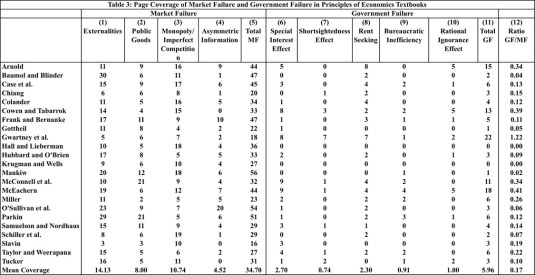
Krugman’s textbook does not mention government failure at all!
Via Economicsone
Why do we have governments?
09 May 2014 Leave a comment
in constitutional political economy, Gordon Tullock, Public Choice Tags: federalism
Ancient philosophers in general thought that it was to establish virtue or do good. Most modern public choice scholars are more modest in their evaluation of government.
We simply want government to provide those goods and services that people in fact want and that, for a variety of reasons, are hard to provide through the market.
Most people, for example, would like to have the poor taken care of by taxes on those better off. It is true they would have no objection if the poor were taken care of by voluntary contributions, but our experience seems to indicate that voluntary contributions don’t produce adequate funds for this purpose. Hence the use of the government to provide that particular service is generally approved. Of course, that does not prove that in general people are in favour of the exact quantity transferred or the methods used by the government.
There is a large literature on why certain types of things, sometimes called public goods, are provided by the market in a very inefficient way and will be provided in a better (although far from optimal) way by the government.
…We will just accept as a fact that there are a number of things which are better dealt with by the government. We will also accept as a fact that there are other things which are better dealt with by the market.
…In general, we want the government to give the citizens what they themselves want. That, indeed, is the point of democracy.
The smaller the government, the smaller the number of its voters. The smaller the number of voters, the more power each individual voter has. That’s one side of the argument.
On the other side, we have the fact that many government services are hard or impossible for small governmental units to provide.
These two arguments have to be set off against each other and since different government activities will turn out to have a different balance, having different governmental sizes is sensible.
… The existence of many small government units dealing with certain special problems has another advantage. Not only are these small governments more under the control of their voters in the sense that each individual voter’s preferences count for more than in the large government, their existence means that citizens may move from one to the other if they are dissatisfied.
Gordon Tullock
The New Federalist (1995)

New Zealand is not a federal state. I like federalism because a divided government is a weak government.
Competition as a force for media accuracy or infotainment
09 May 2014 Leave a comment
in entrepreneurship, industrial organisation, market efficiency, survivor principle Tags: infotainment, media bias, Tyler Cowen
Limiting the number of TV stations has unusual effects on media slant and muckraking.

Tyler Cowen argues that competition by itself is not a powerful force for media accuracy.
In the traditional conception of the demand for news, audiences read, watch, and listen to the news in order to get information. The quality of news is its accuracy.
But when there are many media outlets, competition results in a common slanting of news towards reader biases in the audience niche each network are serving. The market is very good are serving up what the customer wants.
Competition forces news outlets to cater to their customer’s niche preferences.
- Realised profit is the criterion by which the market process selects survivors: those who realise positive profits survive; those who suffer losses disappear.
- Positive profits accrue to those news outlets who are better than their competitors. These lesser rivals will exhaust their retained earnings and fail to attract further new investor support.
On topics where reader beliefs diverge on politically divisive issues, media outlets profit from segmenting the market and slanting reports to the biases of their niche audiences.
There is less bland truth-telling and more of the polemics that each market niche wants.
This means that left-wing and right-wing media outlets will hound the political enemies of their readers to cater to the preferences of their audience niche.
The clearest illustration of infotainment is the Lewinsky affair:
- The left wing press presented information designed to excuse Clinton’s sins; and
- The right wing press dug out details pointing to his culpability.
When there are only a few media outlets, the networks instead go for the median viewer/reader and offer more sedate and less scandal driven coverage.
More media competition increases the chances of the muckraking that brings down ministers and governments.
Lord Denning quotes
08 May 2014 2 Comments
in law and economics Tags: Lord Denning
The House of Commons starts its proceedings with a prayer. The chaplain looks at the assembled members with their varied intelligence and then prays for the country
Daily Telegraph (1989)
“The poorest man may in his cottage bid defiance to all the forces of the Crown.
It may be frail—its roof may shake—the wind may blow through it—the storm may enter—the rain may enter—but the King of England cannot enter—all his force dares not cross the threshold of the ruined tenement.” So be it—unless he has justification by law.
Southam v Smout [1964] 1 QB 308 at 320
There are many things in life more worth while than money.
One of these things is to be brought up in this our England, which is still “the envy of less happier lands”.
I do not believe it is for the benefit of children to be uprooted from England and transported to another country simply to avoid tax… Many a child has been ruined by being given too much. The avoidance of tax may be lawful, but it is not yet a virtue.
Re Weston’s Settlements, [1969] 1 Ch 223
“Unlike my brother judge here, who is concerned with law,” he once teased at a legal dinner, “I am concerned with justice.”
What is the argument on the other side? Only this, that no case has been found in which it has been done before. That argument does not appeal to me in the least.
If we never do anything which has not been done before, we shall never get anywhere. The law will stand still while the rest of the world goes on, and that will be bad for both
A family law case
In June 1970, a big earth-moving machine got stuck in the mud. It sank so far as to be out of sight. It cost much money to get it out. Who is to pay the cost?
British Crane Hire Corporation Ltd v. Ipswich Plant Hire Ltd [1970] 1 All ER 1059
Broadchalke is one of the most pleasing villages in England.
Old Herbert Bundy, the defendant, was a farmer there.
His home was at Yew Tree Farm. It went back for 300 years. His family had been there for generations.
It was his only asset.
But he did a very foolish thing. He mortgaged it to the bank.
Lloyds Bank v. Bundy [1973] 3 All ER 757
More information on Lord Denning, the son of a draper and the most celebrated English judge of the 20th century, is here and here

Denning was the last judge to have the right to stay in the job for life. He joked that he had “every Christian virtue, except resignation”. He retired aged 83 after making some rather poorly chosen remarks and died a few months after his 100th birthday.
Greens as heirs of the 19th century Tory radicals
08 May 2014 1 Comment
in libertarianism, political change, politics - Australia, politics - New Zealand, Public Choice Tags: 19th century British Tory Radicals, green voters
The Greens are no more than a reincarnation of the 19th century British Tory Radicals with their aristocratic sensibilities that combined strong support for centralised power with a paternalistic concern for the plight of the poor:
- 19th century Tory radicals opposed the middle classes and the aesthetic ugliness they associated with an industrial economy; and
- Like the 19th century Tory Radicals, today’s green gentry see the untamed middle classes as the true enemy.
Environmentalists have an aristocratic vision of a stratified, terraced society in which the knowing ones would order society for the rest of us.
Environmentalism offered the extraordinary opportunity to combine the qualities of virtue and selfishness
Many left-wingers thought they were expressing an entirely new and progressive philosophy as they mouthed the same prejudices as Trollope’s 19th century Tory squires: attacking any further expansion of industry and commerce as impossibly vulgar, because it was:
ecologically unfair to their pheasants and wild ducks.
Neither the failure of the environmental apocalypse to arrive nor the steady improvement in environmental conditions because of capitalism has dampened the ardour of those well-off enough to be eager to make hair-shirts for others to wear.

The 19th century Tory radical’s disdain for the habits of their inferiors remains undiminished in their 21st century heirs and successors.
True to its late 1960s origins, political environmentalism gravitates toward bureaucrats and hippies: toward a global, little-brother government that will keep the middle classes in line and toward a back-to-the-earth, peasant-like localism, imposed on others but presenting no threat to the inner city elites’ comfortable middle class lives.
Unlike most, green voters tend to be financially secure and comfortable enough to be able to put aside immediate self-interest when imposing their political opinions.
The rising Green vote is a product of increasing tertiary education. Green voters are typically tertiary educated or undergoing tertiary education.
Green votes are defined by what they studied at university: arts, society and culture, architecture and education. Professionally they tended to be consultants, or worked in the media, health or education. Theses jobs are heavily concentrated in tertiary disciplines that are focused on much more than just making money.
Greens are very well-paid inner-urban dwellers who make more use of public transport and have few religious convictions. They tend not to have children until their 30s, if at all, which makes them even richer and gives them lots more spare time to organise political activities and annoy the rest of us. Some of them still haunt campuses, churning out more arts graduates, but increasingly, green voters comprise a well-heeled professional group.
Greens are distinct from the typical Labor or National voter demographic but they support the the Green Party for social rather than economic reasons. Not unlike middle-class Catholics in the 1950s and 1960s who voted Labour.
How ironic that the green gentry—progressives against progress—turn out to be nothing more than nineteenth-century urbane conservatives. There is nothing new under the sun.
Big HT: http://www.city-journal.org/2010/20_3_american-liberalism.html
Richard Epstein “The Coming Meltdown in Labor Relations”
07 May 2014 Leave a comment
in industrial organisation, labour economics, law and economics, liberalism, personnel economics, Public Choice, Richard Epstein
The con in econometrics
07 May 2014 Leave a comment
in econometerics, history of economic thought Tags: data mining, publication bias
A mathematician, an economist and an econometrician apply for the same job.
The interviewer calls in the mathematician and asks
What do two plus two equal?
The mathematician replies
Four.
The interviewer asks
Four, exactly?
The mathematician looks at the interviewer incredulously and says
Yes, four, exactly.
Then the interviewer calls in the economist and asks the same question
What do two plus two equal?
The economist says
On average, four – give or take ten per cent, but on average, four.
Then the interviewer calls in the econometrician and poses the same question “What do two plus two equal?”
The econometrician gets up, locks the door, closes the shade, sits down next to the interviewer and says,
What do you want it to equal?

Three econometricians went out hunting, and came across a large deer.
The first econometrician fired, but missed, by a meter to the left.
The second econometrician fired, but also missed, by a meter to the right.
The third econometrician didn’t fire, but shouted in triumph,
We got it! We got it!
Those subservient press barons
07 May 2014 Leave a comment
in economics of regulation, entrepreneurship, industrial organisation, politics, Public Choice, survivor principle Tags: media bias, rent extraction
Both political parties used television licensing and the threat of cable TV to manipulate Murdoch, Packer and the other press barons. They were victims of Fred McChesney’s concept of rent extraction:
- Rent extraction is the politician’s pastime of threatening harmful legislation to extract political support and contributions from well-heeled private institutions.
- Payments to politicians are often made not for political favours, but to avoid political disfavour, that is, as part of a system of political extortion or rent extraction.
Rent extraction is money for nothing – money paid in exchange for politicians’ inaction.
The politician is paid, not for rent creation, but for withholding legislative and regulatory action that would destroy existing private rents.
McChesney establishes the conditions under which of rent creation or extraction will occur. The relative attractiveness of the two strategies depends on the elasticities of demand and supply.
- If demand is relatively inelastic, rent creation will occur; and
- If supply is relatively inelastic, rent extraction will occur.
The existence of an organization or a large established firm lowers transaction costs for the politicians negotiating and collecting donations and support, making rent expropriation threats easier.
It is hard to extort rents from those with little in the way of organisation. A cost of being an established lobbying organisation or a large firm with high fixed costs is a greater potential for rent extraction.
The print and electronic media are ripe for rent extraction because of their immobile assets and heavy regulation.
Investors in heavily regulated capital intensive industries such as the mass media, digital and print, do not bite the hand the feeds them.
Little wonder that the media barons were honoured supplicants to whomever is in power in Canberra. They are soon Labor’s business mates whenever Labor was in power.
Threatening to allow cable TV was the big stick in every Australian government’s hand until the 1990s to extract support or at least subservience from the media.
Rupert Murdoch has unashamedly backed political winners, only to dump them when he was convinced that they were washed up or that his newspapers might be left stranded on the losing side of politics.

Murdoch’s see-sawing political stances are entirely pragmatic. He has always been prepared to back winners just before they win, and to shift allegiances on non-ideological grounds.
The Internet Arguing Checklist for Right-Wingers
06 May 2014 Leave a comment
in politics - Australia, politics - New Zealand, politics - USA Tags: infotopia, open society
- Say something offensive.
- Pretend statistics support your offensive statement.
- Claim liberal bias in the media.
- Claim there’s a liberal agenda.
- Offer up a conspiracy theory.
- Call your opponent stupid.
- Gloat about your accomplishments.
- Offer easily disqualified opinions.
- Create derogatory nicknames for opponents.
- Say science proves your point.
- Say science is limited when it conflicts with your point.
- When all else fails, Communism!
via Pox Vopoli: The Internet Arguing Checklist for Right-Wingers.
 Utopia, you are standing in it!
Recent Comments