
What World Bank consultant would risk his fee and return business on advising Egypt to specialise in the export of toilets to Italy? But Egypt’s largest single manufacturing export is toilets to Italy where it captured 93% of the market.
Kenya has a booming export business in cut flowers for men to buy for their wives. Kenya has 40% of the European markets for cut flowers. Nigeria has 84% of the Norwegian market for floating docks. The Philippines has 71% of the global market for electronic integrated circuits.
What development expert would have picked these winners? They’re far too far away from the conventional wisdom and the safe bets that are behind picking winners in government circles.
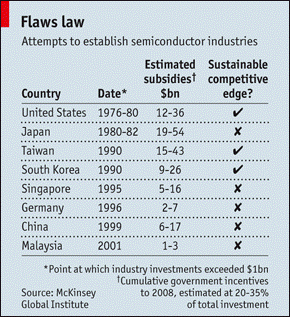
Picking winners by governments requires heroic assumptions not only about the information politicians and bureaucrats have about the present and their ability to predict the future, but also about their motivations and their ability to resist capture by special interests. The Economist explains:
None of these studies addresses a deeper problem with the way industrial policy tends to develop over time.
Earlier efforts have tended to degenerate into rent-seeking, lobbying and cosy deals between incumbent firms and bureaucrats, stifling innovation and the process of creative destruction.
The problem, of course, is that … industrial policy requires disinterested, benevolent policymakers who can do it well. Unfortunately, they do not yet have a recipe for how such policymakers can be created.
Policy is made by real people with political and personal motivations. What they come up with is unlikely to be as well designed as the ones in the models.
 Utopia, you are standing in it!
Recent Comments