Both successful and unsuccessful bids to host the Olympics have a similar positive impact on exports according to Andrew Rose – no relation.
The Olympic effect on trade is from a signal that a country sends when bidding to host the games, rather than actually hosting the event.

A country that wishes to liberalise its trade may want to signal this by bidding to host a mega-event. It generates extra trade-related investment and creates a political atmosphere where back-sliding on trade liberalisation or the mega-event becomes difficult.
- Rome was awarded the 1960 games in 1955: the same year that Italy started to move towards currency convertibility, joined the UN, and began the negotiations that lead two years later to the Treaty of Rome and the creation of the European Economic Community.
- The Tokyo games of 1964 coincided with Japanese entry into the IMF and the OECD.
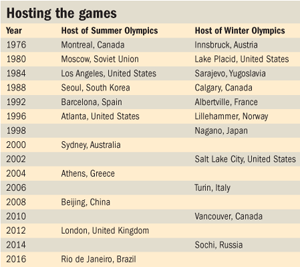
- Barcelona was awarded the 1992 games in 1986, the same year Spain joined the European economic community.
- The decision to award Korea the 1988 games coincided with Korea’s political liberalisation.
Many of the countries that are hosted the Olympic Games in recent years such as China have done so as part of showing to the world that they have made it and there’s no going back.
The trick then for the taxpayer is for your country’s bid to host the Olympics to come a close second without anyone knowing you really want to lose.

The trouble with treating the Olympic bid is all show to boost your image as an investment destination and a liberalising economy is your beard might actually win. Throwing a fight is never easy as many a boxer knows.
 Utopia, you are standing in it!
Recent Comments