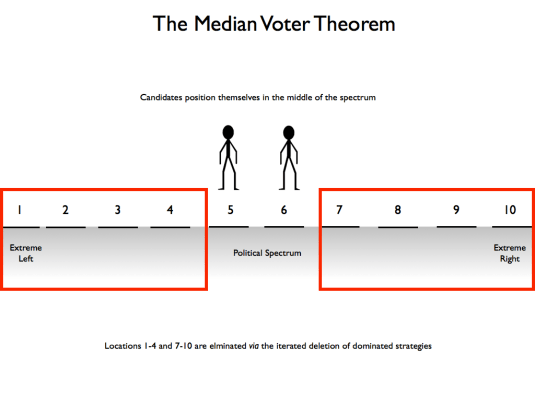
The median voter is the voter in the middle: the voter who has as many voters on either side of him.
Celebrating humanity's flourishing through the spread of capitalism and the rule of law
08 Jul 2014 Leave a comment
in Public Choice Tags: median voter theorem
The median voter is the voter in the middle: the voter who has as many voters on either side of him.
07 Jul 2014 Leave a comment
in applied price theory, labour economics, minimum wage, Public Choice Tags: Free to Choose, Milton Friedman, minimum wage
07 Jul 2014 Leave a comment
in applied price theory, income redistribution, politics - New Zealand, Rawls and Nozick Tags: difference principle, income distribution, John Rawls, Maori economic development, Pasifika economic development
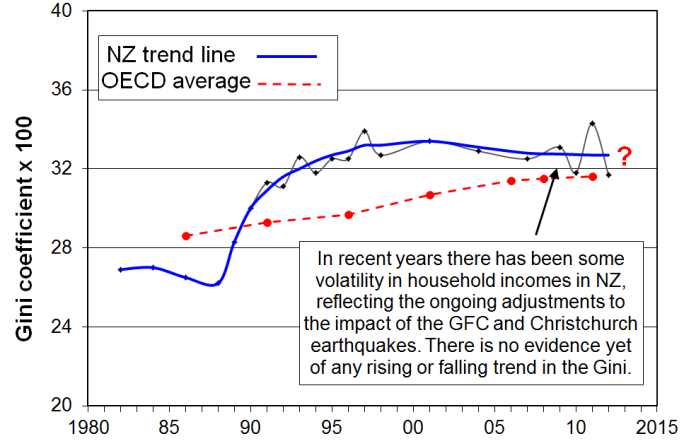
An urban legend in New Zealand is that income inequality is going from bad to worse.
Since the mid 1990s to around 2011 there was a small net fall in New Zealand’s income inequality trend line in the graph for the Gini coefficient for the income distribution for New Zealand shows. inequality in New Zealand is similar to that in Australia, Ireland, Canada and Japan.
Source: Ministry of Social Development (2014)
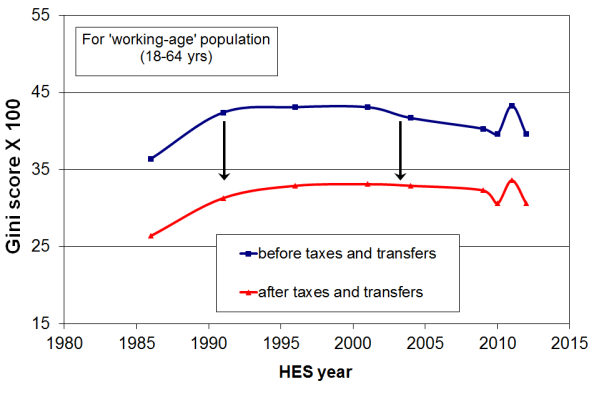
Taxes and transfers have reduced inequality in New Zealand when measured by Gini coefficients, but the trend is been relatively stable for many years.
Source: Ministry of Social Development (2014)
Rawls pointed out that behind the veil of ignorance, people will agree to inequality as long as it is to everyone’s advantage. Rawls was attuned to the importance of incentives in a just and prosperous society. If unequal incomes are allowed, this might turn out to be to the advantage of everyone. Robert Nozick said that:
Political philosophers must now either work within Rawls’s theory or explain why not.
The groups that have been doing best in New Zealand have been Maori and Pasifika. In real terms, overall median household income rose 47% from 1994 to 2010; for Maori, this rise was 68%; for Pacific, 77%!

Source: Ministry of Social Development (2014)
The large improvements in Māori incomes since 1992 were based on rising Māori employment rates, fewer Māori on benefits or zero incomes, more Māori moving into higher paying jobs, and greater Māori educational attainment (Dixon and Maré 2007).
Maori unemployment reached a 20-year low of 8 per cent from 2005 to 2008. Labour force participation by Maori increased from 45% in the late 1980s to about 62% in the last few years.
Most of the remaining income disparities between Māori and non-Māori flow from differences in educational attainment and demographic and socio-economic characteristics including household composition (Chapple 2000; Maani 2004; Dixon and Maré 2007).
How much of the massive increases in incomes over the last 20 years spread throughout the entire community are you willing to give up for a little more equality? How much of your income will you donate to charity to lead the way?
.
07 Jul 2014 Leave a comment
in applied price theory Tags: Bill Allen

If we do not have all of everything we want, there is a problem of rationing. This is the major corollary of scarcity. An individual cannot escape the requirement for "economizing." How shall he disburse his limited income?
The very impersonality of the pricing mechanism, which the advocate of freedom should consider an asset, does not appeal to the compassionate person determined to do good.
Thus we find widely advocated processes of rationing, founded not on each person bidding in the open market on the basis of his own scale of priorities, but on direct disposal of goods and services by some public authority on the basis of what the authority somehow decides are the relative "needs" of the members of the community…
The Smythean scheme [rationing by prices] achieves a number of desirable results.
First, the rationing is done with a minimum cost in time and inconvenience. Paying a price in terms of money, i.e., generalized purchasing power, is neater (although not necessarily smaller in the estimation of everyone) than paying in terms of a specific resource, in this case, the energy required in arising early and groping to the parking lot by moonlight. That, as Smythe has often said, is why money was invented.
Second, a dispensing bureaucracy—suffering the temptations of frail men, guided by arbitrary and often nebulous criteria, and subject to no rewards for efficiency or penalties for inefficiency—is avoided.
Third, there is upheld the basic principle that those who get (in this case, the parking spaces) shall pay. Fourth, there is upheld the equally basic principle that gifts and rewards are best given in generalized purchasing power.
Bill Allen
07 Jul 2014 Leave a comment
in great recession, macroeconomics Tags: cash for clunkers, intertemporal consumption smoothing, permanent income hypothesis
07 Jul 2014 Leave a comment
in macroeconomics, Public Choice Tags: policy uncertianty, political polarisation
John van Reenen, Nicholas Bloom, Scott Bakerand Steven Davis produced these nice charts for the LSE blog:


The 90th Congress of 1967-68 showed a considerable overlap in voting patterns between Democrats and Republicans along liberal and conservative issues allowing the possibility of more compromise. But there was essentially no voting overlap by the 100th Congress of 2007-08.
07 Jul 2014 Leave a comment
in inflation targeting, macroeconomics, politics - New Zealand Tags: exchange rate intervention, exchange rate targeting, inflation targeting
Attempts to keep the dollar from going “too high” would have ruinous domestic consequences as the Governor of the Reserve Bank explained last year:
If New Zealand decided to cap the NZ dollar, depending on where the cap is enforced, similar levels of intervention might be required as global foreign exchange turnover in NZ dollars relative to GDP is similar to that in Swiss francs.
The OCR would need to drop to zero first in order to eliminate the interest arbitrage motivation for NZ dollar inflows. Any attempt to retain non-zero interest rates by “sterilising” such massive intervention would be very difficult.
In effect therefore a Swiss type operation to cap the value of the NZ dollar through large scale FX intervention would also amount to quantitative easing. As I mentioned, this would be highly inflationary in the NZ context.
Graeme Wheeler, Governor of the Reserve Bank of New Zealand
20 February 2013
Sterilised interventions in the foreign exchange market are a fool’s errand
If exchange rate manipulation had any chance of working, the U.S. Fed, the Bank of England, the European Central Bank and the Bank of Japan would be all over it already. Their mutual efforts to depreciate their own currencies would cancel out.
Most central banks gave up on exchange rate interventions in the mid-1990s because attempts to manipulate exchange rates without loosening monetary policy rarely worked. Brute experience taught them that they were on fool’s errand.
These exchange rate interventions, known as sterilised interventions, become an independent source of exchange rate instability and invite counter-speculation by currency traders and hedge funds. Every hint that a central bank might intervene in the exchange rate invites currency speculation. As Milton Friedman said:
The central problem is not designing a highly sensitive [monetary] instrument that offsets instability introduced by other factors [in the economy], but preventing monetary arrangements becoming a primary source of instability…
By trying to move the value of the dollar, the Reserve Bank of New Zealand will add its own element of currency instability and invite counter speculation by currency traders and hedge funds. This is a dangerous game for a small Reserve Bank to play.

As stated by Paul Krugman in 1999 on the concept of the impossible trinity: free capital movement, a fixed exchange rate, and an effective monetary policy –
The point is that you can’t have it all: A country must pick two out of three.
It can fix its exchange rate without emasculating its central bank, but only by maintaining controls on capital flows (like China today); it can leave capital movement free but retain monetary autonomy, but only by letting the exchange rate fluctuate (like Britain – or Canada); or it can choose to leave capital free and stabilize the currency, but only by abandoning any ability to adjust interest rates to fight inflation or recession (like Argentina today or for that matter most of Europe).
Exchange rate manipulation by the Reserve Bank cannot alter the competiveness of exporters. The looser monetary policy will inevitably lead to higher CPI inflation that will erode any temporary advantage to exporters from the initial depreciation of the NZ dollar.
What did the Swiss do to keep their exchange rate down in the GFC?
Labour’s Monetary Policy Upgrade referred to the efforts of the Swiss National Bank to cap a massive appreciation of the Swiss Franc after 2009 and the Euroland sovereign debt crisis:
The Swiss have actively protected their currency from appreciating to the detriment of their tradeable sector (p.16)
 The Swiss National Bank stemmed the rise of Swiss franc by loosening their monetary policy as they say so themselves:
The Swiss National Bank has successfully maintained its exchange-rate floor against the euro, often through heavy nonsterilized purchases of foreign exchange (Swiss National Bank Annual Report, 2012, p. 34).
These non-sterilised exchange rate interventions were a loosening of Swiss monetary policy. The Swiss National Bank happens to be one of a number of central banks that conduct their monetary policies by buying and selling in the foreign exchange markets.
Labour’s aim of a positive external balance through a tightening of monetary policy is a repeat of the fool-hardy policies of the Hawke-Keating government in the late 1980s.
1988 witnessed a major monetary policy tightening in Australia. The tightening was motivated by a current account deficit rather than double-digit inflation:
The current account deficit as a major policy problem was then quietly forgotten in Australia.
Three conflicting monetary policy objectives
The New Zealand Labour Party wants the Reserve Bank to do three impossible things before breakfast:
The best contribution of monetary policy to the competitive positions of exporters is low inflation.
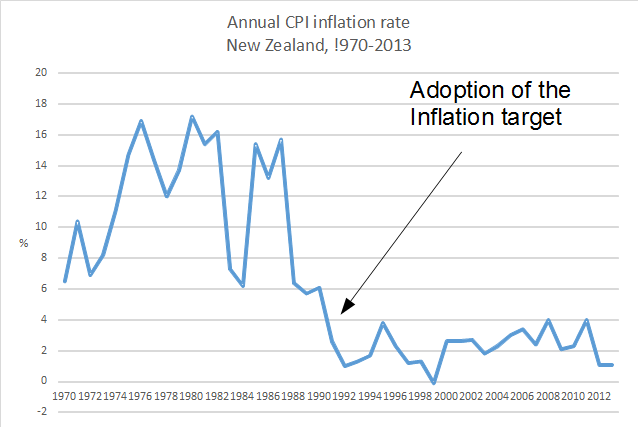
Inflation targeting removes monetary policy as in independent source of exchange rate instability. Attempts to manipulate the exchange rate undermines the inflation target that has been such a great success since 1989, and reduces the commitment of public policy to a stable, predictable business climate. Bordo and Humpage add:
…sterilised foreign-exchange intervention can sometimes affect exchange-rate movements, but sterilised intervention does not provide central banks with a mechanism for systematically altering exchange rates independent of their monetary policies.
Attempts to stabilise or undervalue exchange rates necessarily weaken a country’s control of its monetary policy and ultimately leave the real exchange rate unaffected.
What really matters?
Labour’s monetary policy upgrade is a distraction from the only game in town for the future prosperity of New Zealanders:
Productivity isn’t everything, but in the long run it is almost everything. A country’s ability to improve its standard of living over time depends almost entirely on its ability to raise its output per worker.
Paul Krugman
The Age of Diminishing Expectations (1994)
07 Jul 2014 Leave a comment
in health and safety, health economics, labour economics, labour supply, welfare reform Tags: disability benefits, moral hazard

In the past three decades, the number of people who are on disability benefit has skyrocketed.
There is no compelling evidence that the incidence of disabling health conditions among the working age population is rising. Autor (2006) found that disability rolls in the USA expanded because:
Autor found that the aging of the baby boom generation has contributed little to the growth of disability benefit numbers to date.

David Autor and Mark Duggan (2003) found that low-skills and a poor education is predictor of disability: in the USA in 2004, nearly one in five male high school dropouts between ages 55 and 64 were in the disability program; that was more than double that of high school graduates of the same age and more than five times higher than the 3.7 % of college graduates of that age who collect disability. Unemployment is another driver of disability.

The proportion of working-age people receiving a Sickness Benefit, an Invalid’s Benefit or Accident Compensation weekly compensation in New Zealand rose from around 1% in the 1970s to 5% in June 2002.
Figure 1 The Number of People Receiving Benefit as a Primary Recipient, All Age Groups, 1975–2005

Source: DSW Annual Reports or Statistical Information Reports and MSD SWIFFT data from Dwyer and McLeod (2006).
Most other OECD countries also experienced a rise in the proportion of the working-age population claiming incapacity benefits over this period. By the late 1990s and early 2000s, it was common for around 4–6.5% of the working-age population to receive such benefits. Some European countries have up to 10% of their working age population on disability or sickness benefit!

When the UK undertook reassessments of those on its disability and sickness benefit, fewer than one in 10 people assessed for the new sickness benefit has been deemed too ill to carry out any work.
More than a third of the 1.3million people who applied for Employment and Support Allowance were found to be fully capable of working; a similar proportion abandoned their claims while they were still being processed. Moral hazard seems to be the main explanation of the rise in disability roles.
Before 15 July 1980, a victim of a workplace accident in the state of Kentucky received a payment proportional to his or her wage with an upper limit of $131 per week. On 15 July 1980, the limit was raised to $217 per week. This increase made a considerable difference to the best-paid workers: their periods of convalescence grew 20% longer (Cahuc and Zylberberg 2006).
06 Jul 2014 Leave a comment
in development economics, growth miracles Tags: The Great Escape, The Great Fact
The graph shows the total global proportion of people in extreme poverty from 1820-2005, defined as having less than $1 per day (inflation adjusted across the time period).
HT: Cool It
06 Jul 2014 Leave a comment
in applied welfare economics, David Friedman Tags: poverty
06 Jul 2014 Leave a comment
in economics of regulation, environmental economics, health economics, technological progress, Thomas Schelling, transport economics Tags: Thomas Schelling, value of life

Thomas Schelling’s crucial contribution in 1968 at RAND was the notion of statistical lives—mortality risks—in contrast to valuing the lives of specific, identified individuals. His insight was that economists could evade the moral thicket of valuing life and instead focus on people’s willingness to trade-off money for small reductions in the risks they face.
06 Jul 2014 Leave a comment
in Gordon Tullock, James Buchanan, politics - USA, Public Choice Tags: bicameralism, constitutional design, public choice
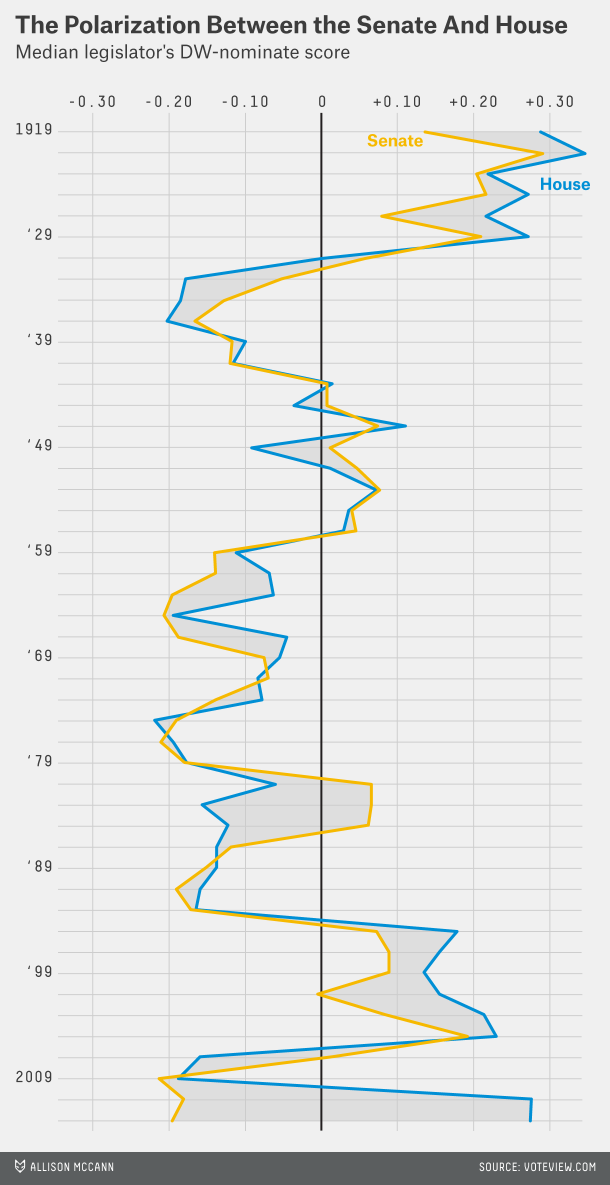
One of the lessons of public choice for constitutional design is there should be two Houses of Parliament and each should be elected by a different method and different geographical basis.
Lower houses tend to be elected in single member constituencies; upper houses tend to be elected in larger multi-member, state-wide or national constituencies by proportional representation.
This diversity in legislative arrangements ensures that more people are participating in decision-making and it is harder to pass new laws without majority support.
The two elected chambers will clash as each exerts its mandate to represent the will of the people who elected it. The laws that pass these two chambers elected by different methods must have substantial popular support.
When upper and lower houses are elected by similar methods, it is much easier to assemble a majority through vote trading and lobbying.
Data via fivethirtyeight.com
Celebrating humanity's flourishing through the spread of capitalism and the rule of law
Scholarly commentary on law, economics, and more
Beatrice Cherrier's blog
Celebrating humanity's flourishing through the spread of capitalism and the rule of law
Celebrating humanity's flourishing through the spread of capitalism and the rule of law
Celebrating humanity's flourishing through the spread of capitalism and the rule of law
Why Evolution is True is a blog written by Jerry Coyne, centered on evolution and biology but also dealing with diverse topics like politics, culture, and cats.
Celebrating humanity's flourishing through the spread of capitalism and the rule of law
Celebrating humanity's flourishing through the spread of capitalism and the rule of law
A rural perspective with a blue tint by Ele Ludemann
DPF's Kiwiblog - Fomenting Happy Mischief since 2003
Celebrating humanity's flourishing through the spread of capitalism and the rule of law
The world's most viewed site on global warming and climate change
Tim Harding's writings on rationality, informal logic and skepticism
A window into Doc Freiberger's library
Let's examine hard decisions!
Commentary on monetary policy in the spirit of R. G. Hawtrey
Thoughts on public policy and the media
Celebrating humanity's flourishing through the spread of capitalism and the rule of law
Politics and the economy
A blog (primarily) on Canadian and Commonwealth political history and institutions
Reading between the lines, and underneath the hype.
Economics, and such stuff as dreams are made on
"The British constitution has always been puzzling, and always will be." --Queen Elizabeth II
Celebrating humanity's flourishing through the spread of capitalism and the rule of law
Celebrating humanity's flourishing through the spread of capitalism and the rule of law
WORLD WAR II, MUSIC, HISTORY, HOLOCAUST
Undisciplined scholar, recovering academic
Celebrating humanity's flourishing through the spread of capitalism and the rule of law
Res ipsa loquitur - The thing itself speaks
In Hume’s spirit, I will attempt to serve as an ambassador from my world of economics, and help in “finding topics of conversation fit for the entertainment of rational creatures.”
Researching the House of Commons, 1832-1868
Articles and research from the History of Parliament Trust
Reflections on books and art
Posts on the History of Law, Crime, and Justice
Celebrating humanity's flourishing through the spread of capitalism and the rule of law
Exploring the Monarchs of Europe
Cutting edge science you can dice with
Small Steps Toward A Much Better World
“We do not believe any group of men adequate enough or wise enough to operate without scrutiny or without criticism. We know that the only way to avoid error is to detect it, that the only way to detect it is to be free to inquire. We know that in secrecy error undetected will flourish and subvert”. - J Robert Oppenheimer.
The truth about the great wind power fraud - we're not here to debate the wind industry, we're here to destroy it.
Celebrating humanity's flourishing through the spread of capitalism and the rule of law
Celebrating humanity's flourishing through the spread of capitalism and the rule of law
Economics, public policy, monetary policy, financial regulation, with a New Zealand perspective
Celebrating humanity's flourishing through the spread of capitalism and the rule of law
Restraining Government in America and Around the World

 Utopia, you are standing in it!
Recent Comments