Is the EITC as Good as an NIT? Conditional Cash Transfers and Tax Incidence

ozidar's avatarowenzidar

From Jesse Rothstein:

The EITC is intended to encourage work. But EITC-induced increases in labor supply may drive wages down. I simulate the economic incidence of the EITC. In each scenario that I consider, a large portion of low-income single mothers’ EITC payments is captured by employers through reduced wages. Workers who are EITC ineligible also see wage declines. By contrast, a traditional Negative Income Tax (NIT) discourages work, and so induces large transfers from employers to their workers. With my preferred parameters, $1 in EITC spending increases after-tax incomes by $0.73, while $1 spent on the NIT yields $1.39.

View original post

Edward Cannan on what should true statesman do?

Image

Milton Friedman on what is monetarism

Image

Many people readily concede many of our regulations are insane, badly designed, and harmful.

Image

The leads and lags on monetary policy are long and variable

Many Keynesians, Friedman notes, advocate “leaning against the wind.” By this they mean, in some sense, that the monetary (and fiscal) authorities should try to balance out the private sector’s excesses rather than passively hope that it adjusts on its own.

There are large uncertainties about the size and timing of responses to changes in monetary policy. There is a close and regular relationship between the quantity of money and nominal income and prices over the years. However, the same relation is much looser from month to month, quarter to quarter and even year to year.

Monetary policy changes take time to affect the economy and this time delay is itself highly variable. The lags on monetary policy are three in all:

  1. The lag between the need for action and the recognition of this need (the recognition lag)

  2. The lag between recognition and the taking of action (the legislation lag)

  3. the lag between action and its effects (the implementation lag)

These delays mean that is it difficult to ascertain whether the effects of monetary policy changes in the recent past have finished taking effect. Secondly, it is difficult to ascertain when proposed changes in monetary policy will take effect. Thirdly, feedbacks must be assessed. The magnitude of the monetary adjustment necessary to deal with the problem at hand is thus never obvious. It is common for a central bank to act incrementally. The central bank makes small adjustments to monetary conditions over time as more information is available on the state of the economy and forecasts are updated.

The existence of lags may mean that by the time policy has its full effect, the problem with which it was meant to deal may have disappeared.

Milton Friedman (1959) tested the Fed’s success at leaning “against the wind” by checking whether the rate of money growth has truly been lower during expansions and higher during contractions. He admits that this method of grading he Fed’s performance is open to criticism, but he decided to go ahead and see what turns up.  Friedman found that Fed has – for the periods surveyed – been unsuccessful.

By this criterion, for eight peacetime reference cycles from March 1919 to April 1958. Actual policy was in the ‘right’ direction in 155 months, in the ‘wrong’ direction in 226 months; so actual policy was ‘better’ than the [constant 4% rate of money growth] rule in 41% of the months.

Nor is the objection that the inter-war period biased his study is good since Friedman found that:

For the period after World War II alone, the results were only slightly more favourable to actual policy according to this criterion: policy was in the ‘right’ direction in 71 months, in the ‘wrong’ direct in 79 months, so actual policy was better than the rule in 47% of the months.

One of the best ways to parry a metaphor is with another metaphor. Keynesians have a host of metaphors in their rhetorical arsenal; one frequently voiced is that a wise government should “lean against the wind” when choosing policy. Friedman counters:

We seldom know which way the economic wind is blowing until several months after the event, yet to be effective, we need to know which way the wind is going to be blowing when the measures we take now will be effective, itself a variable date that may be a half year or a year or two from now. Leaning today against next year’s wind is hardly an easy task in the present state of meteorology.

Friedman’s remarks, as even his strong critics admit, are mighty and strike at the heart of any activist stabilisation policy. By meeting Keynesians on their own theoretical turf and scrutinising their practice, Friedman manages to produce objections that both Keynesians and non-Keynesians must take seriously. A key part of any response to Friedman rests on the ability of forecasters to do their jobs with tolerable accuracy.

Keynesian policies do not necessarily follow even if the Keynesian theory of the business cycle were conclusively proved. It must also be demonstrated that the government has the ability and willingness of the government to act as the theory prescribes. Friedman’s critique does not depend on the quantity theory of money.

The fire of truth: price controls

alt

Image

FRIDAY GRAPH: US vs EU (and NZ)

Business Roundtable's avatarRoger Kerr, New Zealand Business Roundtable Executive Director

Today’s Friday Graph is courtesy of prolific chart-maker Mark Perry:

In a New York Times editorial last year titled ‘Learning from Europe’ Paul Krugman wrote:

The story you hear all the time about Europe– of a stagnant economy in which high taxes and generous social benefits have undermined incentives, stalling growth and innovation – bears little resemblance to the surprisingly positive facts. The real lesson from Europe is actually the opposite of what conservatives claim: Europe is an economic success, and that success shows that social democracy works. The European economy works; it grows; it’s as dynamic, all in all, as our own.

The BEA recently released data for the amount of GDP produced by US states in 2010, which allows for an updated comparison with European countries (and Japan and Canada).  See the table below (international countries are adjusted for PPP).  Key findings:

1. The European Union…

View original post 98 more words

What Economists Do

The Far Left view of the welfare state

HT: Dan Mitchell

Everything is just getting better and better for men’s health

HT: cato.org

New Keynesian macroeconomics as the triumph of monetarism

In The triumph of monetarism, Brad De Long wrote in the Journal of Economic Perspectives—Volume 14, Number 1—Winter 2000—Pages 83–94 that today’s new Keynesian" macroeconomists would include in any list of their  key ideas and premises the five following propositions that:

  1. The key to understanding real fluctuations in employment and output is to understand the process by which business cycle-frequency shocks to nominal income and spending are divided into changes in real spending and changes in the price level.
  2. Under normal circumstances, monetary policy is a more potent and useful tool for stabilization than is fiscal policy.
  3. Business cycle fluctuations in production are best analysed from a starting point that sees them as fluctuations around the sustainable long-run trend (rather than as declines below some sustainable potential output level).
  4. The right way to analyse macroeconomic policy is to consider the implications for the economy of a policy rule, not to analyse each one- or two-year episode in isolation as requiring a unique and idiosyncratic policy response.
  5. Any sound approach to stabilization policy must recognize the limits of stabilization policy—the long lags and low multipliers associated with fiscal policy; the long and variable lags and uncertain magnitude of the effects of monetary policy.

De Long then went on to argue that the above research programme is the macroeconomic research programme of Milton Friedman in the mid-20th century.

Why isn’t Hamas firing missiles at Egypt for its on-going blockade of the Gaza Strip?

You don’t have to be too much of a geography nerd to notice that the Gaza Strip is not an enclave of Israel.

The Gaza Strip has a border with Egypt.  Any blockade of Israel of the Gaza Strip is not grounds to attack Israel because it can always trade across its border with Egypt.

Egypt frequently blockades partially or wholly its border with the Gaza Strip. Hamas is not firing missiles that Egypt for this outrage? Why?

What do political parties do?

The purpose of political parties is to popularise ideas and then present a slate of pre-screened candidates committed to delivering on these ideas, to controlling each other to ensure they stay staunch, and have a defined and published world-view or ideology on what they will do when various contingencies arise. A market for assurances arises through political brand-name capital.

A conviction politician is one who has invested is so much brand-name capital that they know they are finished if they change their views. People vote for them because they know what they will get. When the brand is betrayed, voters punish this unfaithfulness severely – execute one, educate a thousand.

Schumpeter disputed that democracy was a process by which the electorate identified the common good, and that politicians carried this out:

• The people’s ignorance and superficiality meant that they were manipulated by politicians who set the agenda.

• Democracy is the mechanism for competition between leaders.

• Although periodic votes legitimise governments and keep them accountable, the policy program is very much seen as their own and not that of the people, and the participatory role for individuals is usually severely limited.

Modern democracy is government subject to electoral checks. Citizens do have sufficient knowledge and sophistication to vote out leaders who are performing poorly or contrary to their wishes.

The power of the electorate to turn elected officials out of office at the next election gives elected officials an incentive to adopt policies that do not outrage public opinion and administer the policies with some minimum honesty and competence.

Political parties, by investing in brand names and ideologies  governments have betrayed their promises make it easier to vote out governments have betrayed their promises

Let Us All Not Get Together!

What would be a good yard sign for a libertarian politician?

Vote for _______
He Can Give You Less 

Marc Eisner's avatarPILEUS

The always entertaining P.J. O’Rourke has some reflections on the recent FreedomFest in Las Vegas (DailyBeast). Much of the piece is good fun (as one might expect). But O’Rourke does end with an important question that has bedeviled libertarians for quite some time: how do you make the leap to mass politics?   In O’Rourke’s words:

people love to hear what libertarians have to say until those people go into the voting both. Then limitations on the size, power, and expense of government start to get personal.

According to the Census Bureau, 49 percent of Americans receive some kind of government benefits. And political scientists Suzanne Mettler and John Sides of The Century Foundation (which is liberal-centrist) say that if you throw in everything that can be construed as a government benefit, e.g. mortgage interest deductions, 96% of Americans are on the take.

What would be a good yard…

View original post 50 more words

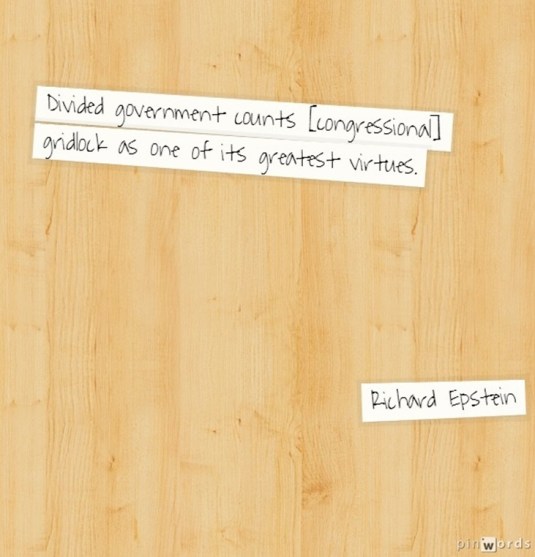
A divided government is a weak government


Image

Previous Older Entries Next Newer Entries

Bassett, Brash & Hide

Celebrating humanity's flourishing through the spread of capitalism and the rule of law

Truth on the Market

Scholarly commentary on law, economics, and more

The Undercover Historian

Beatrice Cherrier's blog

Matua Kahurangi

Celebrating humanity's flourishing through the spread of capitalism and the rule of law

Temple of Sociology

Celebrating humanity's flourishing through the spread of capitalism and the rule of law

Velvet Glove, Iron Fist

Celebrating humanity's flourishing through the spread of capitalism and the rule of law

Why Evolution Is True

Why Evolution is True is a blog written by Jerry Coyne, centered on evolution and biology but also dealing with diverse topics like politics, culture, and cats.

Down to Earth Kiwi

Celebrating humanity's flourishing through the spread of capitalism and the rule of law

NoTricksZone

Celebrating humanity's flourishing through the spread of capitalism and the rule of law

Homepaddock

A rural perspective with a blue tint by Ele Ludemann

Kiwiblog

DPF's Kiwiblog - Fomenting Happy Mischief since 2003

The Dangerous Economist

Celebrating humanity's flourishing through the spread of capitalism and the rule of law

Watts Up With That?

The world's most viewed site on global warming and climate change

The Logical Place

Tim Harding's writings on rationality, informal logic and skepticism

Doc's Books

A window into Doc Freiberger's library

The Risk-Monger

Let's examine hard decisions!

Uneasy Money

Commentary on monetary policy in the spirit of R. G. Hawtrey

Barrie Saunders

Thoughts on public policy and the media

Liberty Scott

Celebrating humanity's flourishing through the spread of capitalism and the rule of law

Point of Order

Politics and the economy

James Bowden's Blog

A blog (primarily) on Canadian and Commonwealth political history and institutions

Science Matters

Reading between the lines, and underneath the hype.

Peter Winsley

Economics, and such stuff as dreams are made on

A Venerable Puzzle

"The British constitution has always been puzzling, and always will be." --Queen Elizabeth II

The Antiplanner

Celebrating humanity's flourishing through the spread of capitalism and the rule of law

Bet On It

Celebrating humanity's flourishing through the spread of capitalism and the rule of law

History of Sorts

WORLD WAR II, MUSIC, HISTORY, HOLOCAUST

Roger Pielke Jr.

Undisciplined scholar, recovering academic

Offsetting Behaviour

Celebrating humanity's flourishing through the spread of capitalism and the rule of law

JONATHAN TURLEY

Res ipsa loquitur - The thing itself speaks

Conversable Economist

Celebrating humanity's flourishing through the spread of capitalism and the rule of law

The Victorian Commons

Researching the House of Commons, 1832-1868

The History of Parliament

Articles and research from the History of Parliament Trust

Books & Boots

Reflections on books and art

Legal History Miscellany

Posts on the History of Law, Crime, and Justice

Sex, Drugs and Economics

Celebrating humanity's flourishing through the spread of capitalism and the rule of law

European Royal History

Exploring the Monarchs of Europe

Tallbloke's Talkshop

Cutting edge science you can dice with

Marginal REVOLUTION

Small Steps Toward A Much Better World

NOT A LOT OF PEOPLE KNOW THAT

“We do not believe any group of men adequate enough or wise enough to operate without scrutiny or without criticism. We know that the only way to avoid error is to detect it, that the only way to detect it is to be free to inquire. We know that in secrecy error undetected will flourish and subvert”. - J Robert Oppenheimer.

STOP THESE THINGS

The truth about the great wind power fraud - we're not here to debate the wind industry, we're here to destroy it.

Lindsay Mitchell

Celebrating humanity's flourishing through the spread of capitalism and the rule of law

Alt-M

Celebrating humanity's flourishing through the spread of capitalism and the rule of law

croaking cassandra

Economics, public policy, monetary policy, financial regulation, with a New Zealand perspective

The Grumpy Economist

Celebrating humanity's flourishing through the spread of capitalism and the rule of law

International Liberty

Restraining Government in America and Around the World