

Abundance in 2012
30 Sep 2014 Leave a comment
in economics


In 1980, Paul Ehrlich, a world famous biologist and author, accepted a bet proposed by Julian Simon, an economist. The bet was to resolve an ongoing debate about resource scarcity. Ehrlich chose five metals (copper, chromium, nickel, tin, and tungsten) and hypothetically bought $200 worth of each. If the real price of the metals increased over the following decade, Ehrlich wagered, it was an indication of increased scarcity. Simon won the bet. The real price of all five metals declined, signifying less scarcity.
Timing is everything. As demonstrated in the figure, the prices of metals wax and wane over time following an overall downward trend. Regardless, Simon’s point remains true. It is human ingenuity that prevents us from running out of resources – even finite resources. The key is not that prices continue to fall over time, rather that prices reflect consumer desires, and producers, given appropriate institutions…
View original post 50 more words
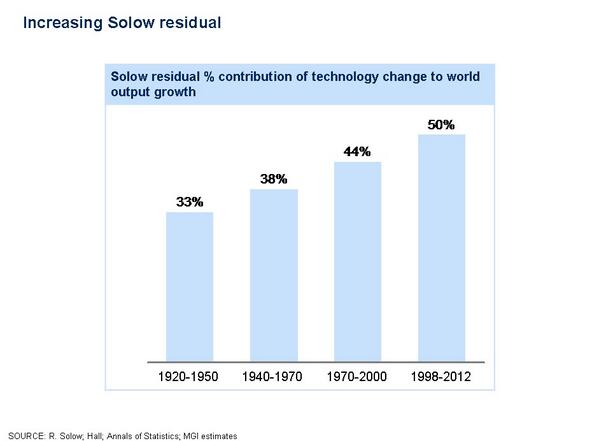
Is our economic ignorance about the sources of growth increasing?
30 Sep 2014 Leave a comment
in development economics, economic growth, growth disasters, growth miracles, macroeconomics Tags: Solow residual

The Demise of Chicago Economics 1: Philosophical Fault-Lines Evolve
30 Sep 2014 Leave a comment
in economics

A primary reason why the Chicago School played such an effective role in promoting laissez-faire capitalism throughout the third quarter of the twentieth century was the philosophical leadership provided by Friedrich von Hayek from the Committee on Social Thought and by Milton Friedman from the Department of Economics. These deep-thinking, widely-read scholars imbued the entire Chicago School program with a sound normative basis from which to direct their influential positive economic analyses.
The philosophy that drove Hayek and Friedman forward in their attack on statism and socialism in the professing of economics was not primarily a desire to maximize the wealth of a society – though that was never very far from their thinking. The fundamental driving force was a belief that individual freedom (or individual liberty) is the most highly-valued ethical goal, and an understanding that individual freedom was under severe threat from the progressive socialist agenda that was…
View original post 740 more words
Solving New Zealand Biodiversity Decline, One Possum Pelt at a Time
30 Sep 2014 Leave a comment
in economics

 The invasive possum, or paihamu, now occupies more than 99 percent of New Zealand. Introduced from Australia in 1837 from British immigrants hoping to kick start the fur industry, 50 to 70 million possums are now wreaking havoc on the ecology of the island nation. Without any natural predators, the possums eat 20,000 tons of vegetation nightly, destroy native forests and rare bird habitats, and keep homeowners awake at night with their endless shrieks.
Considered a “noxious pest” by the New Zealand government, NZ$70 million taxpayer dollars are spent annually in an attempt to control the possum. Most of the money is spent aerially spreading toxic poison, sodium fluoroacetate (1080), which indiscriminately kills other animals. While not only inhumane and ecologically maladroit, these efforts have had little success.
A group of trappers, manufacturers, and industry people have come together to reinvigorate the possum pelt market. Where the government has failed…
View original post 138 more words
An Essay on Gary Becker for the Hoover Digest
30 Sep 2014 Leave a comment
in economics

I wrote this short essay on Gary Becker for the Hoover Digest where it will appear in a forthcoming issue:
Gary Becker was “the greatest social scientist who has lived and worked in the last half century.” So declared Milton Friedman a decade ago, and when Gary Becker died earlier this month at the age of 83 the outpouring of praise from his friends and colleagues reminded us why: His unique style of economic analysis, firmly rooted in facts, yielded a host of truly amazing ideas and predictions from the growth effects of investment in human capital to recent changes in the distribution of income and intergenerational mobility. Many of his ideas—including that free competitive markets help combat discrimination and that simple cost-benefit calculations applied to children help determine fertility rates—were originally controversial, but are now widely accepted. I regularly teach them to beginning students in the Economics 1…
View original post 844 more words
Inequality Conference in Memory of Gary Becker at Stanford’s Hoover Institution
30 Sep 2014 Leave a comment
Last Thursday and Friday the Hoover Institution at Stanford hosted a wonderful Conference on Inequality in Memory of Gary Becker. John Raisian and I opened the conference commenting on the appropriateness of both the venue and the topic: Gary spent a great deal of time doing research at Hoover over the years, and he began diagnosing and recommending policy solutions to inequality problems decades ago, long before the current explosion of popular interest.
I recalled his policy advice on the issue two decades ago in a presidential campaign memo: “we have seen income distribution widen in the United States and other countries” and that reflects, he said, “a particular problem with the education and training of those at the lower end of the income distribution.” He advised that “the aim of policy reforms in this field should be to help stimulate economic growth by encouraging better quality and more…
View original post 858 more words


Why They Heart Keynes
30 Sep 2014 3 Comments
in economics

| Peter Klein |
Luigi Zingales offers Straight Talk on Keynes (via Casey Mulligan):
Keynesianism has conquered the hearts and minds of politicians and ordinary people alike because it provides a theoretical justification for irresponsible behavior. Medical science has established that one or two glasses of wine per day are good for your long-term health, but no doctor would recommend a recovering alcoholic to follow this prescription. Unfortunately, Keynesian economists do exactly this. They tell politicians, who are addicted to spending our money, that government expenditures are good. And they tell consumers, who are affected by severe spending problems, that consuming is good, while saving is bad. In medicine, such behaviour would get you expelled from the medical profession; in economics, it gives you a job in Washington.
Three comments: First, the “hangover” metaphor, while not exactly accurate, is an effective way to communicate the basics of the…
View original post 248 more words
Rent Seeking versus Rent Extraction in the Market-Place of Politics
30 Sep 2014 Leave a comment
in economics
Some economists view lobbying outlays in political markets as a manifestation of free speech – and that is just fine if one is prepared to stretch the meaning of a word or two. Surely the sweet sound of large dollar bills moving from the coffers of well-endowed interest groups into the coffers of well-endowed political parties and well-endowed individual policians is a manifestation of Amazing Grace:
Amazing grace! how sweet the sound,
that saved a wretch like me!
I once was lost but now am found,
was blind but now I see.
Through many dangers, tolls, and snares,
I have already come;
’tis grace hath brought me safe thus far,
and grace will lead me home.
(John Newton, 1779)
Well grace, surely lubricates the wheels of politics, ensuring that those who give also shall receive the fruitful bounty of political harvests. Grace, of course, has nothing in common with the free lunch…
View original post 885 more words
 Utopia, you are standing in it!
Recent Comments