Productivity Pessimism from Productivity Optimists

dvollrath's avatarThe Growth Economics Blog

The projected future path of labor productivity in the U.S. is perhaps the most important input to the projected future path of GDP in the U.S. There are lots of estimates floating around, many of them pessimistic in the sense that they project labor productivity growth to be relatively slow (say 1.5-1.8% per year) over the next few decades compared to the relatively fast rates (roughly 3% per year) seen from 1995-2005. Robert Gordon has laid out the case for low labor productivity growth in the future. John Fernald has documented that this slowdown probably pre-dates the Great Recession, and reflects a loss of steam in the IT revolution starting in about 2007. This has made Brad DeLong sad, which seems like the appropriate response to slowing productivity growth.

An apparent alternative to that pessimism was published recently by Byrne, Oliner, and Sichel. Their paper is titled “Is the…

View original post 882 more words

The science news cycle

Image

Is the Rockerfeller dynasty backing a winner?

image

Image

How did I ever survive my childhood

image

Image

The spirit level approach to data analysis

image

Image

Playing the man and not the ball in research evaluation

image

Image

It’s time to stop the climate scare stories

Allergies, vaccinations and externalties

image

Image

Hong Kong Wrong – What would Cowperthwaite say?

iampaulng's avatarIts Paul


Just wanna share an article that wrote by MILTON FRIEDMAN back in the days.

Hong Kong Wrong – What would Cowperthwaite say? 

BY MILTON FRIEDMAN
Friday, October 6, 2006 12:01 a.m. EDT

It had to happen. Hong Kong’s policy of “positive noninterventionism” was too good to last. It went against all the instincts of government officials, paid to spend other people’s money and meddle in other people’s affairs. That’s why it was sadly unsurprising to see Hong Kong’s current leader, Donald Tsang, last month declare the death of the policy on which the territory’s prosperity was built.

The really amazing phenomenon is that, for half a century, his predecessors resisted the temptation to tax and meddle. Though a colony of socialist Britain, Hong Kong followed a laissez-faire capitalist policy, thanks largely to a British civil servant, John Cowperthwaite. Assigned to handle Hong Kong’s financial affairs in 1945, he rose through the ranks…

View original post 411 more words

How to Tell If You Should Trust Your Statistical Models

We Can’t Talk About Inequality Without Talking About Talent

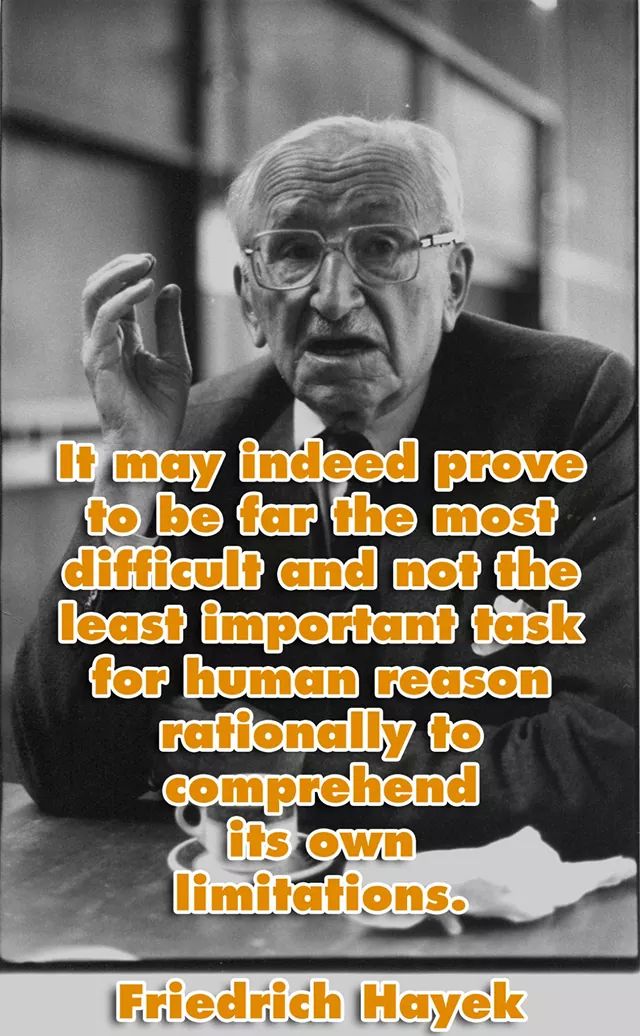
Hayek and the limits of knowledge

image

Image

The Key to victory: Run against Piketty-nomics, Scott Sumner | EconLog | Library of Economics and Liberty

This is good news:

New Zealand’s NZX 50 Index increased 1.1 percent, driven higher by power-company stocks, after John Key won a third term as prime minister. Key, a former head of foreign exchange at Merrill Lynch & Co., led his National party to a 48 percent victory in New Zealand’s weekend election, securing the first single-party majority in the South Pacific nation’s parliament since at least 1996. The main opposition Labour Party, which wanted to introduce a tax on capital gains and raise the minimum wage, suffered its worst defeat since 1922.
Perhaps Labour got their ideas from Paul Krugman.

When right-of-center parties are elected, they generally disappoint. Although right-of-center economists favor free markets, most conservative politicians do not. Abe (Japan) and Modi (India) are two recent examples of conservatives who promised reforms and failed to come through (thus far). Fortunately New Zealand is different.

Via http://econlog.econlib.org/archives/2014/09/the_key_to_vict.html

The difficulty of bureaucratic reform, India edition

Robin's avatarCherokee Gothic

I just found an interesting NBER working paper (gated) looking at the frustrations of trying to reform the Indian bureaucracy.  The paper is titled “Deal with the Devil: The Successes and Limitations of Bureaucratic Reform in India” and is written by Iqbal Dhaliwal and Rema Hanna.

It reinforces the argument that technology is no panacea in these types of reform. There seems to be no easy answers or shortcuts to bringing about real reform. Here is a shortened version of their abstract:

Employing a technological solution to monitor the attendance of public-sector health care workers in India resulted in a 15 percent increase in the attendance of the medical staff. Despite initiating the reform on their own, there was a low demand among all levels of government–state officials, local level bureaucrats, and locally-elected bodies—to use the better quality attendance data to enforce the government’s human resource policies due to a fear of generating…

View original post 73 more words

What Is The Difference Between ISIS and Al Qaeda?

Sandeep Baliga's avatarCheap Talk

Excellent article by Lawrence Wright:

Al Qaeda was originally envisioned as a kind of Sunni foreign legion, which would defend Muslim lands from Western occupation….

Bin Laden had asked Zarqawi [founder of ISIS] to merge his forces with Al Qaeda, in 2000, but Zarqawi had a different goal in mind. He hoped to provoke an Islamic civil war, and, for his purposes, there was no better venue than the fractured state of Iraq, which sits astride the Sunni-Shiite fault line….Violent attacks would create a network of “regions of savagery,” which would multiply as the forces of the state wither away, and cause people to submit to the will of the invading Islamist force….[A] broad civil war within Islam would lead to a fundamentalist Sunni caliphate.

In other words, Al Qaeda is focussed on expelling the West from the Middle East but ISIS is focussed on creating a Sunni Islamic superstate. Hence…

View original post 71 more words

Previous Older Entries Next Newer Entries

Bassett, Brash & Hide

Celebrating humanity's flourishing through the spread of capitalism and the rule of law

Truth on the Market

Scholarly commentary on law, economics, and more

The Undercover Historian

Beatrice Cherrier's blog

Matua Kahurangi

Celebrating humanity's flourishing through the spread of capitalism and the rule of law

Temple of Sociology

Celebrating humanity's flourishing through the spread of capitalism and the rule of law

Velvet Glove, Iron Fist

Celebrating humanity's flourishing through the spread of capitalism and the rule of law

Why Evolution Is True

Why Evolution is True is a blog written by Jerry Coyne, centered on evolution and biology but also dealing with diverse topics like politics, culture, and cats.

Down to Earth Kiwi

Celebrating humanity's flourishing through the spread of capitalism and the rule of law

NoTricksZone

Celebrating humanity's flourishing through the spread of capitalism and the rule of law

Homepaddock

A rural perspective with a blue tint by Ele Ludemann

Kiwiblog

DPF's Kiwiblog - Fomenting Happy Mischief since 2003

The Dangerous Economist

Celebrating humanity's flourishing through the spread of capitalism and the rule of law

Watts Up With That?

The world's most viewed site on global warming and climate change

The Logical Place

Tim Harding's writings on rationality, informal logic and skepticism

Doc's Books

A window into Doc Freiberger's library

The Risk-Monger

Let's examine hard decisions!

Uneasy Money

Commentary on monetary policy in the spirit of R. G. Hawtrey

Barrie Saunders

Thoughts on public policy and the media

Liberty Scott

Celebrating humanity's flourishing through the spread of capitalism and the rule of law

Point of Order

Politics and the economy

James Bowden's Blog

A blog (primarily) on Canadian and Commonwealth political history and institutions

Science Matters

Reading between the lines, and underneath the hype.

Peter Winsley

Economics, and such stuff as dreams are made on

A Venerable Puzzle

"The British constitution has always been puzzling, and always will be." --Queen Elizabeth II

The Antiplanner

Celebrating humanity's flourishing through the spread of capitalism and the rule of law

Bet On It

Celebrating humanity's flourishing through the spread of capitalism and the rule of law

History of Sorts

WORLD WAR II, MUSIC, HISTORY, HOLOCAUST

Roger Pielke Jr.

Undisciplined scholar, recovering academic

Offsetting Behaviour

Celebrating humanity's flourishing through the spread of capitalism and the rule of law

JONATHAN TURLEY

Res ipsa loquitur - The thing itself speaks

Conversable Economist

Celebrating humanity's flourishing through the spread of capitalism and the rule of law

The Victorian Commons

Researching the House of Commons, 1832-1868

The History of Parliament

Articles and research from the History of Parliament Trust

Books & Boots

Reflections on books and art

Legal History Miscellany

Posts on the History of Law, Crime, and Justice

Sex, Drugs and Economics

Celebrating humanity's flourishing through the spread of capitalism and the rule of law

European Royal History

Exploring the Monarchs of Europe

Tallbloke's Talkshop

Cutting edge science you can dice with

Marginal REVOLUTION

Small Steps Toward A Much Better World

NOT A LOT OF PEOPLE KNOW THAT

“We do not believe any group of men adequate enough or wise enough to operate without scrutiny or without criticism. We know that the only way to avoid error is to detect it, that the only way to detect it is to be free to inquire. We know that in secrecy error undetected will flourish and subvert”. - J Robert Oppenheimer.

STOP THESE THINGS

The truth about the great wind power fraud - we're not here to debate the wind industry, we're here to destroy it.

Lindsay Mitchell

Celebrating humanity's flourishing through the spread of capitalism and the rule of law

Alt-M

Celebrating humanity's flourishing through the spread of capitalism and the rule of law

croaking cassandra

Economics, public policy, monetary policy, financial regulation, with a New Zealand perspective

The Grumpy Economist

Celebrating humanity's flourishing through the spread of capitalism and the rule of law

International Liberty

Restraining Government in America and Around the World