
A response to Judith Sloan on monopsony
11 Oct 2014 Leave a comment
in economics, labour economics, minimum wage Tags: Alan Manning, minimum wage, monopsony, search and matching
In the monopsony view view, search frictions in the labour market generate upward sloping labour supply curves to individual firms even when firms are small relative to the labour market.
Peter Kuhn in a great review of monopsony in motion pointed out the correct title was search fictions with wage posting and random matching in motion.This precision is important because, as Kuhn goes on to say:
“Manning clearly recognizes this weakness of search-based monopsony models, and does his best to address it in his discussion of ‘random’ vs. ‘balanced’ matching on pages 284–96. Manning’s basic general-equilibrium monopsony model, set out in chapter 2, assumes ‘random matching’, which means that, regardless of its size, every firm—from the local bakery to Microsoft—receives the same absolute number of job applications per period. The only way for a firm to expand its scale of operations in this model is to offer a higher wage… it is absolutely critical to the search-based monopsony model at the core of this book that there be diminishing returns to scale in the technology for recruiting new workers. In other words, for the theory to apply, firms must find it harder to recruit a single new worker the larger the absolute number of workers they currently employ.”
The evidence in favour of the monopoly view of minimum wage is is not as good as people think.
Under this monopsony view of minimum wages – an upward sloping supply curve of labour – an increase in the minimum wage increases both wages and employment.
That is, there is a very specific joint hypothesis of both more employment and more wages and as there are more workers in the workplace, higher output which the employer can only sell by cutting their prices.
David Henderson made very good points along this line when he reviewed David Card’s book back in 1994:
Interestingly, Card’s and Krueger’s own data on price contradict one of the implications of monopsony. If monopsony is present, a minimum wage can increase employment. These added employees produce more output. For a given demand, therefore, a minimum wage should reduce the price of the output. But Card and Krueger find the opposite. They write: ‘[P]retax prices rose 4 percent faster as a result of the minimum-wage increase in New Jersey…’ (p. 54). If their data on price are to be believed, they have presented evidenceagainst the existence of monopsony. David R. Henderson, “Rush to Judgment,”MANAGERIAL AND DECISION ECONOMICS, VOL. 17, 339-344 (1996)
THOUGHT ECONOMICS: INTERVIEWS WITH THE WORLD’S LEADING THINKERS Edmund Phelps
11 Oct 2014 Leave a comment
in economics
James Heckman: An Economist who Promotes Preschool
11 Oct 2014 Leave a comment
in economics

 Photo: Micaela Bedell for Strategies for Children
Just as the New England Patriots have an award-winning hero in quarterback Tom Brady, early education has a Nobel Prize-winning champion in University of Chicago economist James Heckman.
Heckman’s public policy position is simple and powerful: To make society stronger, invest in early childhood development. Drawing on more than a decade of his own research, Heckman argues that high-quality preschool prepares children to succeed and makes them less likely to enroll in special education classes, become pregnant as teenagers or land in jail.
In addition to a clear message, Heckman is an effective messenger. He’s quoted in newspaper stories, and he has a pervasive social media presence, making his case on his website, as well as on Facebook, Twitter and YouTube.
“What I learned that became so important,” he explains in one his videos, “was that investing in people…
View original post 605 more words
Job Market Idea Explained In A Picture
11 Oct 2014 Leave a comment
in economics

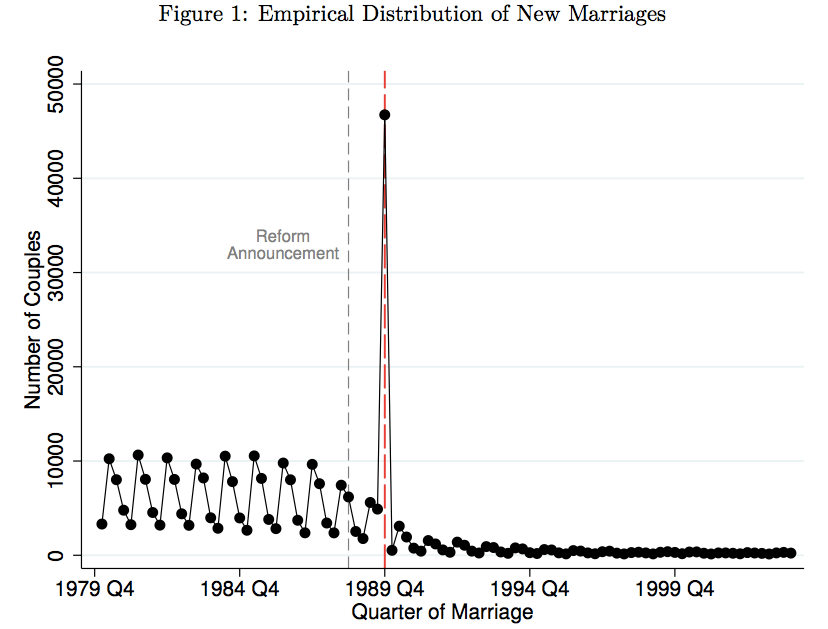
In June of 1988 in Sweden it was announced that survivorship benefits, a sort of government provided life insurance paid to a wife whose husband dies, would be discontinued. There was one interesting exception: an unmarried couple with a child together born before the change could take up survivorship insurance if they married before Jan 1 1990. The spike in new marriages in the graph shows the response to this incentive.
That’s the basis for Petra Persson‘s job market paper. Petra points out that the spike is somewhat mysterious because for all of these couples the promise of survivorship insurance wasn’t enough to induce them to marry previously and only when the option was going to disappear did they exercise it.
Of course some of these new marriages were couples that planned eventually to marry (and take up benefits) and who moved their marriage date earlier. But Petra credibly…
View original post 325 more words
Thomas Schelling on Climate Change
11 Oct 2014 Leave a comment
in economics

Writing about the Tangled Web, Atanu Dey (his new series 1, 2, 3, 4, 5 and more to come) points to the work of Thomas Schelling.
Thomas Schelling is the 2005 Nobel Prize winning Economist for “having enhanced our understanding of conflict and cooperation through game-theory analysis.”
Atanu points to a quote in an article by Tim Harford: “. . . his work treats human frailties as something to be analysed and worked with, rather than denounced or denied.”
Atanu concludes, “That lies at the crux of a multitude of failures. People don’t fully appreciate the fact that what we have is frail human nature and if we refuse to confront reality, we are likely to make public policies that are wrong-headed and disastrous because they are built upon fairy-tale visions of human nature.”
Discussing and reading about the environmental issues I have come…
View original post 1,943 more words
Iran: You Cannot Bomb Knowledge and Technical Expertise
11 Oct 2014 Leave a comment
in economics

Very wise piece on the complexities of negotiating with Iran by Philip Stephens in today’s UK Financial Times.

The who-said-what game about last weekend’s talks in Geneva has become a distraction. The six-power negotiations with Tehran to curb Iran’s nuclear programme may yet succeed or fail. But wrangling between the US and France on the terms of an acceptable deal should not allow the trees to obscure the forest. The organising facts shaping the negotiations have not changed.
The first of these is that Tehran’s acquisition of a bomb would be more than dangerous for the Middle East and for wider international security. It would most likely set off a nuclear arms race that would see Saudi Arabia, Turkey and Egypt signing up to the nuclear club. The nuclear non-proliferation treaty would be shattered. A future regional conflict could draw Israel into launching a pre-emptive nuclear strike…
View original post 874 more words
“The brink is a curved slope”: Thomas Schelling on strategy
11 Oct 2014 Leave a comment
in economics

I’ve been re-reading some Thomas Schelling, and reminded of how much insight there is on nearly every paragraph of every page (as has been said: “whole careers in international relations have been built out of codifying a few sentences in Schelling”).
Some excerpts, below.
First, The Strategy of Conflict (1960):
On the (then) paucity of strategic studies:
“[M]ilitary services, in contrast to almost any other sizable and respectable profession, have no identifiable academic counterpart … Within the universities, military strategy in this country has been the preoccupation of a small number of historians and political scientists, supported on a scale that suggests that deterring the Russians from a conquest of Europe is about as important as enforcing the antitrust laws”. (p8)
On trying to persuade someone you’ll carry out an irrational threat:
“And one can suspend or destroy his own “rationality”, at least to a limited extent; one can…
View original post 1,446 more words
“There is no such thing as macroeconomics.”
11 Oct 2014 Leave a comment
in economics

by Jerry O’Driscoll
Not my words, but those of Armen Alchian, as reported by William Allen in Econ Journal Watch. Allen has written his memoirs and a history of UCLAs economics department in “A Life Among the Econ, Particularly at UCLA.” To a great extent, it is the story of Alchian and the core group around him in the 1950s, 60s and 70s. Allen was co-author with Alchian of University Economics, an influential undergraduate textbook that inspired Paul Heyne’s Economic Way of Thinking.
My own way of thinking was influenced as much by the UCLA tradition as by Mises and Hayek. Mises and Hayek had an important influence on that tradition, however. An emphasis on decision making under uncertainty and incomplete information was its hallmark. All social phenomena could be analyzed by economics, and the economic analysis was micro.
Alchian didn’t deny there were aggregate economic phenomena, only…
View original post 79 more words
The Fate of Dictators
11 Oct 2014 Leave a comment
There was in Wilno a historical marker, alongside the Moscow road, that
read
“On 28 June, 1812, Napoleon Bonaparte passed this way with 45 0,000
men.”
Then, on the other side, approached from the east, was a different
message:
“On 9 December, 1812, Napoleon Bonaparte passed this way with
900 men.”
–Alan Furst, “The Polish Officer” (1995)

What Is Austrian Economics?
11 Oct 2014 Leave a comment
in economics
by Mario Rizzo
Many years ago (around 1982, I think) Jerry O’Driscoll and I wrote a paper that was the basis of an American Economic Association session. The paper was called “What is Austrian Economics?” The paper gradually evolved into our book, The Economics of Time and Ignorance.
The purpose of this book was to present Austrian economics in an updated fashion. To do this we needed to do two things: (1) uncover many of the fundamental ideas implicit in the tradition but not, as of then, sufficiently elaborated or made explicit; and (2) confront Austrian ideas with recent developments in economics, both mainstream and outside of the mainstream.
We faced many initial negative criticisms of the book. I will say that I was very disappointed by some of the old-guard reaction to the book. But do not confuse “old guard” with age because some of the greatest encouragement…
View original post 718 more words
Karl Popper and Thomas Kuhn’s Top Ten Conflict Tips
11 Oct 2014 Leave a comment
in economics
Karl Popper (1902-94) and Thomas Kuhn (1922-96)
One interesting intellectual tradition that contributes to conflict work is the Philosophy of Science especially as developed by Karl Popper and Thomas Kuhn. I have wondered what they would have come up with if they had attempted to consense what advice they come up with on conflict handling:
- Set out to test and disprove your theory of reality
- Know that your existing paradigm may be wrong, but that you are probably going to operate within it unless and until a better theory comes along
- Crises for your theories are what drive improved understanding of reality along, so crisis is good in the long haul
- The critical first step in any conflict is the recognition that we have paradigms, rather than certain error free grip on reality, and we need to test them to get real about the conflict.
- Knowledge has a strong…
View original post 356 more words
Spending Cuts and Politics of Bureaucracy
11 Oct 2014 Leave a comment
in economics

by Chidem Kurdas
I just read The Politics of Bureaucracy by Gordon Tullock, one of the best books written on the behavior of bureaucrats. Although originally published in 1965, it remains very much relevant today, especially as the debt deal currently in Congress could bring spending caps on programs administered by numerous bureaucracies. These entities implement policy changes, yet efforts to rein in government spending or impose new regulation typically pay little or no attention to their behavior.
Professor Tullock derives his insights from the basic observation that when embedded in an administrative hierarchy that is supposed to serve some – typically vague – public interest, people remain individuals; they still have their own preferences and interests. This is nicely expressed in the foreword by James Buchanan, who paraphrases Adam Smith’s well-known dictum about the butcher, the brewer or the baker. I will further paraphrase his take on Smith: “It…
View original post 529 more words

 Utopia, you are standing in it!
Recent Comments