Gullible gaijin (外人), especially those in the foreign media, foreign ministries and academia think that the bureaucrats rule Japan. Nothing could be further from the truth.
I’ll illustrate this first with the way in which the ruling Liberal Democratic Party (LDP) in Japan exercises a tight control over the courts.
Judges in Japan are career judges starting straight out of a specialised Law School for trainee judges in their late 20s as an assistant judge with various promotions all the way to the top to various courts with different jurisdictions in different places in Japan.
Control over transfers between courts in different parts of Japan as well as over promotions is the key to making sure judges know what is required of them and punishing those judges who step out of line.
Japanese lower court judges are reassigned every three years to different courts in different parts of the country. Most Japanese judges find administrative duties prestigious and branch office assignments embarrassing.
The judicial secretariat supervised by the Supreme Court can moves judges up and down the hierarchy from the High Courts (the courts of appeals) to the District Courts (the trial courts) to the Family Courts and to the branch offices of the District and Family Courts. It routinely sends judges to less prestigious postings. Supreme Court judges are appointed directly by the government in their 60s and must retire at the age of 70.
- Like the vast majority of other professionals, Japanese judges want to live in Tokyo if possible, and in Osaka if not.
- If a difficult judges is posted to the north of Japan, which is next to Siberia, they must leave their family behind because of the need to go to good schools and universities.
Every Japanese judge knows that when they are reassigned, the next reassignment is not necessarily as prestigious as the last, depending on how they rule in contentious cases.
J. Mark Ramseyer and Eric B. Rasmusen have written several very good papers and a book on this topic of judicial independence, or more correctly, the lack of judicial independence in Japan.
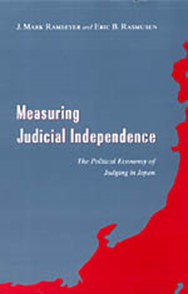
Lower court judges defer to the wishes of the LDP on sensitive political questions because they will do better in their careers. Japan has a judicial career structure that rewards and punishes judges according to their work product, including their rulings in sensitive political cases.
Ramseyer and Rasmusen reviewed the quality of the assignments of 400 judges after deciding politically charged cases, holding constant proxies for effort, intelligence, seniority, and political bias. These political sensitive cases involve judges:
- who held the Self-Defence Force or U.S. bases unconstitutional;
- rejected national electoral apportionment schemes advantageous to the LDP; and
- enjoined the national government in administrative law suits.
Ramseyer and Rasmusen found that judges who defer to the LDP in politically disputes do better in their career assignments than those who do not. Similarly, judges who grant injunctions against the national (but not local) government have less successful careers.
This distinction is important because the national government wants to keep local governments in line with the laws they pass. This differentiation between issuing injunctions against local governments, but not the national government, shows the detail at which judicial decisions are controlled by the ruling party through favourable assignments and promotions.
Ramseyer and Rasmusen also found that:
- judges who joined a communist-leaning bar organization in the 1960s had fewer administrative postings than those who did not join;
- judges who consistently convicted criminal defendants spent less time in branch offices than those who occasionally acquitted;
- judges who found their tax opinions reversed on appeal had fewer administrative assignments and more branch office postings than those without such reversals; and
- judges who held a ban on door-to-door canvassing unconstitutional suffered in their careers.
If the national government, the ruling LDP, exercises such close control over the courts, it would be surprising that they let the bureaucracy tell them what to do.
The LDP controls the bureaucracy, even though it isn’t apparent, as explained by Mark Ramseyer.

The most reliable agent for your interests is the agent who thinks he in charge because the face has grown to fit the mask. Ramseyer as pointed out that a bureaucracy would act the same whether
- it were completely independent or
- it were doing only what the LDP wants (i.e. observational equivalence).
Ramseyer and Rosenbluth argue that the institutional framework of government – the rules of the game among political players – decisively shapes the character of political competition and incentives in Japan.
The ruling LDP works within Japanese electoral rules to maximize its success with voters, and within constitutional constraints to enforce its policies on bureaucrats and judges.
The LDP has several ways of keeping the bureaucracy under control:
- They can easily veto any bureaucratic actions;
- They have control over promotion;
- They encourage dissatisfied constituents to report complaints to the LDP;
- Would-be politicians work in the bureaucracy and have to please the party if they want to run;
- Ministries compete for policy influence;
- The LDP requires “large portions of [bureaucrats’] lifetime earnings as bonds contingent on faithful performance” through their control of post-retirement jobs.
The LDP keeps bureaucratic action closely in line with its preferences through the control of promotions and three yearly transfers and by encouraging intense rivalry between ministries.
Bureaucrats who do as they are told and anticipate the needs of their political masters in the LDP get the best transfers and are promoted to the top and then win the best post-retirement positions.
Japanese bureaucrats start retiring in their mid 40s so having a favourable post retirement job is vital. The Japanese system is based on back loading of pay. This is a well-known system for ensuring fidelity of agents where effort and performance is more difficult to monitor.
The main payoff been a bureaucrat in Japan is the prize at the end of the road. This prize will be denied for you if you step out of line, don’t do as you’re told and don’t know what is required of you.
My political science professor in Japan at the National Graduate Institute of Policy Studies (GRIPS) introduced me to the work of Mark Ramseyer in 1996. Ramseyer is completely fluent in Japanese and writes in Japanese as well as English on law and economics.
 Utopia, you are standing in it!
Recent Comments