We all want the best. The best surgeon, the best TV shows, our favourite sports team, and the best lawyer. We will pay top dollar to get these stars.
In the last few decades, the top performers in many fields have earned extraordinarily large increases in wages, royalties and other forms of income. The top dogs in every field are paid many times more than the top dogs were paid a couple of decades ago.
Sport is an obvious example where cricketers in the early 1970s were paid $200 a test, with six tests per season, but are now paid $1 million a year.
In the past, a successful athlete might hope for an upper middle-class income and some savings for their retirement, which may come early due to injury.
Now, the top athletes in the sports that get on television are seriously rich and are among the richest in the world – athletes and celebrities are genuine members of the top 1%.
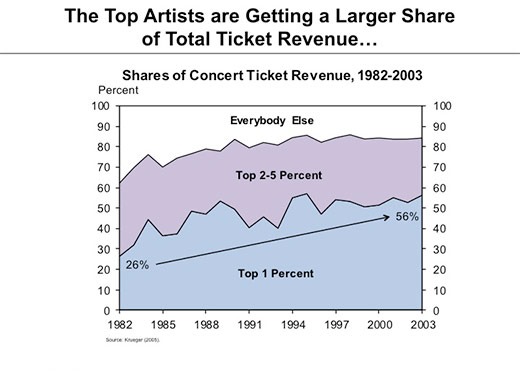
This wage effect is called the superstar effect and is a major driver of income inequality in our time. Superstar wages and income arise in markets that have two characteristics:
1. Every customer wants to enjoy the good supplied by the best producer; and
2. The good or service is produced with a technology that makes it possible for the best producer to supply additional customer at a low cost.
If it becomes much easier for the best of the best in a field to supply their services to a much larger market, these superstars will be paid a lot more than before.
Two economists pioneered the analysis of the superstar wages. The first was Alfred Marshall in 1890; the second was Sherwin Rosen in 1981. Marshall used verbal reasoning; Rosen use sophisticated mathematics.
Marshall’s explanation is easier to understand. Rosen’s mathematics allowed him to be credited for discovering and making sure that the phenomena of superstar wages stayed discovered by economists.
Marshall, by the way, was a critic of mathematics. In 1906, he wrote about his skepticism regarding the use of mathematics in economics:
[I had] a growing feeling in the later years of my work at the subject that a good mathematical theorem dealing with economic hypotheses was very unlikely to be good economics: and I went more and more on the rules –
(1) Use mathematics as a shorthand language, rather than an engine of inquiry.
(2) Keep to them till you have done.
(3) Translate into English.
(4) Then illustrate by examples that are important in real life.
(5) Burn the mathematics.
(6) If you can’t succeed in (4), burn (3). This last I did often.”
Rosen was one of the greatest labour economists of this century. He examined the economics of superstars to determine why
"relatively small numbers of people earn enormous amounts of money and seem to dominate the fields in which they engage.
Rosen argued that in superstar markets:
small differences in talent at the top of the distribution will translate into large differences in revenue… sellers of higher talent charge only slightly higher prices than those of lower talent, but sell much larger quantities; their greater earnings come overwhelmingly from selling larger quantities than from charging higher prices
Those who have above-average talent should earn more because consumers prefer to do more business with them. Consumer preferences dictate that small differences in talent become magnified in large earnings differences. For example, if a surgeon were 10 percent more successful in saving lives, most would be willing to pay more than a 10 percent premium for his services.
Preferences for the best are incapable of explaining the other aspect of the superstar phenomenon: the marked concentration of output (and rewards) on those few sellers who have the most talent.
This something else is technology rather than by tastes. The key is in many instances, one consumer’s consumption of the service does not reduce its availability to other consumers.
A performer or an author must put out more or less the same effort whether 10 or 1,000 or 1 million people show up in the (TV) audience or buy their book. This scale economy allows a few sellers to service the entire market – and the fewer that are needed to serve it, the more they can earn.
This scale economy is limited without the technology to mass duplicate their performance. Films, radio, television, records and CDs and other changes in technology have increased the scope of each performer’s audience. The top performers can reach much larger markets at little additional cost in the digital age.
Marshall had a very simple explanation for the superstar effect on wages, which had already emerged in the 19th century. Marshall explained that technology has greatly extended the power and reach of the most gifted performers.
Marshall referred to the British opera singer Elizabeth Billington. She had a strong voice that did not have access to a microphone or amplifier in 1798, let alone to CDs and the Internet. Elizabeth Billington could only reach a small audience. This limited her ability to dominate the market in the way artists do today.
The microphone was the first manifestation of the superstar effect in the entertainment industry. The architecture of theatres throughout the ages has spent an immense amount of time working out ways to amplify the voices of performers so more people could watch at little extra cost.
Throughout the Industrial Revolution, technological changes would allow the best performers in a given field to serve bigger markets and reap a greater share of its revenue.
A range of technological developments has largely favoured the very top performers in recent years.
Each communications and information technology breakthrough allowed the very top entertainment acts to reach a larger fan base and a bigger share of concert revenue. The second-best are paid not much at all because everyone preferred to buy the best and can do so at a very low cost. The best of the best are, in consequence, handsomely rewarded.
 Utopia, you are standing in it!
Recent Comments