GDP at PPP by population shares
20 Jan 2015 Leave a comment
The purse of the one percent | The Economist
20 Jan 2015 Leave a comment
in applied price theory, applied welfare economics Tags: top 1%

The response of biologists to creation theory as compared to climate alarmism
20 Jan 2015 Leave a comment
in economics of education, environmental economics, global warming, movies Tags: climate alarmism, conjecture and refutation, Inherit the Wind, JS Mill, persuasion, Socratic questions
Biologists spent great effort over many decades to rebut creation science is a cold methodical manner designed to change minds through facts and reasoned arguments. Insults and conceit give peoples excuses to not listen.
Labels like denier and alarmist are not conducive for scientists to change their minds or decide they were right in the first place, and that such unpleasantness encourages many to choose other careers or fields of study.
It is better to ask your interlocutor to think more deeply about this or that point that is in debate. Look for common ground that already exists and for a growing number of important anomalies and puzzles their current way of thinking cannot explain. Knowledge grows through critical discussion, not by consensus and agreement.
J.S. Mill pointed out that critics who are totally wrong still add value because they keep you on your toes and sharpened both your argument and the communication of your message.
If the righteous majority silences or ignores its opponents, it will never have to defend its belief and over time will forget the arguments for it.
As well as losing its grasp of the arguments for its belief, J.S. Mill adds that the majority will in due course even lose a sense of the real meaning and substance of its belief.
What earlier may have been a vital belief will be reduced in time to a series of phrases retained by rote. The belief will be held as a dead dogma rather than as a living truth.
Beliefs held like this are extremely vulnerable to serious opposition when it is eventually encountered. They are more likely to collapse because their supporters do not know how to defend them or even what they really mean.
J.S. Mill’s scenarios involves both parties of opinion, majority and minority, having a portion of the truth but not the whole of it. He regards this as the most common of the three scenarios, and his argument here is very simple.
To enlarge its grasp of the truth the majority must encourage the minority to express its partially truthful view.
Three scenarios – the majority is wrong, partly wrong, or totally right – exhaust for Mill the possible permutations on the distribution of truth, and he holds that in each case the search for truth is best served by allowing free discussion.
Mill thinks history repeatedly demonstrates this process at work and offered Christianity as an illustrative example. By suppressing opposition to it over the centuries Christians ironically weakened rather than strengthened Christian belief, and Mill thinks this explains the decline of Christianity in the modern world. They forgot why they were Christians.
Going on about how climate science is settled and the debate is over is bad tactics for the climate alarmists.
Attempts to close the debate this way provokes suspicion among those who expect some attempt to persuade them rather than to instruct them from on high.
Presumptuousness is never a good influencing strategy nor is dismissiveness. Listen here you stupid dupe of corrupt corporate lackeys converts few.
Most know that the defining feature of the growth of knowledge is knowledge grows and that is often by displacing the received wisdom. These instincts come well before any knowledge is required by the philosophy and sociology of science.

Darrow’s polite and careful cross-examination of Bryan in that great movie Inherit the Wind persuaded many to reject religious-based opposition to the theory of evolution. He asked questions and was very polite. The movie was Spencer Tracy at his finest and in black and white.
The Modern Office and Timeless Tips for ‘Simple Sabotage’
20 Jan 2015 Leave a comment
in labour economics, managerial economics, organisational economics, personnel economics Tags: sabotage

- Managers and Supervisors: To lower morale and production, be pleasant to inefficient workers; give them undeserved promotions. Discriminate against efficient workers; complain unjustly about their work.
- Employees: Work slowly. Think of ways to increase the number of movements needed to do your job: use a light hammer instead of a heavy one; try to make a small wrench do instead of a big one.
- Organizations and Conferences: When possible, refer all matters to committees, for “further study and consideration.” Attempt to make the committees as large and bureaucratic as possible. Hold conferences when there is more critical work to be done.
- Telephone: At office, hotel and local telephone switchboards, delay putting calls through, give out wrong numbers, cut people off “accidentally,” or forget to disconnect them so that the line cannot be used again.
- Transportation: Make train travel as inconvenient as possible for enemy personnel. Issue two tickets for the same seat on a train in order to set up an “interesting” argument.
Will $20-$59 be the new price range for oil? Some insights from micro and game theory
20 Jan 2015 Leave a comment
in economics

Good piece by Anatole Kaletsky (Chief Economist and Co-Chairman of Gavekal Dragonomics and Chairman of the Institute for New Economic Thinking).
Even if his prediction of $20-$50 goes false, one can always apply micro concepts (and game theory) on oil industry as he has done:
Having fallen from $100 to $50, the oil price is now hovering at exactly this critical level. So should we expect $50 to be the floor or the ceiling of the new trading range for oil?
Most analysts still see $50 as a floor – or even a springboard, because positioning in the futures market suggests expectations of a fairly quick rebound to $70 or $80. But economics and history suggest that today’s price should be viewed as a probable ceiling for a much lower trading range, which may stretch all the way down toward $20.
To see why, first consider the ideological irony at…
View original post 771 more words
Thomas Sowell Dismantles Feminism and Racialism
20 Jan 2015 Leave a comment
in discrimination, gender, human capital, labour economics, labour supply, occupational choice Tags: gender wage you, labour economics, racial discrimination, racial wage gap, sex discrimination, Thomas Sowell
Julian Simon–The Ultimate Resource II: People, Materials, and Environment–Videos
20 Jan 2015 Leave a comment
in economics

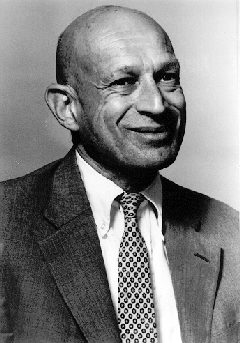
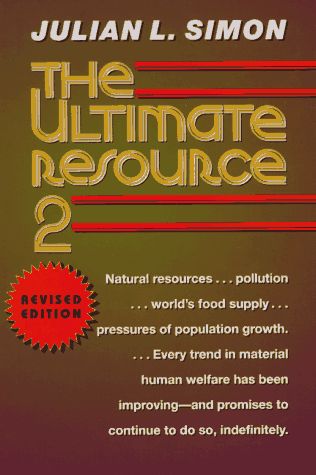
The Ultimate Resource II: People, Materials, and Environment
http://www.juliansimon.org/writings/Ultimate_Resource/
“The world’s problem is not too many people, but lack of
political and economic freedom. Powerful evidence comes from pairs
of countries that had the same culture and history and much the
same standard of living when they split apart after World War II —
East and West Germany, North and South Korea, Taiwan and China. In
each case the centrally planned communist country began with less
population “pressure”, as measured by density per square kilometer,
than did the market-directed economy. And the communist and non-
communist countries also started with much the same birth rates.
But the market-directed economies performed much better
economically than the centrally-planned economies. This powerful
demonstration cuts the ground from under population growth as a
likely explanation of poor economic performance. …”
~Julian Simon, The Ultimate Resource II: People, Materials, and Environment
http://www.juliansimon.org/writings/Ultimate_Resource/
http://www.juliansimon.org/writings/Ultimate_Resource/TINTRO.txt
The…
View original post 2,013 more words

Offsetting behaviour alert: only fools and politicians would believe that a minimum wage increase increases net pay and conditions
20 Jan 2015 1 Comment
in income redistribution, labour economics, minimum wage Tags: minimum wage, offsettinh behaviour, The fatal conceit, unintended consequences
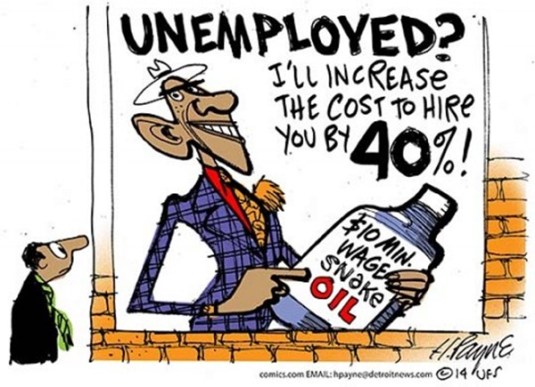
John Schmitt lists 11 margins along which a minimum wage might cause changes in net pay and conditions:
- Reduction in hours worked (because firms faced with a higher minimum wage trim back on the hours they want),
- Reduction in non-wage benefits (to offset the higher costs of the minimum wage),
- Reduction in money spent on training (again, to offset the higher costs of the minimum wage),
- Change in composition of the workforce (that is, hiring additional workers with middle or higher skill levels, and fewer of those minimum wage workers with lower skill levels),
- Higher prices (passing the cost of the higher minimum wage on to consumers),
- Improvements in efficient use of labour (in a model where employers are not always at the peak level of efficiency, a higher cost of labour might give them a push to be more efficient),
- “Efficiency wage” responses from workers (when workers are paid more, they have a greater incentive to keep their jobs, and thus may work harder and shirk less),
- Wage compression (minimum wage workers get more, but those above them on the wage scale may not get as much as they otherwise would),
- Reduction in profits (higher costs of minimum wage workers reduces profits),
- Increase in demand (a higher minimum wage boosts buying power in overall economy), and
- Reduced turnover (a higher minimum wage makes a stronger bond between employer and workers, and gives employers more reason to train and hold on to worker.
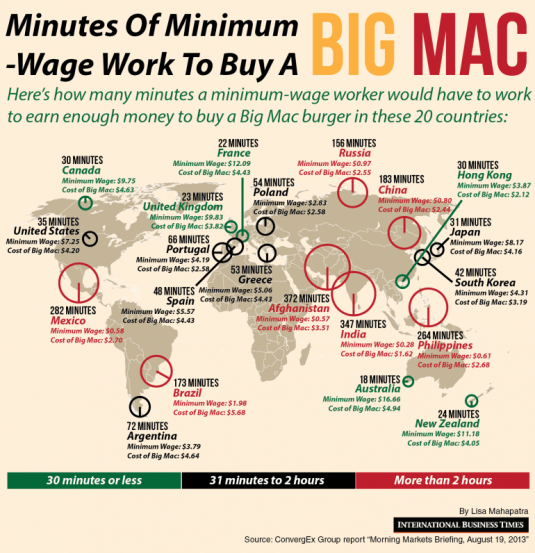
Richard McKenzie argues that the biggest impact of a minimum wage increase is reductions to paid and unpaid benefits for minimum wage workers, including health insurance, store discounts, free food, flexible scheduling, and job security resulting from higher-skilled workers drawn to the higher minimum wage jobs:
- Masanori Hashimoto found that under the 1967 minimum-wage hike, workers gained 32 cents in money income but lost 41 cents per hour in training—a net loss of 9 cents an hour in full-income compensation.
- Other researchers in independently completed studies found more evidence that a hike in the minimum wage undercuts on-the-job training and undermines covered workers’ long-term income growth.
- Wessels found that the minimum wage caused retail establishments in New York to increase work demands by cutting back on the number of workers and giving workers fewer hours to do the same work.
- Fleisher, Dunn, and Alpert found that minimum-wage increases lead to large reductions in fringe benefits and to worsening working conditions.
- Marks found that workers covered by the federal minimum-wage law were also more likely to work part time, given that part-time workers can be excluded from employer-provided health insurance plans.
McKenzie also argued that if the minimum wage does not cause employers to make substantial reductions in fringe benefits and increases in work demands, then an increased minimum should cause
(1) An increase in the labour-force-participation rates of covered workers (because workers would be moving up their supply of labour curves),
(2) A reduction in the rate at which covered workers quit their jobs (because their jobs would then be more attractive), and
(3) A significant increase in prices of production processes heavily dependent on covered minimum-wage workers.
Wessels found that minimum-wage increases had exactly the opposite effect as intended: labour force participation rates went down; job quit rates went up, and prices did not rise appreciably.
These are findings by Wessels are consistent only with the view that minimum-wage increases make workers worse off, rather than better off in terms of net pay and conditions. After the minimum wage increase, the net advantages and disadvantages of menial jobs are less than before. Fewer workers enter the workforce and more quit their jobs.
McKenzie was the first economist to argue that a minimum wage increase may actually reduce the labour supply of menial workers. Employment in menial jobs may go down slightly in the face of minimum-wage increases not so much because the employers don’t want to offer the jobs, but because fewer workers want these menial jobs that are offered.
The repackaging of monetary and non-monetary benefits, greater work intensities and fewer training opportunities make these jobs less attractive relative to their other options. This reduction in labour supply by low skilled workers is why the voluntary quit rate among low-wage workers goes up, not down, after a minimum wage increase. As McKenzie explains
Economists almost uniformly argue that minimum wage laws benefit some workers at the expense of other workers.
This argument is implicitly founded on the assumption that money wages are the only form of labour compensation. Based on the more realistic assumption that labour is paid in many different ways, the analysis of this paper demonstrates that all labourers within a perfectly competitive labour market are adversely affected by minimum wages.
Although employment opportunities are reduced by such laws, affected labour markets clear. Conventional analysis of the effect of minimum wages on monopsony markets is also upset by the model developed.
McKenzie argues that not accounting for offsetting behaviour led to a fundamental misinterpretation in the empirical literature on the minimum wage. That literature shows that small increases in the minimum wages does not seem to affect employment and unemployment by that much.
…. wage income is not the only form of compensation with which employers pay their workers. Also in the mix are fringe benefits, relaxed work demands, workplace ambiance, respect, schedule flexibility, job security and hours of work.
Employers compete with one another to reduce their labour costs for unskilled workers, while unskilled workers compete for the available unskilled jobs — with an eye on the total value of the compensation package.
With a minimum-wage increase, employers will move to cut labour costs by reducing fringe benefits and increasing work demands
Proponents and opponents of minimum-wage hikes do not seem to realize that the tiny employment effects consistently found across numerous studies provide the strongest evidence available that increases in the minimum wage have been largely neutralized by cost savings on fringe benefits and increased work demands and the cost savings from the more obscure and hard-to-measure cuts in nonmoney compensation.
McKenzie is correct in arguing that the empirical literature on the minimum wage is dewy-eyed. The first assumption about any regulation is the market will offset it significantly.
In the course of undoing the direct effects of the regulation, there will be unintended consequences such as the remixing of wage and nonwage components of remuneration packages of low skilled workers covered by the minimum wage. Greg Mankiw concludes that:
The minimum wage has its greatest impact on the market for teenage labour. The equilibrium wages of teenagers are low because teenagers are among the least skilled and least experienced members of the labour force.
In addition, teenagers are often willing to accept a lower wage in exchange for on-the-job training. . . . As a result, the minimum wage is more often binding for teenagers than for other members of the labour force.

Denying Problems When We Don’t Like the Solutions
20 Jan 2015 Leave a comment
in applied welfare economics, politics - New Zealand, politics - USA, Public Choice Tags: advocacy bias, anti-capitalist mentality, Anti-Economics Left, Anti-Science left, expressive voting

There is often a curious distinction between what the scientific community and the general population believe to be true of dire scientific issues, and this skepticism tends to vary markedly across groups.
…What causes such radical group differences? We suggest, as have previous accounts, that this phenomenon is often motivated.
However, the source of this motivation is not necessarily an aversion to the problem, per se, but an aversion to the solutions associated with the problem.
This difference in underlying process holds important implications for understanding, predicting, and influencing motivated skepticism.
In 4 studies, we tested this solution aversion explanation for why people are often so divided over evidence and why this divide often occurs so saliently across political party lines.
Studies 1, 2, and 3—using correlational and experimental methodologies—demonstrated that Republicans’ increased skepticism toward environmental sciences may be partly attributable to a conflict between specific ideological values and the most popularly discussed environmental solutions.
Study 4 found that, in a different domain (crime), those holding a more liberal ideology (support for gun control) also show skepticism motivated by solution aversion.


HT: http://today.duke.edu/2014/11/solutionaversion and http://www.washingtonpost.com/blogs/wonkblog/wp/2014/11/10/conservatives-dont-hate-climate-science-they-hate-the-lefts-climate-solutions/
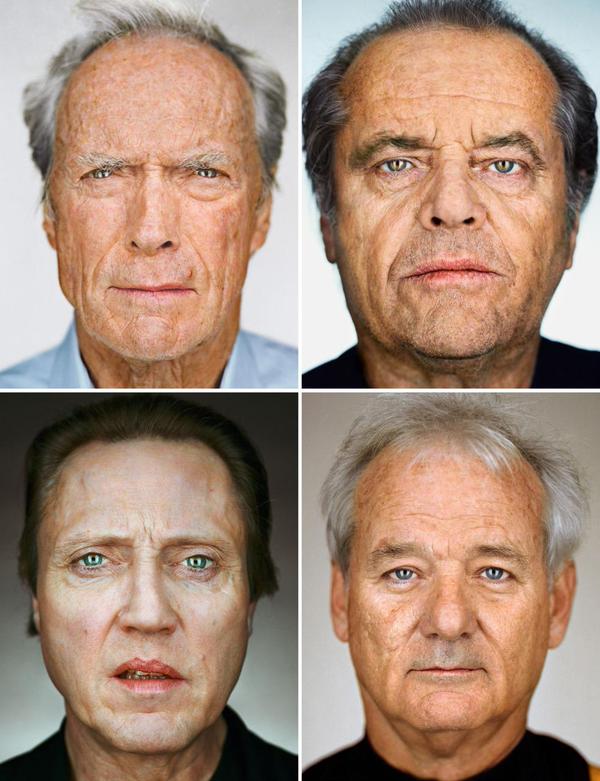
Four Legends by Martin Schoeller
20 Jan 2015 Leave a comment
in economic history, economics of media and culture, movies Tags: movies
How Humans Created Cats – The Atlantic
20 Jan 2015 Leave a comment

It could not have been long before farmers realized the utility of keeping the cats around, which would have led them to support the cat population, “by a) not killing them, and by b) even helping them in various ways—letting them stay in the warmth, providing foods,”

 Utopia, you are standing in it!
Recent Comments