
New Zealand – Chartbook of Economic Inequality
20 Jan 2015 Leave a comment
in applied welfare economics, politics - New Zealand, poverty and inequality Tags: Gini coefficient, poverty and inequality, top 1%
| Has the dispersion of earnings been increasing in recent decades? | Yes, the top decile has risen from 143 per cent of median in 1986 to 186 per cent in 2012. |
| Has overall inequality increased in recent years? | No, the Gini coefficient has been relatively stable around 32 percent since 1996. However, it rose by 7 percentage points between 1988 and 1996. |
| Have there been periods when overall inequality fell for a sustained period? | Yes, from mid-1950s to mid-1970s. |
| Has poverty been falling or rising in recent decades? | Poverty has substantially increased from 1996 to 2004 before decreasing mildly till 2009. |
| Has there been a U-pattern for top income shares over time? | Yes, top gross income shares fell from mid-1950s to mid-1980s, then rose from mid-1980s to mid-1990s. |
| Has the distribution of wealth followed the same pattern as income? | Insufficient evidence. |
| Additional noteworthy features | U-shape over post-war period. Top income shares estimates for the years 1998, 1999 and 2000 are affected by changes in the income tax laws. Top shares series have a break in 1951 (change in tax units). |

You are welcome to share but please refer to A. B. Atkinson and S. Morelli (2014) – ‘The Chartbook of Economic Inequality’ at http://www.ChartbookOfEconomicInequality.com
This visualisation is licensed under a Creative Commons BY-NC-SA license Data visualisation by: Max Roser
Sweet dreams are made of this: The lying-down desk has landed | City A.M.
19 Jan 2015 Leave a comment
in managerial economics, organisational economics, personnel economics Tags: Japan

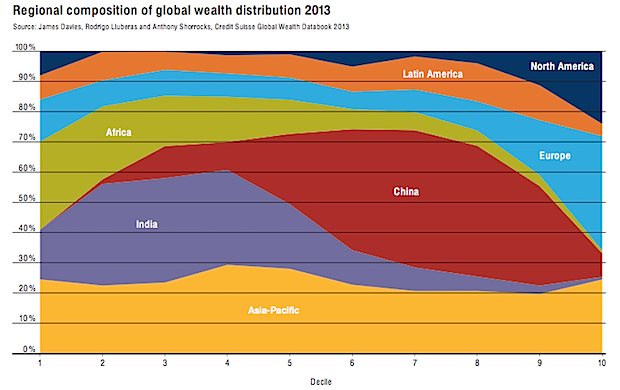
The regional composition of global wealth
19 Jan 2015 Leave a comment
in development economics, growth disasters, growth miracles Tags: The Great Fact
Lords of Poverty
19 Jan 2015 Leave a comment
in economics

I’ve just finished Graham Hancock‘s 1989 classic “Lords of Poverty” and recommend it to anybody interested in the working of the international aid bureaucracy. Hancock is scathing in his assessment of international aid agencies such as the United Nations, bilateral aid agencies (eg US AID), development banks (eg World Bank), and the IMF, and concludes that they haven’t just made a few unfortunate mistakes but they are irredeemably broken and need to be abandoned.
I found a few of his examples to be overly harsh, but found his thesis to be generally persuasive. Instead of trying to review his themes, I think it best to provide some extended quotes, and then encourage you to read the rest…
“This is how the game works: public money levied in taxes from the poor of the rich countries is transferred in the form of ‘foreign aid’ to the rich in…
View original post 1,074 more words
What Oxfam doesn’t want you to know: global capitalism means there’s less poverty than ever » Spectator Blogs
19 Jan 2015 Leave a comment
in development economics, growth disasters, growth miracles Tags: Leftover Left, Oxfam, The Great Escape, The Great Fact


We are, right now, living through the golden age of poverty reduction.
Anyone serious about tackling global poverty (and I’m afraid we have to exclude Oxfam from this category) has to accept that whatever we’re doing now, it’s working – so we should keep doing it.
We are literally on the road to an incredible goal: the abolition of poverty, as we know it, within our lifetime.
Those who care more about helping the poor than hurting the rich will celebrate the fact – and make sure free trade and global capitalism keep spreading so as to finish the job.
The Tale of the Slave
19 Jan 2015 Leave a comment
in economics

This is a remix, no copyright intended. “The Tale of the Slave” features in Robert Nozick‘s book, “Anarchy, State and Utopia”
Consider the following sequence of cases, which we shall call the Tale of the Slave, and imagine it is about you.
- There is a slave completely at the mercy of his brutal master’s whims. He often is cruelly beaten, called out in the middle of the night, and so on.
- The master is kindlier and beats the slave only for stated infractions of his rules (not fulfilling the work quota, and so on). He gives the slave some free time.
- The master has a group of slaves, and he decides how things are to be allocated among them on nice grounds, taking into account their needs, merit, and so on.
- The master allows his slaves four days on their own and requires them to work only three days…
View original post 481 more words
Oxfam forgot to tell Davos that you need only $3650 to be among the wealthiest half of world citizens
19 Jan 2015 Leave a comment
in applied price theory, applied welfare economics, development economics, growth disasters, growth miracles Tags: Davos, top 1%

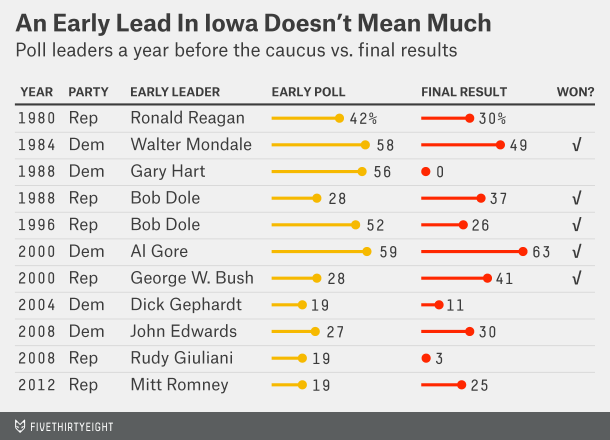
One Year From The Iowa Caucus: What We Know | FiveThirtyEight
19 Jan 2015 Leave a comment
in politics - USA, TV shows Tags: 2016 presidential election

The link between parental leave and the gender pay gap | Pew Research Center
19 Jan 2015 Leave a comment
in discrimination, gender, human capital, labour supply, occupational choice, population economics Tags: gender wage gap, Parental leave, unintended consequences


Gabriel Kolko on the rise in the mixed economy
19 Jan 2015 1 Comment
in Public Choice, rentseeking Tags: Gabriel Kolko, rent seeking

 Utopia, you are standing in it!
Recent Comments