Selma’s error of omission: The specter of Shelby County

Unknown's avatarJONATHAN TURLEY

Selma

By: Cara L. Gallagher, weekend contributor

In one of the opening scenes in Selma, Ava DuVernay’s depiction of Dr. King’s quest for legislation that would end decades of disenfranchisement in the American South, Oprah plays a woman jammed up by Black codes prevalent in the South in 1965. A voter registrar quizzes her with questions that neither she nor any educated person of the time could possibly answer. She fails his test and is once again denied the right to register to vote. Right away we learn Selma is clearly not just a biographical film about Dr. King and other Civil Rights legends like Congressmen John Lewis, but also about the pain, shame, and violence endured by these men and women to get the Voting Rights Act of 1965 passed.

A group of fellow history teachers and I went to see an early release of Selma last week. I…

View original post 678 more words

Motorised roller skates

https://twitter.com/HistoryInPixx/status/556606066734403584

A Balanced-Growth View of Men’s and Women’s Unbalanced Labor Market Recoveries

via A Balanced-Growth View of Men’s and Women’s Unbalanced Labor Market Recoveries – Dallas Fed.

Small business ownership by immigrants to America

Image

Why Healthcare, Education, and Government Spending Keep Going Up – Baumol’s Cost Disease

ozidar's avatarowenzidar

The Economist reviews an important book that I’ve been thinking a lot about recently (research extending these ideas is forthcoming).

HEALTH-CARE expenditure in America is growing at a disturbing rate: in 1960 it was just over 5% of GDP, in 2011 almost 18%. By 2105 the number could reach 60%, according to William Baumol of New York University’s Stern School of Business. Incredible? It is simply the result of extrapolating the impact of a phenomenon Mr Baumol has become famous for identifying: “cost disease”. His new book* gives a nuanced diagnosis, offerings both a vision of a high-cost future and a large dose of optimism. The cost disease may be incurable, but it is also survivable—if treated correctly.

View original post 900 more words

Many variants of Moore’s Law are now over


Image

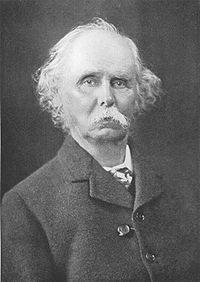
Alfred Marshall (1842-1924)

drsubrotoroy's avatarIndependent Indian: Work & Life of Professor Subroto Roy

Alfred Marshall (1842-1924), founder of modern economics, master of Maynard Keynes, concluding his 1885 Inaugural Lecture: “It will be my most cherished ambition, my highest endeavour, to do what with my poor ability and my limited strength I may, to increase the numbers of those, whom Cambridge, the great mother of strong men, sends out into the world with cool heads but warm hearts, willing to give some at least of their best powers to grappling with the social suffering around them; resolved not to rest content till they have done what in them lies to discover how far it is possible to open up to all the material means of a refined and noble life”.

View original post

The Kaaba, Mecca, in 1889

https://twitter.com/classicepics/status/555875662431387649

Image

Truth is in the eye of the beholder!

Madonna – Like A Prayer

Maynard Keynes on How to Be a Good Economist

drsubrotoroy's avatarIndependent Indian: Work & Life of Professor Subroto Roy

From Facebook, April 11, 2011

Since the name of Keynes is back to being used somewhat in vain around the world, it may be appropriate to recall Maynard Keynes’s description of his own role-model as an economist, his master Alfred Marshall.

“The study of economics does not seem to require any specialised gifts of an unusually high order.  Is it not, intellectually regarded, a very easy subject compared with the higher branches of philosophy and pure science?  Yet good, or even competent, economists are the rarest of birds.  An easy subject , at which very few excel!  The paradox finds its explanation, perhaps, in that the master-economist must possess a rare *combination* of gifts.  He must reach a high standard in several different directions and must combine talents not often found together.  He must be mathematician, historian, statesman and philosopher — in some degree. He must understand symbols and speak…

View original post 134 more words

An Atheist remains unelectable as president.

https://twitter.com/MaxCRoser/status/555495332529049600

Image

A new keyboard for the Left over Left

image

Image

The politics of India’s unfinished economic reforms

Amol Agrawal's avatarMostly Economics

Swaminathan S. Anklesaria Aiyar looks at the current state of Indian reforms from the political economy lens.

He says don’t expect much on reforms. There aren’t any real incentives to reform:

Despite at least two decades of reforms, the liberalization of India’s economy is  incomplete. This is primarily a function of politics. Indian political leaders have few incentives to advance the reform agenda given India’s high growth rate, and instead prefer handouts in the form of welfare schemes and employment guarantees. The ruling Congress Party is inclined towards populism. The realities of coalition politics in both houses of parliament further complicate reforms, as they require concessions from partners and, in some cases, the opposition. While some advances are being made, future economic liberalization in India will likely be hesitant, episodic, and half-hearted.

Despite nearly 20 years of reform India lags way behind in most competitiveness rankings.

View original post 1,055 more words

“NZ up until the 1980s, was a fairly egalitarian country, apart from Maori and women”

Max Rashbrooke is at it again in today’s Sunday Star Times – Wellington’s Sunday paper. He was painting pre-economic reform, pre-1984 New Zealand is a golden era of egalitarianism.
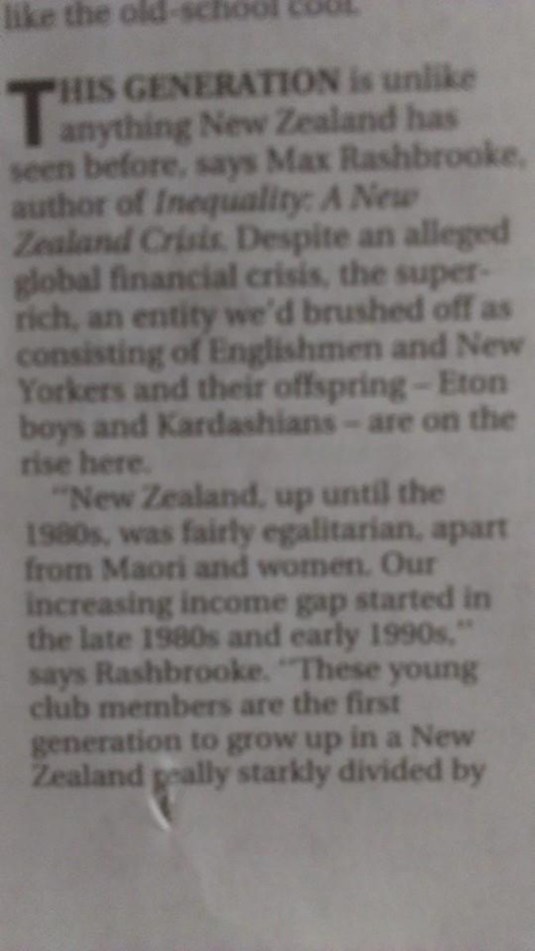
To do this, to paint pre-1984 New Zealand, pre-neoliberal New Zealand as a fairly egalitarian paradise, he only had to ignore up to two thirds of the population and the inequalities they suffered.

“New Zealand up until the 1980s was fairly egalitarian, apart from Maori and women, our increasing income gap started in the late 1980s and early 1990s,” says Rashbrooke. “These young club members are the first generation to grow up in a New Zealand really starkly divided by income.”

Racism and patriarchy can sit comfortably with a fairly egalitarian society if you are to believe the Left over Left.

As he implies in the paper today, captioned and quoted above, New Zealand in the 1980s was not fairly egalitarian for women, the majority of the population, and Māori, another 10% or so of the population.

This ignoring of racial and gender equality is very much in keeping with Max Rashbrooke’s boy’s own view of egalitarianism: women and ethnic minorities such as Māori and Pasifika don’t count in the greater scheme of the Left over Left when they whine and bitch about the Great Enrichment.

The mission in life of the Left over Left is desperately seeking poverty even if they drop out of the statistics most of the people who are no longer in poverty because of the Great Enrichment and the latest blessings of capitalism and freedom.

As shown in figure 1 below, between 1994 and 2010, real equivalised median New Zealand household income rose by 47%; for Māori, this rise was 68%; for Pasifika, the rise in real equivalised median household income was 77%.

Figure 1: Real equivalised median household income (before housing costs) by ethnicity, 1988 to 2013 ($2013)

Source: Bryan Perry, Household incomes in New Zealand: Trends in indicators of inequality and hardship 1982 to 2013. Ministry of Social Development (July 2014).

Median household income increases of nearly 50% in 16 years, and larger increases for ethnic minorities such as Māori and Pasifika should be celebrated rather than simply ignored because they are inconvenient to Left over Left sniping.
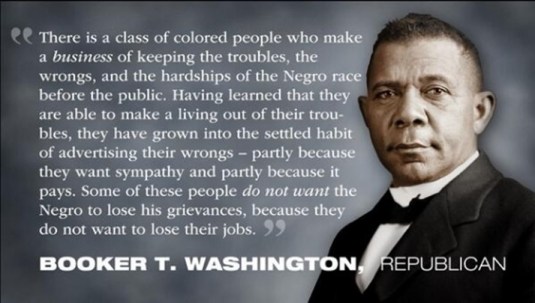
As is common with every member of the Left over Left that I run into these days, such as Max Rashbrooke,, their analysis has no gender analysis.
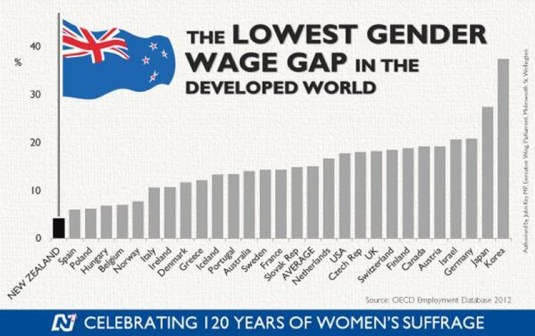
The Left over Left invariably fail to mention that New Zealand has the smallest gender wage gap of all the industrialised countries.
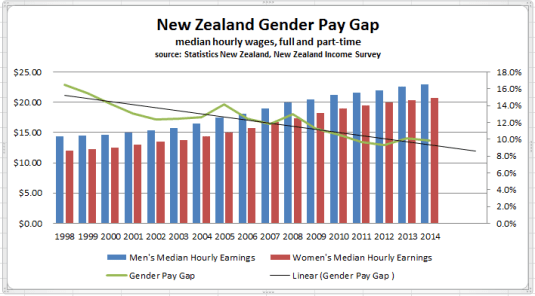
Sources: Ministry of Women’s Affairs and Statistics New Zealand: New Zealand Income Survey

Over the last more than two decades in New Zealand, there has been sustained income growth spread across all of New Zealand society contrary to hopes and dreams of the Left over Left.

Perry (2014) reviews the poverty and inequality data in New Zealand every year for the Ministry of Social Development. He concluded that:

Overall, there is no evidence of any sustained rise or fall in inequality in the last two decades. The level of household disposable income inequality in New Zealand is a little above the OECD median. The share of total income received by the top 1% of individuals is at the low end of the OECD rankings


Previous Older Entries Next Newer Entries

Bassett, Brash & Hide

Celebrating humanity's flourishing through the spread of capitalism and the rule of law

Truth on the Market

Scholarly commentary on law, economics, and more

The Undercover Historian

Beatrice Cherrier's blog

Matua Kahurangi

Celebrating humanity's flourishing through the spread of capitalism and the rule of law

Temple of Sociology

Celebrating humanity's flourishing through the spread of capitalism and the rule of law

Velvet Glove, Iron Fist

Celebrating humanity's flourishing through the spread of capitalism and the rule of law

Why Evolution Is True

Why Evolution is True is a blog written by Jerry Coyne, centered on evolution and biology but also dealing with diverse topics like politics, culture, and cats.

Down to Earth Kiwi

Celebrating humanity's flourishing through the spread of capitalism and the rule of law

NoTricksZone

Celebrating humanity's flourishing through the spread of capitalism and the rule of law

Homepaddock

A rural perspective with a blue tint by Ele Ludemann

Kiwiblog

DPF's Kiwiblog - Fomenting Happy Mischief since 2003

The Dangerous Economist

Celebrating humanity's flourishing through the spread of capitalism and the rule of law

Watts Up With That?

The world's most viewed site on global warming and climate change

The Logical Place

Tim Harding's writings on rationality, informal logic and skepticism

Doc's Books

A window into Doc Freiberger's library

The Risk-Monger

Let's examine hard decisions!

Uneasy Money

Commentary on monetary policy in the spirit of R. G. Hawtrey

Barrie Saunders

Thoughts on public policy and the media

Liberty Scott

Celebrating humanity's flourishing through the spread of capitalism and the rule of law

Point of Order

Politics and the economy

James Bowden's Blog

A blog (primarily) on Canadian and Commonwealth political history and institutions

Science Matters

Reading between the lines, and underneath the hype.

Peter Winsley

Economics, and such stuff as dreams are made on

A Venerable Puzzle

"The British constitution has always been puzzling, and always will be." --Queen Elizabeth II

The Antiplanner

Celebrating humanity's flourishing through the spread of capitalism and the rule of law

Bet On It

Celebrating humanity's flourishing through the spread of capitalism and the rule of law

History of Sorts

WORLD WAR II, MUSIC, HISTORY, HOLOCAUST

Roger Pielke Jr.

Undisciplined scholar, recovering academic

Offsetting Behaviour

Celebrating humanity's flourishing through the spread of capitalism and the rule of law

JONATHAN TURLEY

Res ipsa loquitur - The thing itself speaks

Conversable Economist

Celebrating humanity's flourishing through the spread of capitalism and the rule of law

The Victorian Commons

Researching the House of Commons, 1832-1868

The History of Parliament

Articles and research from the History of Parliament Trust

Books & Boots

Reflections on books and art

Legal History Miscellany

Posts on the History of Law, Crime, and Justice

Sex, Drugs and Economics

Celebrating humanity's flourishing through the spread of capitalism and the rule of law

European Royal History

Exploring the Monarchs of Europe

Tallbloke's Talkshop

Cutting edge science you can dice with

Marginal REVOLUTION

Small Steps Toward A Much Better World

NOT A LOT OF PEOPLE KNOW THAT

“We do not believe any group of men adequate enough or wise enough to operate without scrutiny or without criticism. We know that the only way to avoid error is to detect it, that the only way to detect it is to be free to inquire. We know that in secrecy error undetected will flourish and subvert”. - J Robert Oppenheimer.

STOP THESE THINGS

The truth about the great wind power fraud - we're not here to debate the wind industry, we're here to destroy it.

Lindsay Mitchell

Celebrating humanity's flourishing through the spread of capitalism and the rule of law

Alt-M

Celebrating humanity's flourishing through the spread of capitalism and the rule of law

croaking cassandra

Economics, public policy, monetary policy, financial regulation, with a New Zealand perspective

The Grumpy Economist

Celebrating humanity's flourishing through the spread of capitalism and the rule of law

International Liberty

Restraining Government in America and Around the World