The Beauty of Uncertainty – Thomas J. Sargent
31 Jan 2015 Leave a comment
in macroeconomics Tags: Thomas Sargent

Hayek on why Keynesian macroeconomics initially became popular and stayed popular despite eventual empirical failure
31 Jan 2015 8 Comments

Blade Runner – Final scene, "Tears in Rain" Soliloquy
31 Jan 2015 1 Comment
in movies, Music Tags: Blade Runner, Vangelis
The Anti-Science Left has quite elaborate conspiracy theories about GMOs
31 Jan 2015 Leave a comment
in health economics Tags: antiscience left, GMOs, Quacks
Germany had major labour market deregulation on the eve of the global financial crisis
31 Jan 2015 Leave a comment
Poll: Eleven Percent Of Americans Believe Florescent Bulbs Are A Conspiracy To Control Their Minds And Other Scary Stuff
31 Jan 2015 Leave a comment
in economics

 Every once in a while, we will get a poll that is truly unnerving like the percentage of Americans who entirely reject evolution or think that the Earth is only a few thousand years old. However, a University of Chicago study on conspiracy theories is enough for you to put on your tinfoil hat and look yourself in your underground shelter. Eric Oliver and Thomas Wood at the University of Chicago found that half of the country holds these conspiracy theories and some are just plain wacky.
View original post 292 more words
The Art of Blackmail
30 Jan 2015 Leave a comment
in economics

 You are reorganizing your firm. There are many legacy employees the old CEO was too weak to fire. They are inefficient and incompetent but their connection to the old CEO – an insider – kept their jobs safe. You were hired from the outside and feel no particular affection for the old guard. There is one employee Mr X who is high up. He is terrible at his job but has survived by using his charm and by buttering up the customers. Sometimes he went too far. You hear rumors of “liasons” between your staff and the customers. Also, there were inappropriate exchanges of gifts. While nothing was strictly illegal, if news gets out, your firm will look bad and business will suffer.
You want to sack Mr X. Your problem is that he knows too much: if you fire him, he threatens to go to the press and tell…
View original post 405 more words
Hold my beer while I race
30 Jan 2015 Leave a comment
in economics of media and culture Tags: Darwin awards
The world’s poverty – in 50 seconds from BBC
30 Jan 2015 Leave a comment
in development economics, growth disasters, growth miracles Tags: capitalism and freedom, global poverty, The Great Enrichment, The Great Fact
Spurious correlations alert: executions and murder rates – updated
30 Jan 2015 Leave a comment
in applied price theory, economics of crime, labour economics, labour supply, law and economics, occupational choice Tags: crime and punishment, death penalty, deterrence, occupational hazards, prison conditions, punishment
– Updated
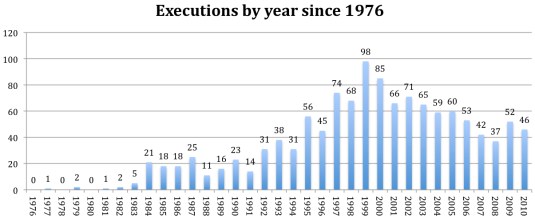
Many a data shyster will make hay with the above chart on the simple correlation between executions and the drop in the US murder rate.

The reality is there are so few executions and they are so infrequent with the exception of Texas that any purported correlation between the death penalty and murder rates requires careful study.

Indeed, for some condemned prisoners, gang bangers are an example, their life expectancy may be increased by the long time they spend on death row versus been murdered by a business associated or a business rival on the streets. As Levitt noted:
no rational criminal should be deterred by the death penalty, since the punishment is too distant and too unlikely to merit much attention.
As such, economists who argue that the death penalty works are put in the uncomfortable position of having to argue that criminals are irrationally overreacting when they are deterred by it.
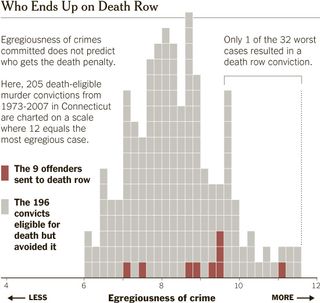
The occupational hazard of been murdered by business rival for gang bangers is higher than the chance of them been arrested, tried , convicted, and condemned to death and then executed after a long appeals process. Not surprisingly, Levitt argued that:
…the quality of life in prison is likely to have a greater impact on criminal behaviour than the death penalty.
Using state-level panel data covering the period 1950–90, we demonstrate that the death rate among prisoners (the best available proxy for prison conditions) is negatively correlated with crime rates, consistent with deterrence. This finding is shown to be quite robust.
In contrast, there is little systematic evidence that the execution rate influences crime rates in this time period.

 Utopia, you are standing in it!
Recent Comments