


Celebrating humanity's flourishing through the spread of capitalism and the rule of law
16 Jan 2015 1 Comment
in economics of crime, law and economics, politics - USA Tags: crime and punishment, deterrence
16 Jan 2015 Leave a comment
in economic history, economics of media and culture Tags: famous photos
16 Jan 2015 Leave a comment
in economic history, politics - USA Tags: maps
History professor Claudio Saunt created the above time-lapse, as well as a corresponding interactive map, to emphasize “the fact that the United States is built on someone else’s land”:
By the time the Civil War came to an end in 1865, it had consumed the lives of 800,000 Americans, or 2.5 per cent of the population, according to recent estimates. If slavery was a moral failing, said Lincoln in his second inaugural address, then the war was ‘the woe due to those by whom the offense came’. The rupture between North and South forced white Americans to confront the nation’s deep investment in slavery and to emancipate and incorporate four million individuals. They did not do so willingly, and the reconstruction of the nation is in many ways still unfolding. By contrast, there has been no similar reckoning with the conquest of the continent, no serious reflection on its centrality…
View original post 23 more words
16 Jan 2015 Leave a comment
in economics
The American Enterprise Institute reports. (H/T Jay Richards tweet)
Higher unemployment:
A new NBER working paper from Jeffrey Clemens and Michael Wither of the University of California, San Diego, suggests that the 30% increase in the average effective minimum wage over the late 2000s “reduced the national employment-to-population ratio — the share of adults with any kind of job — by 0.7 percentage point” between December 2006 and December 2012.
That works out to 14% of the total working-age decline during that period. Clemens and Wither basically looked at what happened to workers in states that were affected by federal minimum wage hikes versus what happened in states that weren’t. They also adjusted for the differing state-level impact of the Great Recession.
Low-skill workers hurt the most:
Now what’s particularly interesting in what Clemens and Wither found is that the minimum wage hikes made it harder for low-income workers to climb…
View original post 272 more words
16 Jan 2015 Leave a comment
in politics - USA Tags: 2016 presidential election
16 Jan 2015 Leave a comment
in economics
A few papers of interest regarding the persistent effect of historical conditions (geographic or not) on subsequent development:
View original post 443 more words
16 Jan 2015 Leave a comment
in economics

 As many on this blog know, I am a great fan of Pope Francis who has brought an inspiring leadership to the Church that has drawn millions back to the faith. Given that admiration, I was disheartened to read the Pope’s comment on free speech today. I ran a column last weekend on how world leaders are failing over themselves to “Stand With Charlie” after the massacre of editors and staff at Charlie Hebdo magazine. However, the West has been rolling back on free speech rights, including some of these very leaders. Pope Francis added his view this week to those insisting that free speech must have limits when it comes to insulting people about their religion. It is a disappointing observation, particularly when coupled with a rather poor analogy.
View original post 301 more words
16 Jan 2015 Leave a comment
in economics
It’s very frustrating to write about the minimum wage. How often can you make the elementary observation, after all, that you’ll get more unemployment if you try to make businesses pay some workers more than they’re worth?
But it’s my mission to promote economic liberty, so I’ve written on why government-mandated wages can create unemployment by making it unprofitable to hire people with low work skills and/or poor work histories. 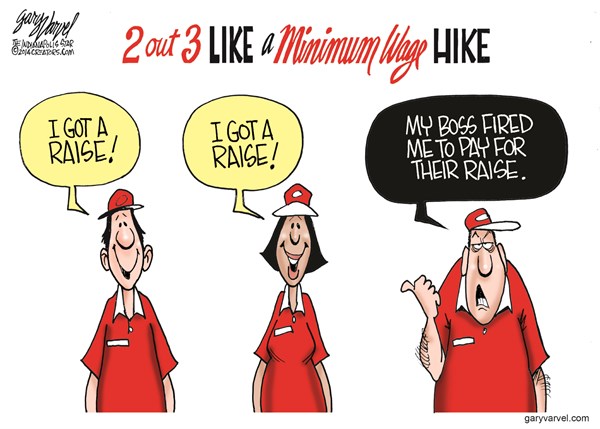 And I’ve attacked Republicans for going along with these job-killing policies, and also pointed out the racist impact of such intervention.
Heck, just about everything sensible that needs to be said about the topic is contained in this short video narrated by Orphe Divougny
But I guess I’m the Sisyphus of the free-market movement because once again I’m going to try to talk some sense into those who think emotion can trump…
View original post 953 more words
16 Jan 2015 Leave a comment
in labour economics, occupational choice, politics - USA
16 Jan 2015 1 Comment
in Alfred Marshall, Armen Alchian, economics of education, George Stigler, human capital, job search and matching, labour economics, occupational choice, politics - New Zealand, rentseeking Tags: 2nd laws of supply and demand, Alfred Marshall, Armen Alchian, george stigler, search and matching, skills shortgaes
Known but yet to be exploited opportunities for profit do not last long in competitive markets, including hitherto unnoticed opportunities for the greater utilisation and development of skills and experience (Hakes and Sauer 2006, 2007; Ryoo and Rosen 2004; and Kirzner 1992). Moneyball is the classic example of entrepreneurial alertness to hitherto unexploited job skills which were quickly adopted by competing firms (Hakes and Sauer 2006, 2007).
There is considerable evidence that the demand and supply of human capital responds to wage changes. For example, over- or under-supplied human capital moves either in or out in response to changes in wages until the returns from education and training even out with time (Ryoo and Rosen 2004; Arcidiacono, Hotz and Kang 2012; Ehrenberg 2004).
As evidence of this equalisation of returns on human capital investments across labour markets, the returns to post-school investments in human capital are similar – 9 to 10 percent – across alternative occupations, and in occupations requiring low and high levels of training, low and high aptitude and for workers with more and less education (Freeman and Hirsch 2001, 2008). There is evidence that workers with similar skills in similarly attractive jobs, occupation and locations earn similar pay (Hirsch 2008; Vermeulen and Ommeren 2009; Rupert and Wasmer 2012; Roback 1982, 1988).
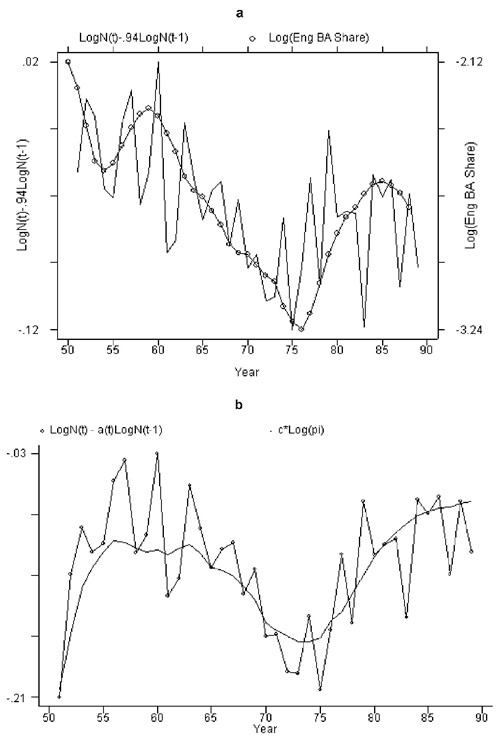
Ryoo and Rosen (2004) found that the labour supply and university enrolment decisions of engineers is “remarkably sensitive” to career earnings prospects. Graduates are the main source of new engineers. Engineers who moved out into other occupations such as management did not often moved back to work again as professional engineers. Ryoo and Rosen (2004) observed when summarising their work that:
Both the wage elasticity of demand for engineers and the elasticity of supply of engineering students to economic prospects are large. The concordance of entry into engineering schools with relative lifetime earnings in the profession is astonishing.
Ryoo and Rosen (2004) found several periods of surplus in the market for engineers. These periods of shortage or surplus corresponded to unexpected demand shocks in the market for engineers such as the end of the Cold War.
Figure 1: New entry flow of engineers: a, actual vs. imputed from changes in stock of engineers; b, time-varying coefficients.
Source: Ryoo and Rosen (2004)
Ryoo and Rosen (2004) noted that importance of permanent versus transitory changes in earnings. Transitory rises and falls in earnings prospects have much less influence on occupational choices and the educational investments of students.
In light of these findings that the supply of engineers rapidly adapted to changing market conditions, Ryoo and Rosen (2004) questioned whether public policy makers have better information on future labour market conditions than labour market participants do. When politicians get worked up about skill shortages, the markets for scientists and engineers often where they make extravagant claims about the ability of the market to adapt to changing conditions because of the long training pipeline involved in university study, including at the graduate level.
There can be unexpected shifts in the supply or demand for particular skills, training or qualifications. These imbalances even themselves out once people have time to learn, update their expectations and adapt to the new market conditions (Rosen 1992; Ryoo and Rosen 2004; Bettinger 2010; Zafar 2011; Arcidiacono, Hotz and Kang 2012; Webbink and Hartog 2004).
For example, Arcidiacono, Hotz and Kang (2012) found that both expected earnings and students’ abilities in the different majors are important determinants of student’s choice of a college major, and 7.5% of students would switch majors if they made no forecast errors.
The wage premium for a tertiary degree was low and stable in New Zealand in the 1990s (Hylsop and Maré 2009) and 2000s (OECD 2013). This stability in the returns to education suggests that supply has tended to kept up with the demand for skills at least over the longer term at the national level. There were no spikes and crafts that would be the evidence of a lack of foresight among teenagers in choosing what to study.
All in all, the remarkable sensitivity of engineers to a career earnings prospects, the frequent changes of college majors by university students in response to changing economic opportunities, and the stability of the returns on human capital over time suggest that the market for human capital is well functioning.
The argument that the market was not working well was assumed rather than proven. Likewise, the case for additional subsidies for science, technology, engineering and mathematics because of perceived skill shortages has not been made out. There is a large literature showing that the market for professional education works well.
The onus is on those who advocate intervention to come up with hard evidence, rather than innate pessimism about markets that are poorly understood because of a lack of attempts to understand it. Studies dating back to the 1950s by George Stigler and by Armen Alchian found that the market for scientists and engineers works well and the evidence of shortages were more presumed than real.
16 Jan 2015 Leave a comment
in economics of media and culture, movies Tags: Four Lions
Celebrating humanity's flourishing through the spread of capitalism and the rule of law
Scholarly commentary on law, economics, and more
Beatrice Cherrier's blog
Celebrating humanity's flourishing through the spread of capitalism and the rule of law
Celebrating humanity's flourishing through the spread of capitalism and the rule of law
Celebrating humanity's flourishing through the spread of capitalism and the rule of law
Why Evolution is True is a blog written by Jerry Coyne, centered on evolution and biology but also dealing with diverse topics like politics, culture, and cats.
Celebrating humanity's flourishing through the spread of capitalism and the rule of law
Celebrating humanity's flourishing through the spread of capitalism and the rule of law
A rural perspective with a blue tint by Ele Ludemann
DPF's Kiwiblog - Fomenting Happy Mischief since 2003
Celebrating humanity's flourishing through the spread of capitalism and the rule of law
The world's most viewed site on global warming and climate change
Tim Harding's writings on rationality, informal logic and skepticism
A window into Doc Freiberger's library
Let's examine hard decisions!
Commentary on monetary policy in the spirit of R. G. Hawtrey
Thoughts on public policy and the media
Celebrating humanity's flourishing through the spread of capitalism and the rule of law
Politics and the economy
A blog (primarily) on Canadian and Commonwealth political history and institutions
Reading between the lines, and underneath the hype.
Economics, and such stuff as dreams are made on
"The British constitution has always been puzzling, and always will be." --Queen Elizabeth II
Celebrating humanity's flourishing through the spread of capitalism and the rule of law
Celebrating humanity's flourishing through the spread of capitalism and the rule of law
WORLD WAR II, MUSIC, HISTORY, HOLOCAUST
Undisciplined scholar, recovering academic
Celebrating humanity's flourishing through the spread of capitalism and the rule of law
Res ipsa loquitur - The thing itself speaks
Celebrating humanity's flourishing through the spread of capitalism and the rule of law
Researching the House of Commons, 1832-1868
Articles and research from the History of Parliament Trust
Reflections on books and art
Posts on the History of Law, Crime, and Justice
Celebrating humanity's flourishing through the spread of capitalism and the rule of law
Exploring the Monarchs of Europe
Cutting edge science you can dice with
Small Steps Toward A Much Better World
“We do not believe any group of men adequate enough or wise enough to operate without scrutiny or without criticism. We know that the only way to avoid error is to detect it, that the only way to detect it is to be free to inquire. We know that in secrecy error undetected will flourish and subvert”. - J Robert Oppenheimer.
The truth about the great wind power fraud - we're not here to debate the wind industry, we're here to destroy it.
Celebrating humanity's flourishing through the spread of capitalism and the rule of law
Celebrating humanity's flourishing through the spread of capitalism and the rule of law
Economics, public policy, monetary policy, financial regulation, with a New Zealand perspective
Celebrating humanity's flourishing through the spread of capitalism and the rule of law
Restraining Government in America and Around the World


 Utopia, you are standing in it!
Recent Comments