Climate Experts To The Rescue In 1974
15 Jan 2015 1 Comment
in economics
I remember writing high school essays about the coming global calling, and the cover pages of Newsweek and Time Magazine, which were the magazines of record at that time.
Whenever I brought this up over the last 10 or 15 years, the climate alarmists went into denial and tried to rewrite history.

In 1974, climate experts at the National Academy of Sciences wanted to evacuate six million people, to save them from global cooling

Child poverty and single parent households in the USA
15 Jan 2015 Leave a comment
in labour economics, poverty and inequality, welfare reform Tags: child poverty, single parenthood
A great chart that may be misleading because so many taxpayers pay no net income tax
15 Jan 2015 Leave a comment
in Public Choice, taxation Tags: expressive voting, rational ignorance, tax incidence
Very useful #DataViz! UK now gives a breakdown of what your taxes were spent on.
Example via bit.ly/1BAz9vh http://t.co/Ero8h6kHCM—
Max Roser (@MaxCRoser) January 05, 2015
The places in the world that have a burqa ban
15 Jan 2015 Leave a comment
in economics of religion Tags: Religious head dress
Several religions have rules about head dress and and clothing.
A number of countries have rules requiring you to either remove the mask it if requested by a police officer to allow identification and about the wearing of masks at demonstrations. These more limited prohibitions are quite justified.
People who wish to enter private property when wearing masks shouldn’t expect banks and other places that are targets for robberies to welcome them.
For decades, now banks have prohibited anyone wearing a motorbike helmet from entering with it on.
When I worked on a bank, if anyone was in the bank wearing a motor bike helmet, we were supposed to get straight on the phone to the security department to give early notice of an attempted robbery.
How many New Zealand prime ministers and cabinet ministers have been convicted of sedition?
15 Jan 2015 Leave a comment
in defence economics, politics - New Zealand
New Zealand must be forgiving place. 15 years after World War I, it elected into office a Prime Minister and three Cabinet ministers who were convicted of sedition during the First World War. They were the leaders of the first Labour Party government in New Zealand.
Peter Fraser was sentenced to 12 months in prison for a seditious speech. Walter Nash was fined £5 for importing seditious literature. Both became prime ministers in time.
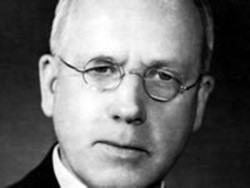

These four men, all members of the newly founded Labour Party and lifelong Christian Socialists, opposed the introduction of conscription in World War I. A major factor in the formation of the Labour Party New Zealand in 1916 was the imposition of conscription in 1915.
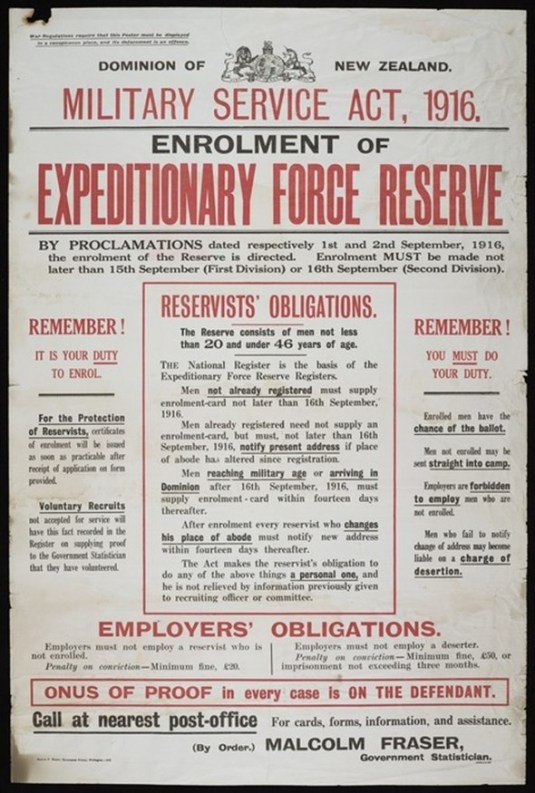
Ironically, these same men, Prime Minister Peter Fraser and Cabinet minister and later Prime Minister Walter Nash, along with two other Cabinet members who were convicted of sedition for opposing conscription in World War I introduced conscription into New Zealand in 1940 to fight the Second World War. Difficulties in filling the Second and Third Echelons for overseas service in 1939 and 1940, the Allied disasters of May 1940 and public demand led to its introduction.
The total eventually conscripted was more than 312,000. About 800 were labelled ‘military defaulters’ and interned for the duration of the war in specially built camps in remote areas.
The police cracked down severely on anti-conscription groups. As Russia haven’t yet been invaded by the Nazis, leading opponents of conscription included those traitors in the Communist Party.
Progressive Definition Of Free Speech
15 Jan 2015 Leave a comment
in economics
According to CNN and MSNBC, free speech means you can criticize Christianity or Judaism, but not Islam.
UK’s Sky News Loses It After Charlie Hebdo Writer Holds Up Mohammed Cover On-Air | National Review Online
15 Jan 2015 Leave a comment
in economics of media and culture, liberalism Tags: Censorship, free speech, Leftover Left, media bias, moral panic, war on terror
Zombie lending and lower Japanese productivity growth
15 Jan 2015 Leave a comment
in economic growth, macroeconomics, politics - New Zealand, public economics Tags: fiscal stimulus, Japan, Lost Decade, Think Big
The low Japanese productivity growth throughout the 1990s could have been the result of subsidies to inefficient firms and declining industries both directly and through a banking system rolling over loans in arrears to insolvent firms.
This policy is known as zombie lending, and it lowered productivity because higher cost firms kept producing a greater share of Japanese output than would otherwise have been the case (Hayashi and Prescott 2003; Ahearne and Shinada 2005).
- Zombie firms are insolvent firms often propped up with new loans and loan rollovers from Japanese banks.
- Zombie banks are insolvent banks propped up with loans from the central bank and by lax regulatory inspections of their weak loan portfolios and lack of adequate capital.
Japan’s economic policies have until recently kept insolvent banks operating, further encouraging zombie lending, which impeded the flow of capital to the more efficient firms.
The competitive process where zombies shed workers and lose market share was thwarted. The Japanese authorities subsidised insolvent banks and firms and provided credit to some firms and not to others (Prescott 2002; Hayashi and Prescott 2002; Caballero et al. 2005; Hoshi and Kashyap 2004).
The pervasiveness and long-term persistence of zombie lending as a shock to Japanese productivity growth cannot be understated. As Kashyap noted:
The government allowed even the worst banks to continue to attract financing and support their insolvent borrowers
…By keeping these unprofitable borrowers alive, banks allowed the zombies to distort competition throughout the rest of the economy.
Caballero et al. (2008) estimated that 30 per cent of all publicly traded Japanese manufacturing, construction, real estate, retail, wholesale, and service sector firms were on life support from banks in the early 2000s, and that most large Japanese banks only complied with capital standards because regulators were lax in their inspections.
The percentage of zombies hovered between 5 and 15 per cent up until 1993 and rose sharply over the mid-1990s to exceed 25 per cent for every year after 1994 (Caballero et al. 2008).
Figure 1: Prevalence of Firms Receiving Subsidized Loans in Japan

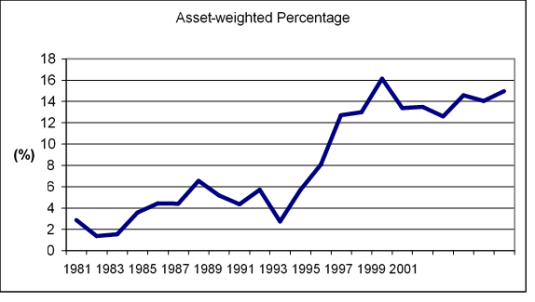
Source: Caballero et al. (2008) Zombie Lending and Depressed Restructuring in Japan. American Economic Review.
Zombie lending is a more serious problem for Japanese non-manufacturing firms than for manufacturing firms (Caballero et al. 2008). Small and medium size firms were also major beneficiaries of zombie lending.
Zombie lending also discourages new investments that increase Japanese productivity, encourages inefficient firms to avoid making the decisions necessary to raise their profitability, and impedes the solvent Japanese banks from finding good lending opportunities (Caballero et al. 2008; Sekine et al. 2003). As Kashyap noted:
Usually when an industry is hit by a bad shock, many firms exit… In Japan, firms never exited. Given that they never exited, it is not surprising that new firms weren’t created.
Under normal conditions, higher cost firms would go bankrupt and be replaced by new and better ideas and firms. Instead, firms that were more efficient than the zombie firms tended to exit industries because their demise does not require the banks to acknowledge large bad loans. This exit of the firms of intermediate efficiency rather than the exit of the least efficient firms dragged productivity down even further (Nishimura et al. 2005; Okana and Horioka 2008). New Zealand in the 1970s and in the early 1980s also had a range of policy measures that supported high-cost firms and declining industries.
When bankrupt firms can stay in business, they retain workers who otherwise would be willing to work for lower wages at a healthy firm and depress market prices for their products. Low prices and high wages reduce the profits that more productive firms can earn which discourages entry and investment.
The creation of new jobs is a measure of industry dynamism. In manufacturing, which suffered the least from the zombie problem, job creation hardly changed from the early 1990s to the late 1990s. In contrast, there was a large decline in job creation in the non-manufacturing sectors, particularly in construction (Caballero et al. 2008; Hoshi 2006; Caballero et al. 2008).
There was less restructuring of employment and market shares in favour of the more productive firms. The gap in productivity growth between the Japanese manufacturing and non-manufacturing sectors more than doubled over the 1990s (Caballero et al. 2008).
Japanese R&D spending has also slowed down significantly since the start of the 1990s (Comin forthcoming). The gap in the rate of computer adoption between Japan and USA also increased in the 1990s. The speed of diffusion of new technologies slowed to the point that South Körea has now surpassed Japan in the diffusion of computers and the Internet (Comin forthcoming).
Over the 1990s, there were ten massive fiscal packages to maintain employment and investment. Much of this additional Japanese government spending was on public works and other projects whose social payoffs have been queried by independent observers. The consumption tax was increased from 3 per cent to 5 per cent in 1997. There were two rounds of temporary tax cuts – for 2 years only.

Japan pursued economic policies in response to a recession that stifled total factor productivity by providing bad incentives to the private sector.

The unproductive firms depressed Japanese productivity because they competed for labour and capital that could have been used by the more productive firms. Zombie lending allowed many firms to stay in business long after the monetary policy changes that uncovered their unprofitable petered out. The diversion of resources to these insolvent firms prevented a productivity recovery. The lack of a productivity recovery depressed wages, incomes and consumer demand.
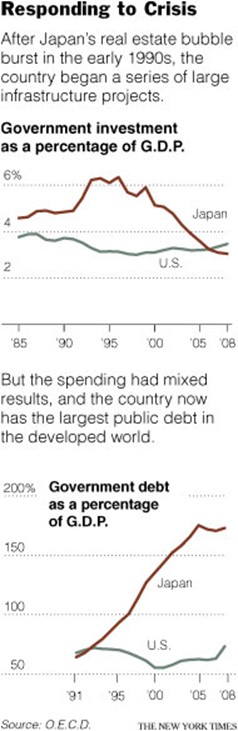
The zombie lending and fiscal packages compounded the 1990 monetary contraction into the highly persistent shocks that were required to be able to depress Japanese productivity growth for more than a decade.

More and more resources were tied up in high cost firms and in declining industries. This was rather than be reallocated to more productive uses by the normal market processes of relative price and wage changes, free entry and profit and loss. Kashyap argues that:
The experience in Japan definitely shows that providing subsidized credit to dying firms will be costly over time. Keeping an industry from restructuring only delays the day of reckoning and raises the cost substantially
…There are many examples besides Japan where people fail to recognize that it is dangerous to keep people attached to businesses that are fundamentally unprofitable
The massive Japanese government investments have echoes of the ‘Think Big’ energy investments in New Zealand in the late 1970s.

The productivity impact of ‘Think Big’ was suspect. In addition, state-owned enterprises offering a net return of zero to the Crown in the 1980s has Japanese parallels.
The propping up of high cost state owned and private firms in the 1970s and 1980s in New Zealand helped to depress productivity growth rates. State-owned enterprises offered a net return of about zero to the taxpayer, even as recently as last year in New Zealand.
More and more resources were tied up in New Zealand in the high cost firms and declining industries than be reallocated to more productive uses by the market processes of price and wage changes, free entry and profit and loss. The lack of productivity growth depressed wages, incomes and consumer demand in New Zealand.
The productivity based explanations for the slumps in New Zealand from 1974 to 1992 and in Japan from 1990 to 2003 have a number of common threads.
Amazon Invests In Woody Allen
15 Jan 2015 Leave a comment
in economics
A nice roundup of American culture and about how some people are immediately destroyed by allegations of sexual assault while they bounce off others.

James Poniewozik ponders the new deal:
Allen agreeing to make a TV series for anyone would have been big news in itself a few years ago. But now, after last year’s renewal of charges that the director sexually abused his adopted daughter Dylan Farrow when she was a child—charges Allen has long denied—it’s going to be a lightning rod. The re-emergence of rape accusations by many women against Bill Cosby was evidently enough last year to scuttle preliminary plans for him to return with a sitcom for NBC, even though he continues to deny them. Maybe Amazon feels that Allen’s circumstances are different, or that the blowback will be worth taking. But it’s hard to imagine there won’t be blowback; as many fans as Allen may still have, we saw around last year’s Oscars that there are legions who will view this deal as rewarding a predator.
Jessica Goldstein wonders
View original post 598 more words
Bitcoins Are Tanking Today
15 Jan 2015 Leave a comment
in economics

Bitcoins opened today at $226.04. As I write this, they are now trading at about $178. So they have lost about 25% of their value today, and its only 1PM EST.
Here’s a chart of what’s happened today.

Over the last month, bitcoins have lost nearly half their value. Bitcoins were trading at about $350 on December 15.
Here’s a chart of what’s happened over the last month.
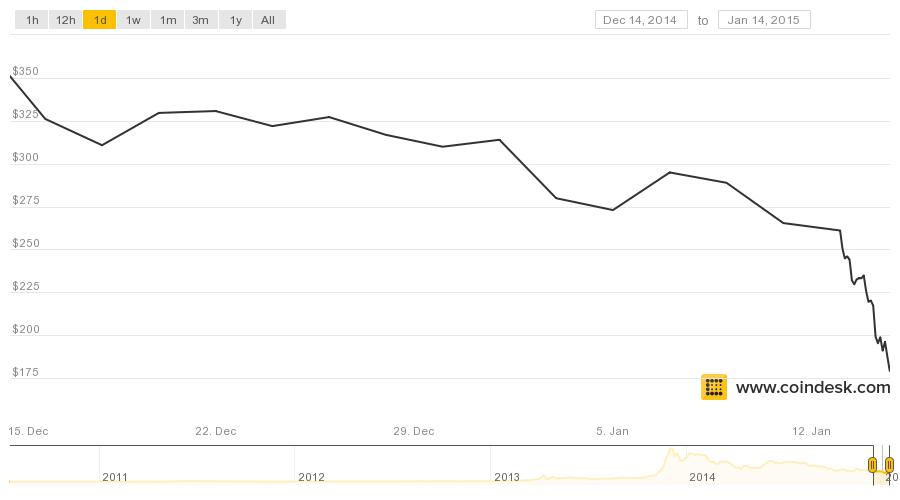 Last April, I wrote a post asking why bitcoins aren’t a bubble. Some people, including me, didn’t take that post too seriously, but I still don’t understand why bitcoins are worth anything. I seem to have more company now.
PS I have been spending a lot of time over the last 10 days thinking about the 1920-21 depression. I hope to post something later today or tomorrow on that topic.
How we know what to rely upon
15 Jan 2015 Leave a comment
in economics

Lots of people seem to be very confused about the nature of evidence and the meanings of terms such as ‘theory’, ‘hypothesis’, ‘science’ and ‘nonsense’. So I’ve put together a little table that I hope will be helpful. It might clear up a few misunderstandings.
For example the phrase ‘only a theory’ doesn’t mean it’s not reliable. In fact, in the case of very strong theories such as the theories of evolution or gravity it’s as close to fact as cautious, scientific convention will allow. Creationists beware – you have no idea how silly you appear when you use that particular phrase to try to knock down Darwinian evolution.
I’ve made some amendments to the table below. This is because some people have challenged the ranking of the examples I used in the original. Since the point of this post is to outline the hierarchy itself I’m quite happy to use…
View original post 116 more words
 Utopia, you are standing in it!
Recent Comments