Seven Years Since BOM Announced The End Of Rain In Australia
14 Jan 2015 Leave a comment
in economics


12 Men Walked On the Moon, and They Left Some Things Behind
14 Jan 2015 Leave a comment
in economics of media and culture Tags: conjecture and refutation, conspiracy theories, moon landing hoax
![[optional image description]](https://i0.wp.com/cdn.theatlantic.com/static/mt/assets/science/apollo17.jpeg)
more than 70 spacecraft, including rovers, modules, and crashed orbiters
• 5 American flags
• 2 golf balls
• 12 pairs of boots
• TV cameras
• film magazines
• 96 bags of urine, feces, and vomit
• numerous Hasselbad cameras and accessories
• several improvised javelins
• various hammers, tongs, rakes, and shovels
• backpacks
• insulating blankets
• utility towels
• used wet wipes
• personal hygiene kits
• empty packages of space food
• a photograph of Apollo 16 astronaut Charles Duke’s family
• a feather from Baggin, the Air Force Academy’s mascot falcon, used to conduct Apollo 15’s famous “hammer-feather drop” experiment
• a small aluminum sculpture, a tribute to the American and Soviet “fallen astronauts” who died in the space race — left by the crew of Apollo 15
• a patch from the never-launched Apollo 1 mission, which ended prematurely when flames engulfed the command module during a 1967 training exercise, killing three U.S. astronauts
• a small silicon disk bearing goodwill messages from 73 world leaders, and left on the moon by the crew of Apollo 11
• a silver pin, left by Apollo 12 astronaut Alan Bean
• a medal honoring Soviet cosmonauts Vladimir Komarov and Yuri Gagarin
• a cast golden olive branch left by the crew of Apollo 11

via Carbon Dating » 172 Men Walk On Moon and http://www.theatlantic.com/technology/archive/2012/12/the-trash-weve-left-on-the-moon/266465/
Is there a link between family structure and safety? » AEI
14 Jan 2015 Leave a comment
in economics of crime, labour economics, welfare reform Tags: child abuse, domestic violence, family structures, single parents

Not very likely alert: How much oil, gas and coal do we need to leave in the ground?
14 Jan 2015 Leave a comment
The Industrial Revolution and Modern Development
14 Jan 2015 Leave a comment
in economics
I must get back to writing my blog on why the Industrial Revolution was 528 years late, if Deirdre McCloskey is to be believed.

I’m not an economic historian, but like most growth economists I am an avid consumer of economic history. Maybe it’s our version of “physics envy”. Regardless, it isn’t always obvious why growth economists look backwards so much for motivation, examples, and inspiration. Let me try to give an example of the usefulness of economic history by looking at recent “big theories” of the British Industrial Revolution (IR).
If you have any interest in learning about the IR, then you could do a lot worse than reading the following two books:
- Joel Mokyr’s The Enlightened Economy: An Economic History of Britain 1700-1850
You’ll find yourself agreeing with Mokyr because the writing is so engaging, so remind yourself to remain skeptical (in the scholarly sense) as you read. - Robert Allen’s The British Industrial Revolution in Global Perspective
You’ll find yourself disagreeing with Allen because he makes it sound too easy, so remind…


View original post 1,087 more words

Why is anybody still living in East Germany (or New Zealand)?
14 Jan 2015 1 Comment
in economic history, macroeconomics, politics - Australia, politics - New Zealand Tags: East Germany, Germany, immigration, Trans-Tasman income gap
When I pointed to Jennifer Hunt’s so titled paper freshly released in 2000 on why does anyone still live in East Germany, none of my New Zealand colleagues understood the parallel with their own country.
The wage gap between East and West Germany is about the same as the wage gap between Australia and New Zealand.
- East Germans have the advantage of being able to getting their car to go to the west. Some do commute from the east to jobs in the West; and
- New Zealanders have to get into a plane and commuting done a daily basis is really out of the question – the air flight time alone is three hours.
There are in fact bigger language, or more correctly dialect differences between Germany than there are across the Tasman Sea between New Zealanders and Australians. Educational standards are similar between New Zealanders and Australians.
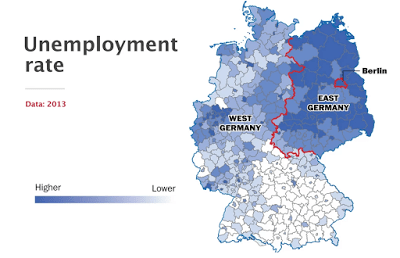
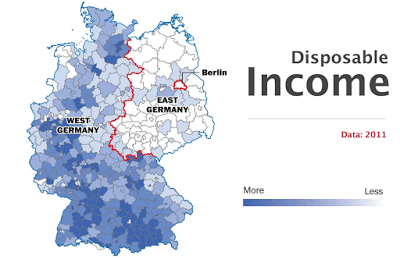
In 1997 GDP per capita in East Germany was 57% of that of West Germany, wages were 75% of western levels, and the unemployment rate was at least double the western rate of 7.8%.
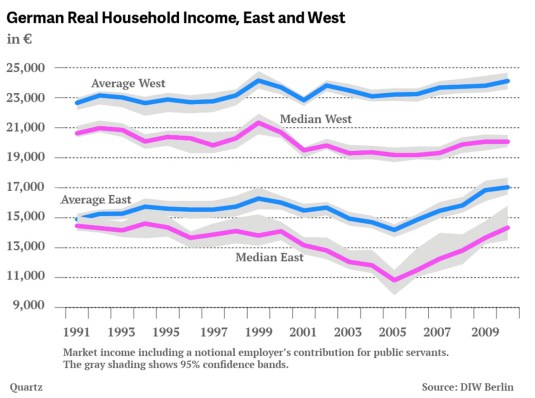
The wage gap across the Tasman between New Zealand and Australia is about one third. Wage gaps between East and West Germany and between Australia and New Zealand are about the same.

Australia and New Zealand have a single integrated labour market. Any New Zealander Australian is free to work in the other country.
New Zealanders are not eligible for social security benefits if they first arrived in Australia after mid-2001. Prior to 2001, New Zealanders have the same rights as Australians for social security benefits.
One would expect that if capital flows and trade in goods failed to bring convergence between East and West Germany, labour flows should respond, enhancing overall efficiency.
Same goes between Australia and New Zealand. About 35,000 New Zealanders used to move to Australia each year, but that’s recently dried up to about zero. Funnily enough, by the late 1990s net emigration from East Germany has fallen from high levels in 1989-1990 to close to zero.
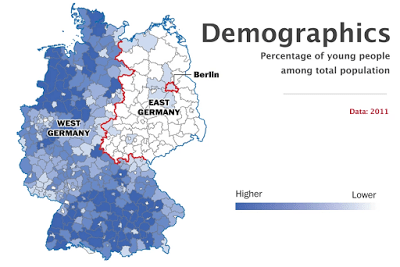
Jennifer Hunt found through her analysis of the eastern sample of the German Socio-Economic Panel for 1990-1997 that commuting is unlikely to substitute substantially for emigration.
Wage convergence between the East and the West was a main factor that stemmed immigration. The individual-level data further indicate that emigrants are disproportionately young and skilled, and that individuals suffering a layoff or non-employment spell are also much more likely to emigrate. This is all as predicted by the Roy model of immigration self-selection.
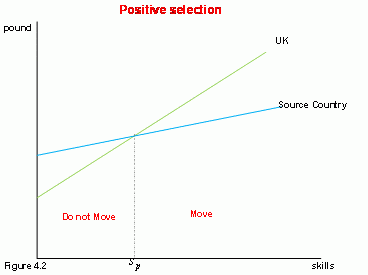
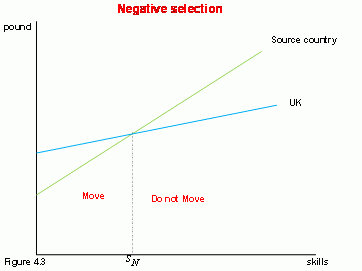
Like all human capital investments, both international and within country migration is based on the comparison of the present value of lifetime earnings in all available employment opportunities. Individuals compare the potential incomes and the destination country with the income in the home countries, and make the migration decision based on these income differentials (net of mobility costs).

Creative destruction at work: jobs that no longer exist – pinsetters and human alarm clocks
14 Jan 2015 Leave a comment
in labour economics, occupational choice, survivor principle, technological progress Tags: creative destruction

A 50 billion note
14 Jan 2015 Leave a comment

The psychology of big personalities will determine our global course in 2015
13 Jan 2015 Leave a comment
in economics
How does the standard of living compare across the EU?
13 Jan 2015 Leave a comment
in macroeconomics Tags: European Union

 Utopia, you are standing in it!
Recent Comments