Two rules for success http://t.co/qeRC8iKuyX—
Learning (@FactsGuide) December 27, 2014
The two rules of success
10 Jan 2015 Leave a comment
in economics of information, entrepreneurship
A rather effective safety notice
10 Jan 2015 Leave a comment
in economics of information, transport economics
😂😂😂😂😂😂😂😂😂😂😂 http://t.co/X4bG3BBoSU—
OnlyOneWeez (@Cryspp_) January 09, 2015
Fareed Zakaria: Blasphemy and the law of fanatics
10 Jan 2015 Leave a comment
in economics of media and culture, economics of religion, liberalism Tags: Blasphemy
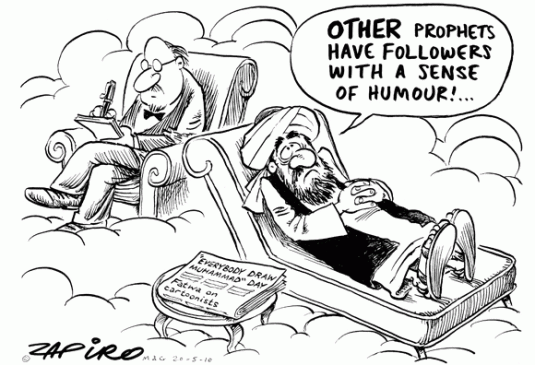
By contrast, the word blasphemy appears nowhere in the Koran. (Nor, incidentally, does the Koran anywhere forbid creating images of Muhammad, though there are commentaries and traditions — “hadith” — that do, to guard against idol worship.)
Islamic scholar Maulana Wahiduddin Khan has pointed out that “there are more than 200 verses in the Koran, which reveal that the contemporaries of the prophets repeatedly perpetrated the same act, which is now called ‘blasphemy or abuse of the Prophet’ . . . but nowhere does the Koran prescribe the punishment of lashes, or death, or any other physical punishment.” On several occasions, Muhammad treated people who ridiculed him and his teachings with understanding and kindness.
“In Islam,” Khan says, “blasphemy is a subject of intellectual discussion rather than a subject of physical punishment.”
HT: http://wapo.st/1zXY2PA but cartoon inserted independently, not in Washington Post
On Charlie Hebdo and campus speech codes
10 Jan 2015 Leave a comment
in liberalism Tags: Blasphemy, campus speech codes

Irish Muslim Leader Warns Any Newspaper From Publishing Charlie Hebdo Cartoons Or Face Blasphemy Charges
10 Jan 2015 Leave a comment
in economics

 Ali Selim of the Islamic Cultural Centre of Ireland has declared publicly that he will bring legal action against any Irish newspaper or publication that runs the Charlie Hebdo or other similar cartoons featuring Muhammad. As discussed in my Sunday Washington Post column, these laws in Western countries like France have served to emboldened those like Selim in demanding that others confirm to their religious sensibilities. Despite his effort to deter others from speaking in this fashion, Selim insists without any appearance of embarrassment that he is “a great advocate of freedom of expression” . . . so long of course that it is his expression or an expression that does not offend him.
View original post 256 more words
Pocket computers in the good old days
10 Jan 2015 Leave a comment


Bryan Caplan on expressive voting and environmentalism
10 Jan 2015 Leave a comment
in applied price theory, economics of media and culture, environmental economics, Public Choice Tags: Bryan Caplan, do gooders, environmentalism, expressive voting
“Caring about the environment” is probably one of the biggest expressive issues of our time but most environmental issues are expressive voting issues:
1. Recycling
2. Preserving wild lands
3. Endangered species
4. Conservation
5. Logging
Even for the more instrumental-looking problems, green voters are bizarrely hostile to efficient solutions:
1. Emissions trading, domestic and international
2. Planting trees as carbon sinks
3. Liming lakes to counter acid rain
4. Privatizing common resources
via Prof.
Right Wing Views Make The Less Intelligent Feel ‘Safe’
10 Jan 2015 Leave a comment
in economics
Does this study actually find that, given link of intelligence and income, the working class is not disposed to voting for the Left?
Understanding the Revolutions of 2011 Weakness and Resilience in Middle Eastern Autocracies
09 Jan 2015 Leave a comment
in economics

By Jack A Goldstone
Foreign Affairs, May/Jun 2011, Volume 90, Issue 3,
The wave of revolutions sweeping the Middle East bears a striking resemblance to previous political earthquakes. As in Europe in 1848, rising food prices and high unemployment have fueled popular protests from Morocco to Oman. As in Eastern Europe and the Soviet Union in 1989, frustration with closed, corrupt, and unresponsive political systems has led to defections among elites and the fall of once powerful regimes in Tunisia, Egypt, and perhaps Libya. Yet 1848 and 1989 are not the right analogies for this past winter?s events. The revolutions of 1848 sought to overturn traditional monarchies, and those in 1989 were aimed at toppling communist governments. The revolutions of 2011 are fighting something quite different: “sultanistic” dictatorships. Although such regimes often appear unshakable, they are actually highly vulnerable, because the very strategies they use to stay in power make…
View original post 4,038 more words
Charlie Hebdo suspects well-known to anti-terror police
09 Jan 2015 Leave a comment
in economics


One had a long history of jihadist ties and links to a key Islamic State militant while the other was on a US watchlist and trained with Al-Qaeda in Yemen, yet the Charlie Hebdo suspects still managed to slip under the radar of French intelligence.
Cherif Kouachi, 32, and his brother Said, 34, are accused of carrying out the deadly attacks on the office of satirical magazine Charlie Hebdo on Wednesday that left 12 dead.
Born to Algerian parents in Paris and orphaned at a young age, they grew up in the east of the city not far from the site of this week’s attack.
According to US officials, Said Kouachi was known by French intelligence to have travelled to Yemen in 2011, where he received training from Al-Qaeda’s affiliate there in small arms combat and marksmanship.
Both were on a US database and no-fly list as terror…
View original post 591 more words
 Utopia, you are standing in it!
Recent Comments