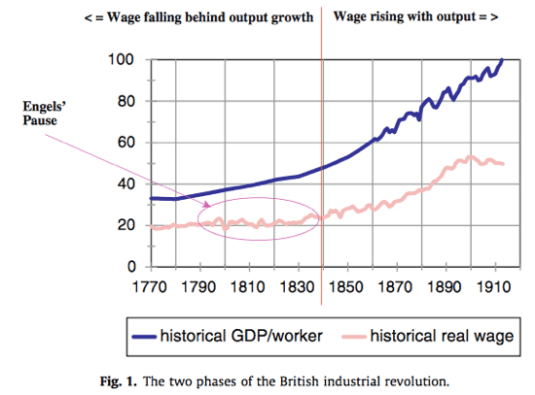
…In the first half of the 19th century, the real wage stagnated while output per worker expanded. The profit rate doubled and the share of profits in national income expanded at the expense of labour and land.
After the middle of the 19th century, real wages began to grow in line with productivity, and the profit rate and factor shares stabilized….
Technical progress was the prime mover behind the industrial revolution. Capital accumulation was a necessary complement.
The surge in inequality was intrinsic to the growth process: technical change increased the demand for capital and raised the profit rate and capital’s share. The rise in profits, in turn, sustained the industrial revolution by financing the necessary capital accumulation.
After the middle of the 19th century, accumulation had caught up with the requirements of technology and wages rose in line with productivity.
via Today’s Economic History: Robert Allen: Engels’s Pause (Brad DeLong’s Grasping Reality…).
 Utopia, you are standing in it!
Recent Comments