The latest counting in the New South Wales Legislative Council election shows the ease in which ordinary citizens can form a political party and be elected to Parliament when there is federalism and an upper house elected by proportional representation.
Five of the six Australian states have an upper house. In four of those states, the electoral system is proportional representation, with results in the election of many small parties.
In Tasmania, my home state, the Legislative Council as single member constituencies with two or three vacancies filled every year but is full of independents elected the six-year terms. The political parties having no chance of getting candidates elected in front of them. The Tasmanian voters simply don’t vote for party candidates in the Legislative Council elections. Out of 15 members, there is one Liberal Party member, and two members from the Labour Party
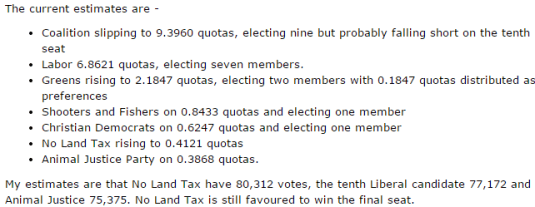
In the current New South Wales Legislative Council election, the favourite to win the last seat, and with it the balance of power in the upper house is a previously unheard of No Land Tax party. The Shooters and Fishers party is electing another member this year in New South Wales. The Christian Democrats also have two members.
In Victoria, the Australian Sex Party finally got a candidate elected to the upper house late last year through the courtesy of proportional representation.
Other small parties in the Victorian Legislative Council are the Shooters and Fishers Party with two members, the Democratic Labour Party with one member and a party of never heard of, Vote 1 Local Jobs, with the last seat. These small parties share the balance of power.
The South Australian Legislative Council includes two members from the No Pokies Party, two members from the Family First Party, and one from the Death with Dignity party. Again, this motley crew shares the balance of power.
Western Australian Legislative Council has a government majority, but there is one member from the Shooters and Fishers Party.
The crossbench in the Australian Senate is made up of eight independents and small parties. Several Australian senators on the crossbenchers are completely mad and ignorant; in one certain case, as thick as two short planks. This doesn’t harm, in the case of Jackie Lambie, her chances of being re-elected to the Senate for Tasmania for another six-year term in 2019. A number of Tasmanian voters, including members of my family, value her honesty, though they do admit she is not very bright and is rather rough around the edges.
The strength of democracy lies in the ability of small groups of concerned and thoughtful citizens to band together and change things by running for office and winning elections. That is how new Australian parties such as the ALP, the country party, DLP, Australian democrats and Greens changed Australia. One Nation even had its 15 minutes of fame. Most of these parties started in someone’s living room, full of concerned citizens aggrieved with the status quo.
In Australian elections in recent years, about a quarter of the electorate do not give their vote in upper house selections to the major parties: the Labour Party, the Liberal Party and the Australian Greens. That is fertile ground for small parties to flourish.
So fertile ground is the Australian Senate that the big parties want to change the election system to make it harder for the small parties to swap preferences to get elected through proportional representation and make it much harder to register a political party in the first place.
As would be expected, the far left parties get nowhere in the upper houses of the Australian State parliaments, despite the benefits of proportional representation and preferential voting. These upper houses are filled with small parties from both the left and the right, populist parties all, but the battle cry of socialism just doesn’t resonate with the Australian electorate.
Same thing happened in New Zealand in its recent parliamentary elections. New Zealand has no upper house, but does have proportional representation for the House of Representatives.
A pre-existing hard left party well-funded by a millionaire with an agenda to avoid extradition to the USA got 1.2% of the party vote, but it lost its electorate seat and so is out of Parliament since late last year’s general election.
 Utopia, you are standing in it!
Recent Comments