The Conservative Party of New Zealand in the 2014 general election was very much formed around the notion of introducing citizen initiated binding referendums in a country with the Parliament is sovereign. The first referendum is likely to be on one of the following:
· decriminalising marijuana,
· banning smoking,
· voluntary euthanasia,
· a living wage,
· life means life in prison,
· same-sex marriages,
· marriage is between a man and a woman,
· entrenching the Treaty of Waitangi,
· abolishing the Maori seats,
· entrenching the Maori seats,
· stop school closures, and
· capital punishment; and
· future referendums not be binding
Binding referenda are unworkable. Parliament can’t amend them later as we learn from the implementation of the law and unintended consequences arise. Every new law is riddled with unintended consequences and blow-backs.
Do you really want to have to have another referendum to undo a binding referendum that turned out to be a bit of a mistake? One of the few redeeming features of the Parliament that is sovereign – a parliament for can make or unmake any law whatsoever – is it can repeal its mistakes quickly.
The first citizens initiated referendum was held on 2 December 1995. The question was
Should the number of professional fire-fighters employed full-time in the New Zealand Fire Service be reduced below the number employed in 1 January 1995?
Turnout was low as the referendum was not held in conjunction with a general election, and the measure was voted down easily, with just over 12% voting “Yes” and almost 88% voting “No”.
The key to constitutional design is not empowering you and yours – it is how to restrain those crazies to the Left or the Right of you, as the case may be, when they get their hands on the levers of power, as they surely will in three, six or nine years’ time.
The one inevitability of democracy is power rotates – unbridled power and binding referenda lose their shine when you must share that power with the opposing side of politics who put up their own referendum question.
Constitutions are brakes, not accelerators. Much of constitutional design is about checks and balances and the division of power to slow the impassioned majority down.
Constitutional constraints are basically messages from the past to the present that you must think really hard, and go through extra hurdles before you do certain things.
The 18th and 19th century classical liberals were highly sceptical about the capability and willingness of politics and politicians to further the interests of the ordinary citizen, and were of the view that the political direction of resource allocation retards rather than facilitates economic progress.
Governments were considered to be institutions to be protected from but made necessary by the elementary fact that all persons are not angels. Constitutions were to constrain collective authority.
The problem of constitutional design was ensuring that government powers would be effectively limited. The constitutions were designed and put in place by the classical liberals to check or constrain the power of the state over individuals.
The motivating force of the classical liberals was never one of making government work better or even of insuring that all interests were more fully represented. Built in conflict and institutional tensions were to act as constraints on the power and the size of government.
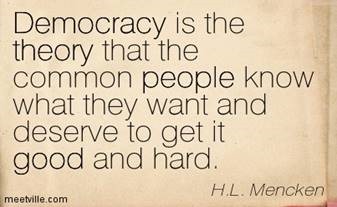
Representative democracy is a division of labour in the face of information overload. John Stuart Mill had sympathy for parliaments as best suited to be places of public debate on the various opinions held by the population and as a watchdog of the professionals who create and administer laws and policy:
Their part is to indicate wants, to be an organ for popular demands, and a place of adverse discussion for all opinions relating to public matters, both great and small; and, along with this, to check by criticism, and eventually by withdrawing their support, those high public officers who really conduct the public business, or who appoint those by whom it is conducted.
Representative democracy has the advantage of allowing the community to rely in its decision-making on the contributions of individuals with special qualifications of intelligence or character. Representative democracy makes a more effective use of resources within the citizenry to advance the common good.
Members of parliament are trustees who follow their own understanding of the best action to pursue in another view. As Edmund Burke wrote:
Parliament is not a congress of ambassadors from different and hostile interests; which interests each must maintain, as an agent and advocate, against other agents and advocates; but parliament is a deliberative assembly of one nation, with one interest, that of the whole; where, not local purposes, not local prejudices ought to guide, but the general good, resulting from the general reason of the whole.
You choose a member indeed; but when you have chosen him, he is not a member of Bristol, but he is a member of parliament. … Our representative owes you, not his industry only, but his judgment; and he betrays instead of serving you if he sacrifices it to your opinion.
Modern democracy is government subject to electoral checks. Citizens do have sufficient knowledge and sophistication to vote out leaders who are performing poorly or contrary to their wishes. Modern democracy is the power to replace governments at periodic elections.
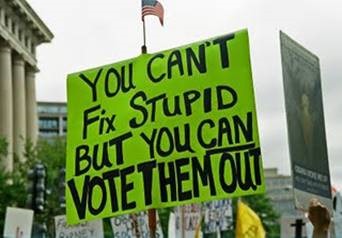
The power of the electorate to turn elected officials out of office at the next election gives elected officials an incentive to adopt policies that do not outrage public opinion and administer the policies with some minimum honesty and competence.
Richard Posner argued that a representative democracy enables the adult population, at very little cost in time, money or distraction from private pursuits commercial or otherwise:
- to punish at least the flagrant mistakes and misfeasance of officialdom,
-
to assure an orderly succession of at least minimally competent officials,
-
to generate feedback to the officials concerning the consequences of their policies,
-
to prevent officials from (or punish them for) entirely ignoring the interests of the governed, and
-
to prevent serious misalignments between government action and public opinion.
Enough of politics and elections, I have a life to lead. Don’t you? Too many want to remake democracy with the faculty workshop as their model.

Such deliberation has demanding requirements for popular participation in the democratic process, including a high level of knowledge and analytical sophistication and an absence, or at least severe curtailment, of self-interested motive. The same goes for citizen initiated binding referendums.
 Utopia, you are standing in it!
Recent Comments