Ezra Klein and Matt O’Brien posed an interesting variation of Brad De Long’s Time Machine question. O’Brien asked:
Try this thought experiment. Adjusted for inflation, would you rather make $50,000 in today’s world or $100,000 in 1980’s? In other words, is an extra $50,000 enough to get you to give up the internet and TV and computer that you have now? The answer isn’t obvious.
And if $100,000 isn’t enough, what would be? $200,000? More? This might be the best way to get a sense of how much better technology has made our lives—not to mention the fact that people are living longer—the past 35 years, but the problem is it’s particular to you and your tastes. It’s not easy to generalize.
This doesn’t mean, though, that the middle class is doing well or even as well as it should be. Just that it’s doing better than the official numbers say it is.
Let them have iPhones is the new let them eat cake.
The same questions are asked in New Zealand in a different way when people go on about how much more unequal New Zealand is compared to the 1980s and how bad things have got because of that rise in inequality.
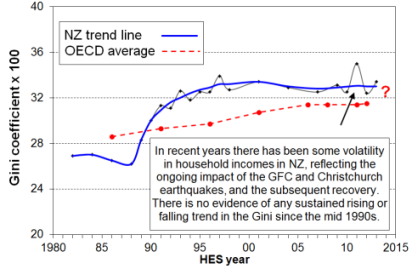
Would it better to be on the welfare benefit in the 1980s than on a benefit today in a less equal New Zealand than in the 1980s? It is certainly the case that the Gini coefficient is worse than it was in the 1980s – see figure 1.
Figure 1: Gini coefficient New Zealand 1980-2015
Source: Bryan Perry, Household incomes in New Zealand: Trends in indicators of inequality and hardship 1982 to 2013. Ministry of Social Development (July 2014).
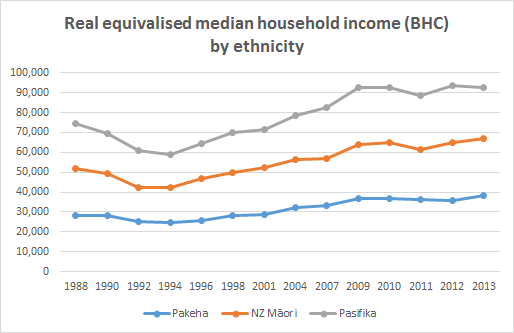
But household incomes on a real basis increased across the border in New Zealand – see figure 2 – including for Maori and Pasifika. As shown in figure 2 below, between 1994 and 2010, real equivalised median New Zealand household income rose by 47%; for Māori, this rise was 68%; for Pasifika, the rise in real equivalised median household income was 77%.
Figure 2: Real equivalised median household income (before housing costs) by ethnicity, 1988 to 2013 ($2013)
Source: Bryan Perry, Household incomes in New Zealand: Trends in indicators of inequality and hardship 1982 to 2013. Ministry of Social Development (July 2014).
The biggest worry for anyone longing to be on a welfare benefit or to be otherwise working back in the good old days in the 1980s on the more equal incomes of back then is instant death.

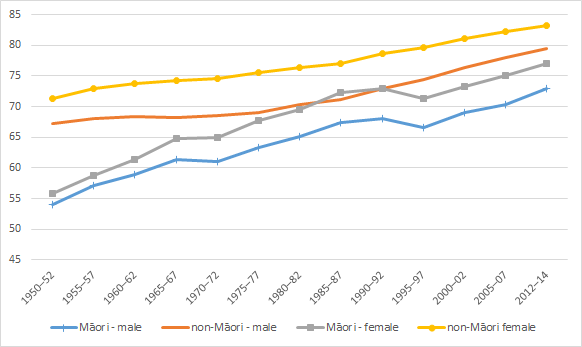
Stepping into that Time Machine to go back to the more equal, more egalitarian 1980s shaves about five years off your life expectancy, if not more! Death certainly is the great leveller when it comes to Left over Left fantasies about the good old days before the economic reforms of the 1980s. Indeed, the 1980s was a period where life expectancies started to increase again after a hiatus in the 1960s and 1970s.

Time travel back to the good old days in the 1980s before neoliberalism would be particularly grim from Maori because of their much lower life expectancies of Maori back in the 1980s – see figure 3.
Figure 3: Life expectancy at birth, Maori and non-Maori by sex
Source: Statistics New Zealand.
The most apt summary of how bad it was in the 1980s compared to today is by veteran left-wing grumbler Max Rashbrooke. To paint pre-1984 New Zealand, pre-neoliberal New Zealand as an egalitarian paradise, he had to ignore the economic progress of two thirds of the population and the inequalities they suffered:
New Zealand up until the 1980s was fairly egalitarian, apart from Maori and women, our increasing income gap started in the late 1980s and early 1990s.
 Utopia, you are standing in it!
Jun 21, 2015 @ 19:51:34
I am awfully curious as to why you ascribe the increase in life solely to improvements in economic standing, rather than improved medical care. For instance, in this time span checklists were introduced for surgery, something that simple has resulted in a huge improvement in patient outcomes, entirely independent of the cost of the operation.
LikeLiked by 1 person