
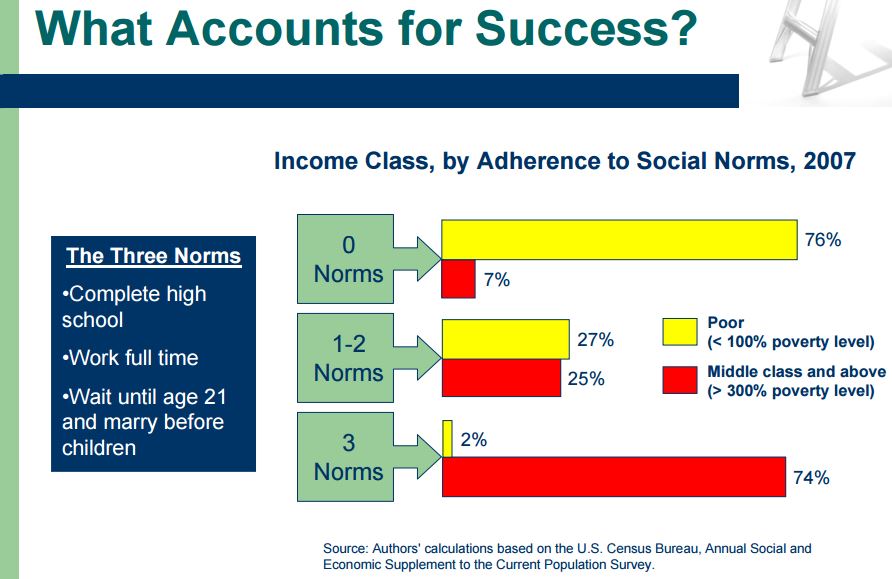
The “success sequence” is an idea from Ron Haskins and Isabel Sawhill at the Brookings Institution. They want to balance government investment and “personal responsibility” to reduce poverty. By personal responsibility, they mean adherence to what they call “the three norms”: complete high school, work full time, wait until you’re 21 and married to have children. If you do that — and smile while doing it — they’re willing to spot you a little welfare and some education.
I’ll describe it, and some criticism of the idea, then show a little data analysis.
Haskins and Sawhillclaim to have analyzed data to show that when you follow all three of these norms, you have a 98% chance of not being poor. This is how they illustrate it (from this slideshow):
 Matt Bruenig at Demos has an important post explaining how misleading — and wrong — this is. There are three…
View original post 655 more words
 Utopia, you are standing in it!
Recent Comments