This Labour Party link made it very easy for me to submit to the Select Committee of Parliament to oppose the Bill on regulating zero hours contracts. I oppose the Bill for the exact opposite reasons that the Labour Party opposes the Bill.
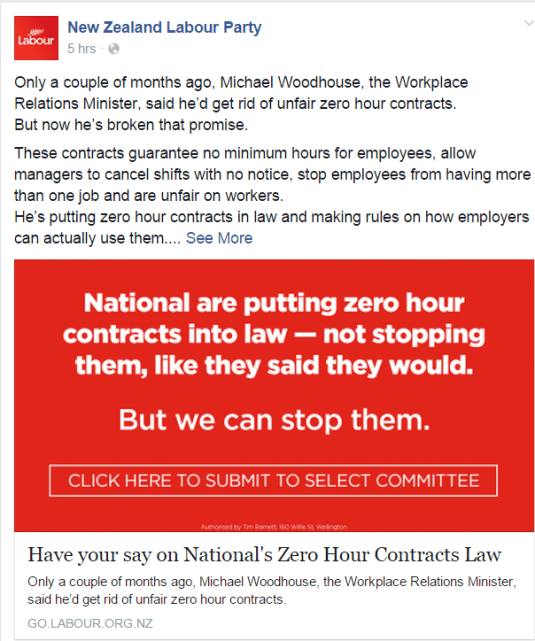
I encourage others to make a submission to Parliament as well opposing this draft amendment that will lower the wages of workers. My submission is as follows:
I do not support the proposed changes to the legislation governing zero hour contracts in the Employment Standards Legislation Bill. There should be no regulation of zero hours contracts.
Zero hours contracts is creative destruction at work in the labour market, sweeping away obsolete working time arrangements, mostly in the retail services sector. Plenty of new ways of working have emerged in recent years that include the proliferation of part-time work, temporary workers, leased workers, working from home, teleworking and sub-contracting. Employment laws were built on the now decaying assumption that workers had career-long, stable relationships with single employers.
Advance notice of work schedules is always known only to a minority of temporary and permanent employees in New Zealand, and there’s not much difference between that advance notice between temporary and permanent employees.
Critics overplay their hand if they suggest that somehow workers are very much disadvantaged and employers are holding all the cards. Job turnover and recruitment problems are a serious cost to a business. Workers will not sign zero hours contracts if they are not to their advantage.
Unless labour markets are highly uncompetitive with employers having massive power over employees, employers should have to pay a wage premium if zero-hour contracts are a hassle for workers.
The fixed costs of employment are such that you shouldn’t expect zero-hour contracts: you’ll typically do better with one 40-hour worker over two 20-hour workers because of these costs. Zero hour contracts would be most likely in jobs with low recruitment costs and where specialised training needs are low. Workers with low fixed costs of working will move into the zero-hour sector while those with higher fixed costs would prefer lower hourly rates but more guaranteed hours. Again, read lower here as meaning relative to what they could elsewhere earn.
Unless we have a good idea about why firms are moving to zero hours contracts, which we don’t, and why employees sign these contracts rather than work for other employers who offer more regular hours, meddling in these novel working time arrangements is risky.
Employers must pay a wage premium to induce in workers to sign zero hours contracts. This Bill seeks to deny workers the right to seek higher wages.
Feel free to use the above text as the basis for your own submission to Parliament.
 Utopia, you are standing in it!
Oct 05, 2015 @ 19:15:57
Reblogged this on Utopia – you are standing in it! and commented:
Do not forget to make your submission to Parliament through this handy link.
LikeLike