It seems that the top 10% of men are so busy oppressing the top 10% of women that they forgot to keep up the violence inherent in the capitalist system against the bottom 10% of women. The gender pay gap at the bottom of the economic strata closed quite dramatically and consistently since 1970 or as far back as data was available in Australia, New Zealand, the UK and USA. Much of the closing of the gender pay gap for the low-paid was under the scourge of Reagan, Thatcher, Hawke and Keating and Rogernomics.
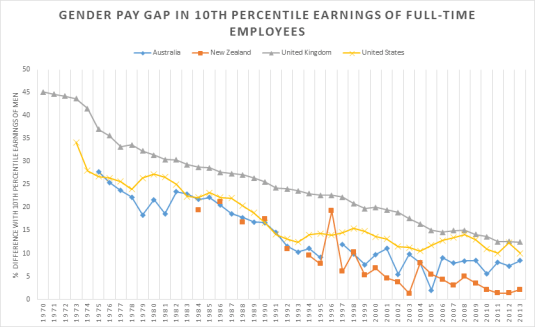
Source and Notes: OECD Employment Database. The gender gap plotted below is unadjusted. It is calculated as the difference between the 10th percentile earnings of men and the 10th percentile earnings of women relative to the 10th percentile earnings of men. Estimates of earnings used in the calculations refer to gross earnings of full-time wage and salary workers. However, this definition may slightly vary from one country to another.
By comparison to this dramatic liberation of women from the gender pay gap at the bottom, the gender pay gap for full-time employees has not really tapered down that much at the top of the income distribution and has been pretty flat for coming on 20 years. It seems the class war is over and has been won by women at the bottom but not at the top?
Younger, more educated women delay having families and can earn as much as their partners. bit.ly/1jw98Ky http://t.co/BaDIlBIBA2—
Ninja Economics (@NinjaEconomics) October 14, 2015
Rather than up the workers, the battle cry of the Posh Trots is up the managers, liberate them from insidious pay inequities imposed upon them by a vast sexist conspiracy of male managers.
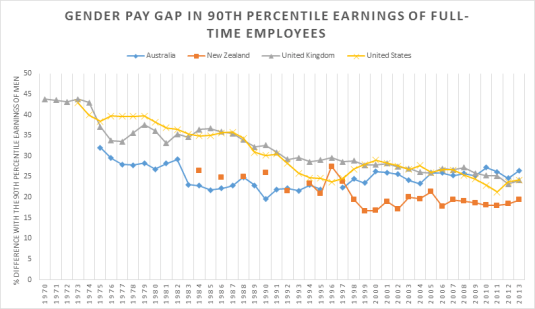
Source and Notes: OECD Employment Database. The gender gap plotted below is unadjusted. It is calculated as the difference between the 10th percentile earnings of men and the 10th percentile earnings of women relative to the 10th percentile earnings of men. Estimates of earnings used in the calculations refer to gross earnings of full-time wage and salary workers. However, this definition may slightly vary from one country to another.
This failure to close the gender pay gap at the top requires more investigation. The available of reliable contraceptives in the late 1960s led to an explosion of investment by women in long duration professional education and in careers where absences because of motherhood in their 20s and 30s was penalised in terms of human capital depreciation and promotional opportunities.

The reason for the endurance of the gender pay gap at the top of the income distribution is compensating differentials. Women at the top were able to have it all.

Professional women could invest in a career and a family and mix-and-match according to their own preferences for career and family and timing of births rather than the preferences of others who looked upon them as some sort of pathfinder for their gender. It is at the top of the income distribution where short absences from the workplace can has very large consequences for wages and promotion.

 Utopia, you are standing in it!
4 Comments (+add yours?)