#inequality matters for achieving the end of #poverty. #EvenItUp @OxfamAmerica @dpaulobrien https://t.co/Ld9qhJhfcl—
Nick Galasso (@vngalasso) October 19, 2015
The Left over Left would grumble at the gates of heaven.
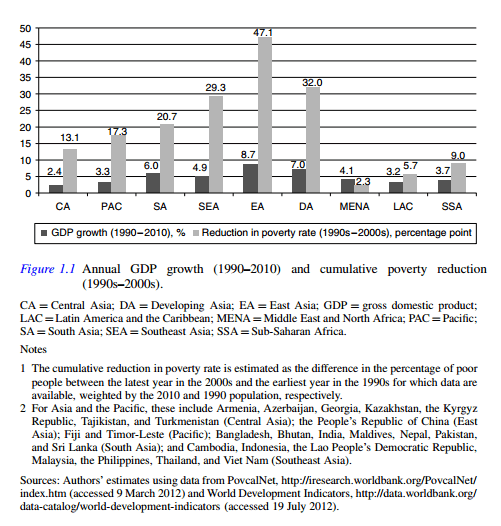
Source: Inequality in Asia and the Pacific | Asian Development Bank.
The fact that most of the Twitter Left would have to go through the eye of a needle would not dawn of them. They would be more interested in whether there was free Wi-Fi.
where do the extreme poor live? this @worldbank graphic wont tell you as it ignores new survey data 4 Nigeria & India http://t.co/APb0M0TuYK—
Laurence Chandy (@laurencechandy) April 14, 2014
The latest grumblings of the Twitter Left is after the World Bank announced that extreme poverty is to drop below 10% of the world’s population for the first time ever.
Rather than celebrate this tremendous achievement of capitalism and freedom, the Twitter Left grumbles about inequality.
A look at hunger reduction → performance + projections by region: brook.gs/1FWLLOS http://t.co/ELNzKn6BCQ—
Brookings Global (@BrookingsGlobal) June 16, 2015
A legitimate reason for the opposition to capitalism in Latin America is crony capitalism. This is opposed to the competitive capitalism that produces economic miracles. Becker defines crony capitalism as
…a system where companies with close connections to the government gain economic power not by competing better, but by using the government to get favoured and protected positions. These favours include monopolies over telecommunications, exclusive licenses to import different goods, and other sizeable economic advantages. Some cronyism is found in all countries, but Mexico and other Latin countries have often taken the influence of political connections to extremes.
Nearly all of Asia (where much of the world’s population lives) has undergone rapid and sustained economic and social progress because they became market economies, starting with the Asian Tigers and recently in previously socialist India and communist China.
Growth paths of #LatAm & the Caribbean the South East Tigers: wrld.bg/NCtLt #RiseoftheSouth http://t.co/IFuUOWldox—
World Bank Pubs (@WBPubs) May 31, 2015
Latin America adopted the inward economic policies of the mid-20th century that renegade liberals praise so much and they became development disasters.
How can we eradicate #poverty by 2030? @Winnie_Byanyima wef.ch/1QvSVPW #development http://t.co/reBsT24BU3—
World Economic Forum (@wef) September 24, 2015
The trend in past several decades in most countries has been toward more open economies with greater competition within industries. There is more reliance on private enterprise, and with a reduced role for government, government-run enterprises, and cronyism.
Hot off the press: @WorldBank publishes new global poverty estimates and forecasts. 1.01 billion < $1.25/day in 2011 http://t.co/cGfdEAdOMo—
Laurence Chandy (@laurencechandy) October 08, 2014
As the world embraced free market policies in the late 20th century, living standards rose sharply; life expectancy, education and democracy improved and absolute poverty declined.
Xavier Sala-I-Martin and Maxim Pinkovskiy (2010) found that between 1970 and 2006, extreme poverty fell by 86% in South Asia, 73% in Latin America, 39% in the Middle East and 20% in Africa.
The percentage of people living on less than $1 a day (in PPP-adjusted 2000 dollars) fell from 26.8% in 1970 to 5.4% in 2006.
#Africa represents the last hurdle to ending extreme #poverty ($1.25 per day) → brook.gs/1JS4EUH http://t.co/ihDFc6R3ly—
Brookings Global (@BrookingsGlobal) July 29, 2015
Xavier Sala-I-Martin also estimated eight indexes of income inequality. All of them show reductions in global inequality during the 1980s and 1990s.
 Utopia, you are standing in it!
Recent Comments