I stayed on after my Parliamentary testimony this morning to listen to others. A dozen or more made submissions arguing for more regulation – usually asking that zero hours contracts be outlawed.
I was the only submitter so far who argued against any regulation of zero hours contracts. I was thanked for putting a different perspective at the end of my submission. All members of the committee were very polite and listen to what I had to say.
Inadvertently, of course, Iain Lees-Galloway and Sue Moroney of the Labour Party and several members of the Public Service Association unearthed telling points against the case for regulation of zero hours contracts in the course of the morning in both the submissions and through the Q&A.
The first member of the Public Service Association to present information against zero hours contracts was a home support worker who was a union organiser.
This Public Service Association union organiser said, among many points in a kitchen sink submission, that zero hour contracts would deter people from entering her industry. That’s my point about zero hours contracts:
- Zero hours contracts are a risk to employers when recruiting unless they are packaged within an attractive job offer; and
- Offering a zero hours contracts will deter applicants from accepting a job offer unless there is some compensating factor in that offer.
A second member of the Public Service Association talked about her daughter who was on a zero hours contract in her first job. After a seven-month spell of unemployment, her daughter worked as many shifts as possible to show she was a valued member of her team. Good for her. In low skilled jobs, what employers look for is someone who is friendly and reliable.
Part of that story was about the difficulties of her daughter with the correct payment of her unemployment benefit. Every Friday she has to telephone WINZ to forecast how many hours she expected to work in the following week so her unemployment benefit is correctly calculated for the following paid day.
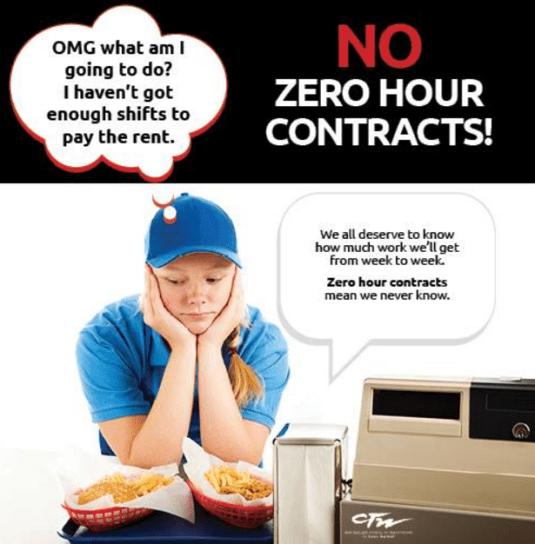
From time to time, the submitter’s daughter was called in at the last minute for a shift on her zero hours contract at the weekend so that estimate of the previous day is incorrect and she is overpaid on her benefit.
This retention of unemployment benefit eligibility is a key point against the arguments raised by Iain Lee-Galloway about how workers and, in particular, the unemployed have no option but to accept zero hours contracts. Galloway was correct in making this the crux of the matter.
He can he kept stressing the inequality of bargaining power and a lack of options of job applicants when questioning me at the hearings this morning.
It was Iain Lees-Galloway who set up this bargaining power inequality as a crucial argument against zero hours contracts, not me. Zero hours contracts are said by the Labour Party and the unions to be a bad deal. It’s an offer job seekers cannot refuse, especially if they’re unemployed.
If beneficiaries do have options and they can refuse an offer of a zero hours contract, as 50% of British unemployment beneficiaries do, most arguments for the regulation or prohibition of zero hours contracts fall of the first hurdle.
The submitter’s daughter was still on an unemployment benefit despite taking a zero hours contract. She had options. She had a basic income, the unemployment benefit, so she was never left in the lurch if there was no shift that week. She never earned less than the unemployment benefit weekend and week out and often earned more.
- No one who already has a job would take a zero hours contracts unless they were confident of matching the hours and income they earn now; and
- An unemployment beneficiary keeps the unemployment benefit as a cushion when they accept a zero hours contract unless they earn more than $200 a week.
The unemployment benefit allows beneficiaries to earn up to $200 a week after which benefit is withdrawn at 50 cents per dollar. As the beneficiary is still on the benefit, they have access to those all-important 2nd tier benefits ranging from accommodation allowances to special grants for unexpected urgent expenses.
Zero hours contracts allow the unemployed to make the benefit pay. Simon Chapple pointed out to me a few years ago that part-time work and benefit receipt can be an attractive long-term option for low skilled workers such as single mothers. The unemployment or single-parent beneficiary who works part-time has the certainty of the unemployment benefit plus a couple hundred dollars extra-week from their part-time job while retaining the second tier benefits that guard against unexpected expenses.
Sue Moroney then finished off the case against regulating zero hours contracts when questioning a submitter from the construction industry. The submitter was discussing the generosity of parental leave as well as zero hours contracts.
Sue Moroney pointed out that because of childcare responsibilities, the ability of that industry to attract women is greatly diminished if they offer zero hours contracts. She was pointing out a major cost of zero hours contracts to employers who offer them.
Sue Moroney highlighted the risk to employers of cutting themselves off from a major part of the job applicant pool – mothers of young children. That is a big cost unless employers offering zero hours contracts either pay a wage premium to keep access to that talent or offer these contracts to teenagers and adults, men and women, who circumstances dispose to working variable hours, sometimes working long hours and sometimes not working at all that week.
Zero hours contracts is an issue about job search and job matching. These contracts will benefit some employers and some employees. Other jobseekers will not sign such contracts. Still others will find that after signing a zero hours contract, that was not the best choice for them in retrospect. That form of on-the-job learning about competing job opportunities is common. Young people spend their first 10 to 15 years in the workforce job shopping. They move through half a dozen or more different jobs, employers and even industries before they find a good fit for them and stay on.
All in all, zero hours contracts empower the unemployed. Zero-hours contracts allow the unemployed to try out jobs while keeping their unemployment or single parent benefit. They don’t have to go completely off the benefit then risk a stand-down period of 6 to 12 weeks if they leave a regular job that is unsatisfactory.
Furthermore, the zero hours contracts give them an opportunity sometimes to earn a lot of money in a short period of time was still retaining their benefit eligibility. As another member of the Public Service Association mentioned when your wages balloon because of long hours one week, your benefit is wound back, but they are still on their benefit. They don’t have to reapply and risk of stand-down period
Zero hours contracts expand the options of jobseekers, especially the unemployed. Taking a zero hours contract gives the unemployed the option to test out a job without having to give up their unemployment benefit. They are empowering, not put upon as the Labour Party and the union members argued today.
 Utopia, you are standing in it!
Recent Comments