I can only speculate for the reasons why Italy has the smallest gender pay gap when there are children. One possibility is low fertility rates. Another is that Italian mothers either work full-time or don’t work at all.
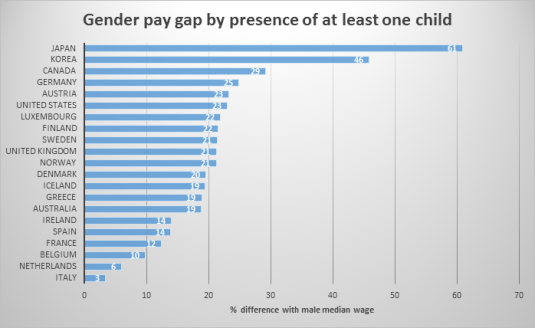
Closing the Gender Gap: Act Now – © OECD 2012: OECD Secretariat estimates based on EUSILC (2008), HILDA (2009), CPS (2008), SLID (2008), KLIPS (2007), JHPS (2009), CASEN (2009) and ENIGH (2010) (Annex III.A3).
As for the remaining countries, having children increases the gender wage gap. This increase in the gender wage gap cannot be attributed to employer bias. They don’t know whether the female applicant has children. It is unlawful to ask.
The number of children and the spacing between their births has been a major driver of the gender wage gap for decades. These long-standing findings have been devastating to the notion that there is discrimination against women on the demand side of the labour market. Employer discrimination is unimportant to the gender wage gap as Polachek explains:
The gender wage gap for never marrieds is a mere 2.8%, compared with over 20% for marrieds. The gender wage gap for young workers is less than 5%, but about 25% for 55–64-year-old men and women.
If gender discrimination were the issue, one would need to explain why businesses pay single men and single women comparable salaries. The same applies to young men and young women. One would need to explain why businesses discriminate against older women, but not against younger women. If corporations discriminate by gender, why are these employers paying any groups of men and women roughly equal pay?
Why is there no discrimination against young single women, but large amounts of discrimination against older married women? …Each type of possible discrimination is inconsistent with negligible wage differences among single and younger employees compared with the large gap among married men and women (especially those with children, and even more so for those who space children widely apart).
The main drivers of the gender wage gap are unknown to employers such as whether the would-be recruit or employer is married, the father is present to help with childcare, how many children they have, how many of these children are under 12, and how many years between the births of their children. These are the main drivers of the gender wage gap.
All of these factors that drive much of the gender wage gap are totally unknown to employers and of no relevance to making a profit. Furthermore, it is costly to discover this information about family composition as well as illegal. Where is the profit in that information? Searching for information only sacrifices more profit. That is not a good business survival strategy: searching for irrelevant information.
 Utopia, you are standing in it!
Recent Comments