The gender wage gap from married women is 3 to 30 times that of single women. This was actually have a positive gender wage gap.
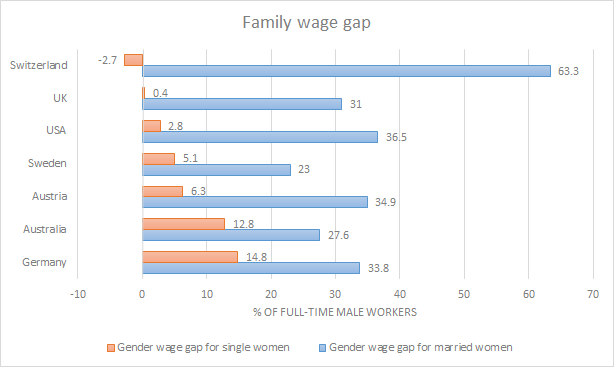
Source: IZA World of Labor – Equal pay legislation and the gender wage gap.
The smallest of the gender wage gap for single women, which has been well known for a long time, does not bode well for those such as Geoff Simmons who argue that implicit bias is an important driver of the gender pay gap.
Why are there vast differences in this implicit bias against women between countries. Why is this implicit bias so much stronger against married women? Having an implicit bias against married women but not single women is a very odd implicit bias.
These puzzles are before considering the information extraction problem facing employers who are implicitly bias against married women. Employers do not know whether an applicant is married or single and pay less accordingly. As Polachek observed:
Corporate discrimination cannot explain these wage patterns. Were corporate discrimination the reason, one would need an explanation why corporations hardly discriminate against single women, but discriminate enormously against married women, especially married women with children spaced widely apart, given that they often cannot legally ask questions about marital status in employment applications.
Even if they could get this marital status information, they wouldn’t have information on the number and spacing of one’s children. But even if supervisors knew number of children, they are far less knowledgeable about children’s ages, and hence less likely to know much about child spacing.
Employers who are slightly less implicitly biased against married women would have a far higher quality recruitment pool which gives them a competitive advantage. Employers who are implicitly biased against women and married women are less likely to survive in competition.
 Utopia, you are standing in it!
Recent Comments