Lord Ashcroft has written a fascinating review of the unexpected 2015 general election result in the UK based on his polling and focus group work. I will start my summary of it with UKIP because that party is the most interesting way to illustrate his analytical approach.
UKIP increased its vote from 3% in 2010 British general election to 12% in 2015. UKIP won 1 seat and came second in 120.
UKIP was initially seen as a threat to the Tory party. What will make the Tory party rather conflicted in winning those votes back is as many Tory voters vote UKIP as Tory voters vote for the Liberal Democrats. The Tories cannot win both blocs back.
UKIP voters have more of an attitude rather than a series of policies despite their preoccupation with immigration as Ashcroft explains:
It was true that those who were drawn to the party were more preoccupied than most with immigration, and would complain about issues such as Britain’s contribution to the EU or the international aid budget.
But their overarching view was that Britain was changing for the worse. They were pessimistic, even fearful, and did not think mainstream politicians were willing or able to keep their promises or change things for the better.
Surprisingly, European Union membership is not a top three priority for most UKIP voters. They are grumpy about the country they grew up in fading into their past to be replaced by political correctness and identity politics.
Not surprisingly UKIP voters are attracted to it because the party would ‘say things that need to be said but others are scared to say’. Nigel Farage was regarded by UKIP voters as entertaining and straight talking but a little too interested in the limelight.
Ashcroft has as fascinating way of cutting past social acceptability bias in responses of focus groups by asking them to think about a political party or leader as a car or house. In the case of UKIP, this is what they thought:
If UKIP were a house, it would have ‘a wrought-iron fence all round to keep everyone out’. The ageing residents would spend their time ‘talking about how things were in their day’ and would not get on with their neighbours ‘because they are a different colour’. The timer on the stereo would be set to play the national anthem every day at noon.
Surprisingly few UKIP voters have illusions about the competence or good sense of UKIP. They were voting for UKIP as a protest. They are voting UKIP because they wanted to give it a voice which they can build on and become more competent and sensible.
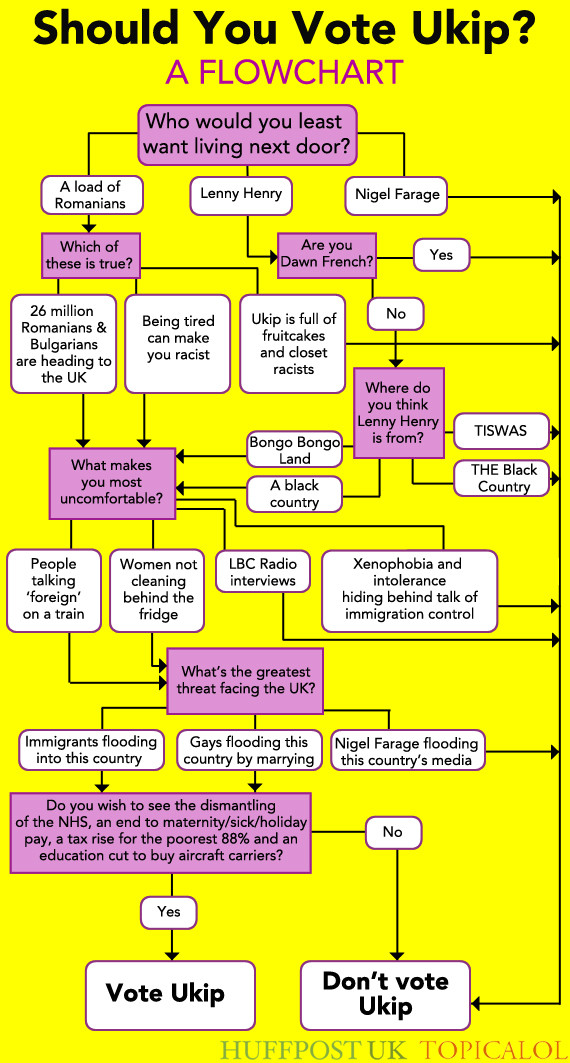
Source: FLOWCHART: Should You Vote Ukip?
 Utopia, you are standing in it!
Recent Comments