If our friends on the left are to be believed, trade liberalisation is bad unless it involves Cuba, Vietnam, Iraq and other heroes of the anti-west left. The anti-west left is different from the antifascist left and is sometimes known as the renegade left or regressive left.
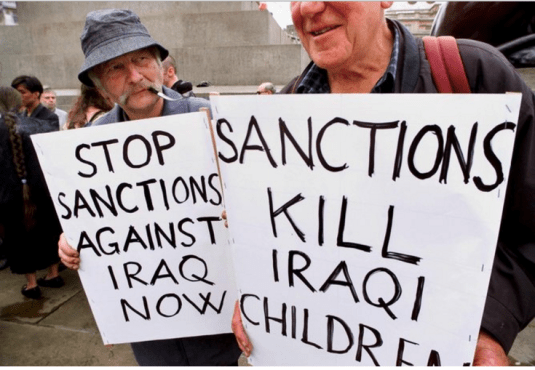
Access to world markets, and the removal of trade sanctions and travel and investment restrictions are all to the benefit of the Vietnamese, Iraqi and Cuban people in the street and not just their elites in the eyes of the anti-west left. There you have: trade liberalisation is bad because reduced tariffs at home and abroad hurts ordinary people; trade sanctions are bad because they hurt ordinary people by denying them access to import from and exporting into world markets.
Trade sanctions against Iraq were to terrible for the Iraqi people. Removing those trade sanctions and similar sanctions on Cuba and Vietnam, which expanded their ability to export and import was essential to improving the welfare of Iraqis, Cubans and Vietnamese respectively. Two of these three countries are not a democracy with the guarantees elections have in ensuring broad-based benefits but nonetheless greater trade liberalisation was seen as to the advantage of the ordinary people of those dictatorships by the Left.
https://twitter.com/GazaReports/status/686399912485994496
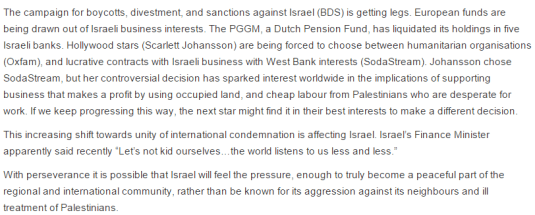
Likewise boycotting, disinvesting and sanctions on Israel will change the Israeli policy because the Israeli people. The logic here is that trade and investment is wealth enhancing, so restricting trade punishes Israelis.
Source: Kennedy, New Zealand Greens: Tipping points – Israel, Palestine, and peace.
A comprehensive study by Kim Elliott, Jeffrey Schott, and Gary Hufbauer looked at whether sanction works. Do they accomplish the goals identified by U.S. policy-makers such as ending apartheid or undermining Libya’s support of terrorism? The study estimated they have succeeded 23 percent of the time. But of course as Kaempfer and Lowenberg say
Sanctions may be imposed not to bring about maximum economic damage to the target, but for expressive or demonstrative purposes. Moreover, the political effects of sanctions on the target nation are sometimes perverse, generating increased levels of political resistance to the sanctioners’ demands.
It is also that case that Kaempfer, Lowenberg and Mertens (2001) found that sanctions generate rents that can be appropriated by a dictator and his cronies and supporters such as those who were close to Saddam. The losses from the sanctions were borne by those who are opposed to the regime. This weakens their capacity to oppose it, leading to the further entrenchment in power of the dictator and his supporters. As Wintrobe explains:
In the public choice approach, sanctions work through their impact on the relative power of interest groups in the target country. An important implication of this approach is that sanctions only work if there is a relatively well organized interest group whose political effectiveness can be enhanced as a consequence of the sanctions.
What is reasonably clear from the literature on the economics of trade sanctions is at ordinary people in both dictatorships and democracies suffer from trade sanctions the most. The political elite can shift the costs of the trade and investment sanctions onto the disenfranchised within their country. Those with political connections have a better chance of minimising the costs and profiting from any windfall rents:
as Galtung (1967) observes, sanctions can be counterproductive by giving rise to a new elite in the target nation that benefits from international isolation. For example, Selden (1999) notes that, in the long run, sanctions often foster the development of domestic industries in the target country, thus reducing the target’s dependence on the outside world and the ability of sanctioners to influence the target’s behaviour through economic coercion…
Damrosch (1993, p. 299) contends that sanctions will almost inevitably benefit an autocratic regime because the regime will always be in a better position than the civilian population to control external transactions and the internal economy. In Damrosch’s view, the creation and enrichment of a criminal class that profiteers from trading bootleg or scarce goods means that even the most skilfully targeted sanctions will serve only to entrench the power of the ruling elite
One of the hopefully unintended consequences of trade and investment sanctions is disinvestment entrenches the position of capitalists in the sanctioned country and raises the rate of return on the capital in the targeted country as Kaempfer and Lowenberg again found:
…disinvestment sanctions can have the perverse effect of enhancing the target country’s ability to pursue its objectionable behaviour. The existing foreign capital stock – the physical plant and capacity previously owned by foreigners – is purchased by domestic capital owners at reduced prices, causing yields to rise and prompting target-country residents to sell foreign assets and substitute into domestic assets with higher rates of return.
The increase in the rate of return due to the acquisition of productive assets at fire-sale prices translates into a windfall gain to domestic capital owners, which increases the tax base available to the government to finance its policies, including those that attracted the sanctions in the first place
So far so good in terms of international economics of the renegade left until we start considering their attitude to trade agreement such as the Trans-Pacific Partnership. The logic of BDS is swept aside as is the rationale for opposing trade sanctions against Iraq, Cuba and Vietnam. Now enhanced opportunities for trade and investment is not in the interests of ordinary people even if they are Vietnamese – the biggest winner from the Trans-Pacific Partnership.
Now increased opportunities to export are a bad thing. Investor state dispute settlement procedures, which were initially proposed by the governments of poor countries such as in South America, which offer a relief to foreign investors against expropriation and discrimination become a bad thing. Safeguards against corrupt and venial developing country politicians, bureaucrats and courts expropriating foreign investors are a bad thing even if you are talking about Vietnam or Cuba.
The Greens are the first to call for trade sanctions as an alternative to military intervention. Trade sanctions on the grounds of human rights violations as far back apartheid in South Africa make no sense unless the reduced access to world markets imposes a cost on a country. In the case of a democracy like Israel, trade sanctions must hurt the man in the street otherwise the sanctions will not shift electoral fortunes.
The last line of defence of the trade sanctions work but trade liberalisation is bad line of thought is most of the profits and losses of both trade sanctions and trade liberalisations fall on the elite. It is a trickle up argument.
The first flow in that argument is the sanctions against apartheid in South Africa and Rhodesia. They were aimed at ordinary people such as those that play and watch cricket, rugby and other sports. The idea is to encourage people to change their political views and votes if they want access to global sport.
Both Rhodesia and South Africa were democracies for whites. White settler politics in Rhodesia was particularly colourful. It was a brave man to make any statement that put him at the risk of being overtaken on his right in white settler politics.
The bigger problem for the trade sanctions are good, trade liberalisation is bad argument comes from the interest group based explanations of industrialisation in Japan and the East Asian Tigers. Economic development often comes to developing countries through export based industrialisation.
The reason that export based industrialisation is a common path to economic development for poor countries is it does not threaten the existing configuration of special interests. It does not involve deregulating any domestic industry. The export industries do not threaten the business interests and profits of existing rent seekers and ruling elites.

Post-war trade liberalisation and tariff cuts gave Korean and the other East Asian Tigers much greater access to major export markets. This allowed export production to expand without limit. This expansion did not threaten local special interests because they kept their privileges and barriers to entry into the domestic markets.
Incumbent suppliers and workers are less likely to be hurt by the adoption of more efficient technologies because output expands greatly through exporting. If a market is small and limited to one country, and output cannot be increased without price cuts, greater production efficiency from a new technology can lead to less employment and business closures. Industry insiders may oppose this. Exporting reduce the incentives for insiders to block more efficient technologies (Parente and Prescott 2005; Holmes and Schmitz 1995; Olson 1982). Distributional coalitions slow down a society’s capacity to adopt new technologies and to reallocate resources in response to changing conditions and thereby reduce the rate of economic growth.
Many other under-developed nations did not grow because institutional sclerosis locked them into yesterday’s technologies and industries with low growth and major declines in relative incomes (Olson 1982, 1984; Heckelman 2007; Bischoff 2007). A growing accumulation of distributional coalitions – institutional sclerosis – slowed down the capacity of these under-developed countries to adopt new technologies and reallocate resources across firms and industries in response to changing conditions and new opportunities (Olson 1982, 1984; Acemoglu and Robinson 2005).
Mancur Olson argued that over time, stable societies accumulate “distributional coalitions,” narrow special-interest organizations that burden the economy with overregulation and opaque forms of wealth redistribution.
Latin America is a good example of stagnation after initial prosperity because of the accumulation of barriers to efficient production. Latin America has many more international and domestic barriers to competition than do Western and the successful East Asian countries (Cole et al. 2005).
Institutional reforms and imported new technologies increased employment and incomes through this explosion in exporting in Japan and the newly industrialised countries in East Asia. This allowed the losers from the economic changes to be compensated directly or with new opportunities in the export sectors (Parente and Prescott 1999, 2005; Olson 1982, 1984; Acemoglu and Robinson 2005).
The argument that trade sanctions are good while trade liberalisation is bad simply does not stand up against the economic history of trade sanctions, trade liberalisation and export-led industrialisation. If they did, the economic histories of Latin America and East Asia would swap. Latin America took the path of import substitution and crony capitalism while East Asia chose export led industrialisation, low taxes and the market economy.
 Utopia, you are standing in it!
Recent Comments