The desire of the recipients to receive the money is the leading motivation for income redistribution according to Gordon Tullock. That particularly applies to university and Polytech students and their desire not to pay tuition fees. There is no case in either economics or social justice for them not to pay.
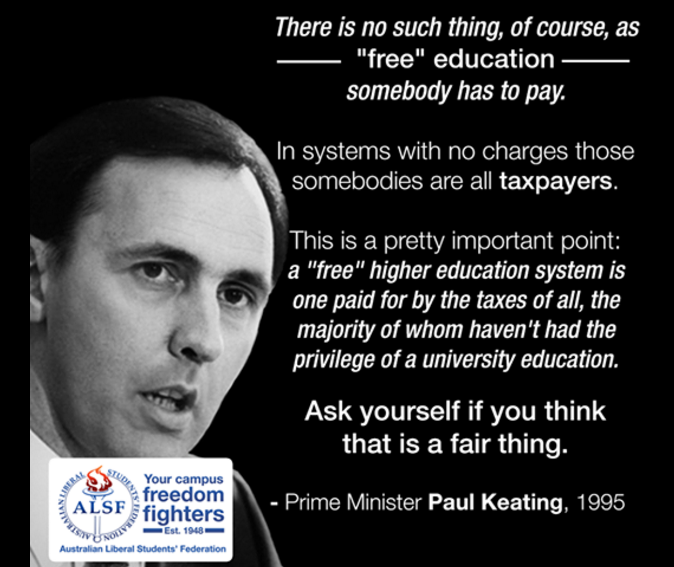
Free tuition at University is a handout to those already had a good start in life. It will be paid for by those who will never go because they do not have an above average IQ.
An investment in further education, be it at University or Polytechnic, is an investment. It should have some payoff to those that make it rather than just a good thing to do because of a subsidy.
How much more will you earn by going to university? It depends hugely on which country you're from http://t.co/7RMnUTM8nj—
paulkirby (@paul1kirby) September 11, 2015
The wage premium for a tertiary degree was low and stable in New Zealand in the 1990s (Hylsop and Maré 2009) and 2000s (OECD 2013). This stability in the returns to education suggests that supply has tended to kept up with the demand for skills at least over the longer term at the national level. There were no spikes and drops that would be the evidence of a lack of foresight among teenagers in choosing what to study. Whatever rationale may be put forward for free tuition, an undersupply of graduates is not among them.
Wow. I mean, WOW. College completion figures over time by income quartile. bit.ly/16Bb1jh http://t.co/y0MVyiDCEZ—
Richard V. Reeves (@RichardvReeves) February 04, 2015
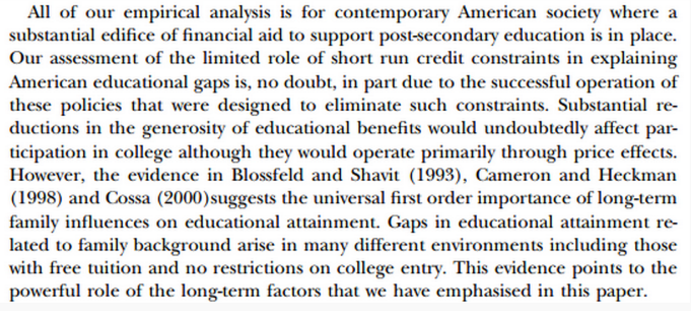
In 2002, with Pedro Carneiro, James Heckman showed that lack of access to credit is not a major constraint on the ability of young Americans to attend college. Short-term factors such as the ability to borrow to fund higher education has been found to be seriously wanting as an explanation for who and who does not go on to higher education. This has great relevance to New Zealand because the levels of student debt in the USA are much higher than here.
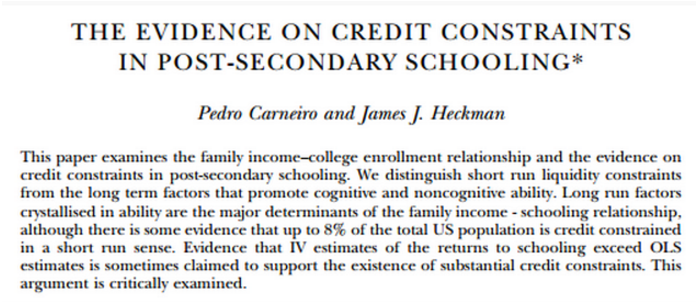
If you have been prevented from going on to university or otherwise studying after completing high school because of financial constraints, there is no social justice nor efficiency reason for free tuition fees. Any problems regarding borrowing against the human capital investment can be solved through student run loans.
The evidence that human capital is a key contributor to higher economic growth is weakening rather than strengthening. As Aghion said:
Economists and others have proposed many channels through which education may affect growth–not merely the private returns to individuals’ greater human capital but also a variety of externalities.
For highly developed countries, the most frequently discussed externality is education investments’ fostering technological innovation, thereby making capital and labour more productive, generating income growth. Despite the enormous interest in the relationship between education and growth, the evidence is fragile at best.
The trend rate of productivity growth did not accelerate over the 20th century despite a massive rise in investments in human capital and R&D because of the rising cost of discovering and adapting new technological knowledge.
The number of both R&D workers and highly educated workers increased many-fold over the 20th century in New Zealand and other OECD member countries including the global industrial leaders such as the USA, Japan and major EU member states.
Gough Whitlam abolished tuition fees at Australian universities in 1972. His idea was to reduce inequality. He instead gave a flying start to those of already above-average talents.
Charles Murray points out that succeeding at college requires an IQ of at least 115, but 84% of the population don’t have this:
Historically, an IQ of 115 or higher was deemed to make someone “prime college material.” That range comprises about 16 per cent of the population. Since 28 per cent of all adults have BAs, the IQ required to get a degree these days is obviously a lot lower than 115.
Those on the margins of this IQ are getting poor advice to go to college. Free tuition makes the likelihood of this poor investment in university in further education more likely.

Murray argues that other occupational and educational choices would serve them better in light of their abilities and likelihood of succeeding at college.Murray believes a lot of students make poor investments by going on to College, in part, because many of them don’t complete their degrees:
…even though college has been dumbed down, it is still too intellectually demanding for a large majority of students, in an age when about 50 per cent of all high school graduates are heading to four-year colleges the next fall. The result is lots of failure. Of those who entered a four-year college in 1995, only 58 per cent had gotten their BA five academic years later.
David Autor in a recent paper has illustrated how the gap between the highly educated and the less educated is growing at a far faster rate than the gap between the top 1% in the bottom 99% in the USA. David Autor argues that
a single minded focus on the top 1% can be counterproductive given that the changes to the other 99% have been more economically significant.
Autor found that in the USA since the early 1980s, the earnings gap between workers with a high school degree and a college education became four times greater that the shift in income during the same period to the very top from the 99%; Between 1979 and 2012, the gap in median annual earnings of households of high-school educated workers and households with college-educated ones expanded from $30,298 to $58,249, or by roughly $28,000.
Will more education decrease inequality? A simulation provided an answer. nyti.ms/1xw5m9W http://t.co/paQp19BEWc—
The Upshot (@UpshotNYT) March 31, 2015
If social justice is to mean anything, it does not involve giving freebies to those who have a head start in life. The standard policy response to growing inequality is to send people on a course. Trouble is that just makes smart people wealthier without helping the not so smart and increases the chances of smart men and women marrying off together. This increases the inequality between power couples and the rest.

 Utopia, you are standing in it!
Recent Comments