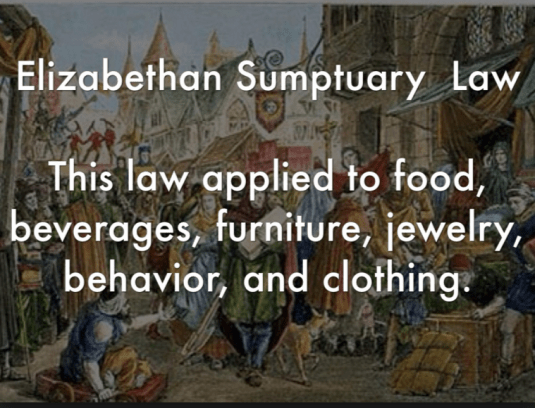
The sugar tax championed by among others the Morgan Foundation is the latest manifestation of do-gooding that dates back to sumptuary laws of mediaeval times. Black’s Law Dictionary defines them as
Laws made for the purpose of restraining luxury or extravagance, particularly against inordinate expenditures in the matter of apparel, food, furniture, etc.
These early attempts through sumptuary laws to regulate how people live their lives to make sure that they did not dress above their social rank as well as risk hellfire and damnation has been critically applied include alcohol prohibition, drug prohibition, gun control laws, bans, and restrictions on dog fighting.
The sugar tax attempts to save us from a bad diet because others know how to run our lives better than we do despite having never met us, much less lived our lives and dreamed our dreams. The calling of the do-gooder is a busy vocation.
The do-gooders want to stop smoking, overeating, and the partaking of too much sugar but undoubtedly support the decriminalisation of marijuana because of the futility of prohibition.
The right to get stoned is a civil liberties issue but sugar is a legitimate topic of public health regulation. Those who do not want to save people from sugar are ignorant or steeped in moral turpitude, preferably both.

We live in an age of obesity. When I was a kid, the poor were thin, they are now fat. I can still remember the names of the 2 boys in my high school class who were in any way overweight. Now the majority of school kids are overweight.
Sugar taxes are also when the Left stage a temporary conversion to supply-side economics. When you tax something, less will be supplied. The Left are surprisingly unwilling to admit that unless it suits their agenda of the day.
The Morgan Foundation is a curious position of advocating a great big new tax: a comprehensive capital taxation. It is also arguing that sugar taxes will cut consumption. I wonder what it estimates to be the response of saving and investment in its capital tax. Does it take the conservative estimates, or the liberal estimates of the responsiveness of savings, investment and labour supply to higher taxes?
Sugar taxes are a blunt instrument. They tax fat people, thin people and the potentially fat of tomorrow. They are not like alcohol and tobacco taxes which are narrowly tailored to taxing sin. Richard Posner said that
People who crave sugar will find no dearth of substitutes for sugar-sweetened sodas. Moreover, most consumers of these sodas are not and never will be obese. They may well be overweight, but all that that means is that they are heavier than the “ideal” weight calculated by physicians; if they are only slightly or even moderately heavier, the consequences for health or social or professional success are apparently slight. To the extent that a soda tax would cause substitution of equally sugared foods, it would not only have no effect on obesity; it would yield no revenue…
Last time I looked, people enjoy food. Some enjoy food quite a lot.
We are in a free society where some people are just simply like eating while others have a bad draw of the genes. Others like to exercise. As Richard Posner said:
The obese are people who by dietary choice and preference for a sedentary style of life have traded off the costs of obesity against the costs of being thin and have decided (at least in a “revealed preference” sense–they may not have consciously chosen a style of life that predisposes them to obesity) that the costs of thinness preponderate over the benefits. And in general we do not try to prevent people from making such trade-offs.
But there are two situations in which preventing people from choosing the style of life that maximizes their utility can be defended (provided certain assumptions are made about cost and efficacy) on economic grounds.
One is where consumers are unable to evaluate a product or to act upon their evaluation; another is where a voluntary transaction imposes costs on other people which the transactors do not take into account.
The fact that car unhealthy lifestyles may impact on the public health budget is not much of an argument for intervention. Private insurers are quite capable of working out whether they need information on people’s lifestyle and diet or not.

If you are to provide people with universal health insurance at the expense of the long-suffering taxpayer, you should at least have the decency not to try and take over their entire lives so that you can be a social justice warrior on the cheap.
As for children seeing advertising for sugar, the sugar tax and a ban on advertising is a token gesture. You trying to take over from their parents. As Gary Becker noted:
Many doctors and others who advocate taxing sugared beverages and fast foods at heart do not believe that consumer taste for sugar and fast foods should be taken into account in devising public policy.
Until the nanny state brigade and sugar tax advocates address that simple question, they have no standing in a public debate. Like all the prohibitionists who came before them, they are simply unwilling to admit the people like food, drink and sugary things.
Women demonstrating against Prohibition, 1932. https://t.co/xE30ApkNBB—
Historical Images (@Historicalmages) January 29, 2016
Until they put forward a way of balancing that common preference to enjoy life including food and risk against their meddlesome preferences in their role as the great central planner of our lives, they are just having us on. As Richard McKenzie said recently
The people most concerned with the country’s weight gain—self-appointed “fat police”—have favoured supposedly easy and direct policy solutions: tax and ban high-sugar and high-fat products.
Such policy courses are a snare and delusion, especially if Americans’ cherished freedoms of choice, which are at the heart of the country’s economic engine, are to be preserved.
The great driver of obesity is prosperity, not sugar. People can simply afford to buy more and enjoy the food they have more.

John Rawls argued that people should have every right to live their lives according to their own lights. In nanny state brigade just do not accept that point of view.
Rawls believed the most distinctive feature of human nature is our ability freely to choose our own ends. The state’s first duty with its citizens is to respect this capacity for autonomy.
Instead, the fat police and the do-gooders want to engage in the futile gesture of pestering you and taxing you when you buy a sugary drink even though there are almost unlimited alternative supplies of sugar laden products.

The fat police are far too busy feeling good about themselves in the expressive politics of public health. They cheer for sugar taxes, boo obesity and feel good about themselves for having told other people how to live their lives better. A good number of them then celebrate by lighting-up a joint. Many of the rest have a wine, not beer.
The particularly annoying ones ride a bike, which is a dangerous activity, or are so boorish as to exercise in a public place, much to the annoyance of the rest of us who are getting on with having a good time.
 Utopia, you are standing in it!
Mar 17, 2016 @ 13:10:17
Reblogged this on Utopia – you are standing in it! and commented:
LikeLike