
In a bizarre twist, the Economic Policy Institute is spinning one of the strongest arguments against minimum wage increases into an argument for them.
The Economic Policy Institute pointed out this week that raising the minimum wage saves billions because public assistance to low-paid workers is wound back as their wages rise.
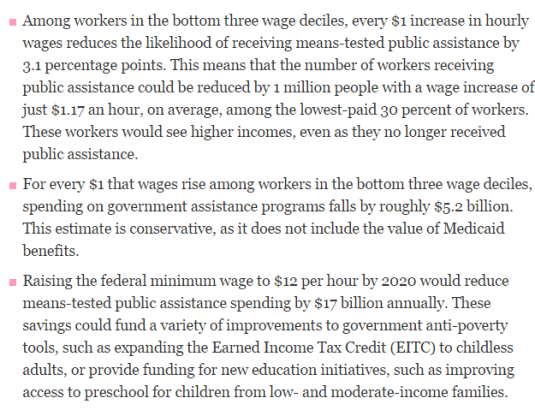
A bog standard argument against minimum wage rises is the take-home pay of low paid workers will rise by much less than the rise in labour costs to their employers.
The reason for that discrepancy between before and after-tax pay is cash and non-cash assistance from government reduces as their wages rise with the minimum wage increase.
It is pretty standard for effective marginal tax rates and low-paid workers to be high because of the many forms of assistance in cash and in-kind which they receive winds back as their wages rise.
Working Class American Families Face Marginal #Tax Rates up to 43.7% bit.ly/1IGqQqE @ScottElliotG https://t.co/zJwIfrp2pT—
Tax Foundation (@taxfoundation) January 04, 2016
There is a large literature on the labour supply effects of this winding back of family tax credits and other assistance to low-paid as their earnings increase.
The poverty trap facing welfare beneficiaries and the low-paid because of this winding back of family tax credits and other social assistance is so widely accepted that is the only time that the Left believes in supply-side economics. It is one of the reasons for their enthusiasm for a universal basic income.
Because of the interaction between wage rises and social assistance, the practical upshot is the job of the low-paid worker is put at risk by the minimum wage increase and yet their take-home pay increases by much less. Some will lose their jobs. Others will not be hired in the first place.
Jens Rushing's perfect response to #RaiseTheWage critics went viral this summer. Read it: attn.com/stories/2619/e… https://t.co/KBIM5XLKmz—
The Fairness Project (@ProjectFairness) November 06, 2015
Almost 20 years ago, Paul Krugman pondered on why supporters of the minimum wage was so adamant that their before-tax wage must increase rather than their incomes be supplemented by family tax credits and other social assistance. He asked:
…why take this route? Why increase the cost of labour to employers so sharply, which–Card/Krueger notwithstanding–must pose a significant risk of pricing some workers out of the market, in order to give those workers so little extra income? Why not give them the money directly, say, via an increase in the tax credit?
In his book review, Krugman nailed it when he concluded that the demands for a higher minimum wages about morality:
…I suspect there is another, deeper issue here-namely, that even without political constraints, advocates of a living wage would not be satisfied with any plan that relies on after-market redistribution. They don’t want people to “have” a decent income, they want them to “earn” it, not be dependent on demeaning handouts…
In short, what the living wage is really about is not living standards, or even economics, but morality. Its advocates are basically opposed to the idea that wages are a market price–determined by supply and demand, the same as the price of apples or coal.
And it is for that reason, rather than the practical details, that the broader political movement of which the demand for a living wage is the leading edge is ultimately doomed to failure: For the amorality of the market economy is part of its essence, and cannot be legislated away.
The advocates of the living wages simply offended by the notion of people earning so little. I am less kind than Krugman to this moralising.
These do-gooders are perfectly willing to put the jobs of the low-paid at risk so that they are not offended by how little they have paid.
In the finest traditions of rational irrationality and expressive voting, they simply deny they are putting jobs at risk and going into terribly convoluted arguments about how the employment effects of be small and everyone are we better off and more productive. Arguments that Paul Krugman laughed at back in 1998.
Living wage advocates are not using the low-paid for policy experiments, which would be pretty bad, they use them to make themselves feel better about the inequalities of the world. They just want to drive the sinners out of the temple come what may.
 Utopia, you are standing in it!
Recent Comments