The New Zealand Treasury understands neither who pays company taxes when capital is internationally mobile nor why Ireland was relentlessly bullied over its 12.5% company tax rate.
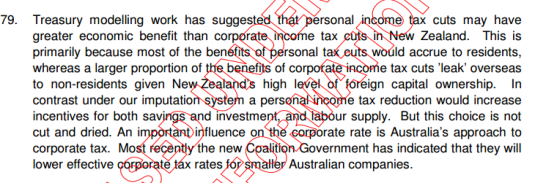
The Treasury makes the surprising claim that the benefits of company tax cuts will leak overseas to non-residents because of the high level of foreign capital ownership.
Now if New Zealand were to substantially cut its company tax rate, hell will freeze over before the Australian Treasurer rings up and say thanks mate. The Australian worry will be the loss of investment and corporate headquarters to New Zealand.
Who pays company tax when capital is internationally mobile is one of the easiest questions you can get in an economics quiz. Just trace out how investors will react to a lower company tax in New Zealand.
If company taxes are lower in New Zealand, more investment will flow into New Zealand, increasing the size of the capital stock in New Zealand and with it wages in New Zealand because New Zealand workers have more capital to work with.
When will these international capital inflows stop? It is obvious! When risk-adjusted after-tax returns equalise for internationally mobile investors. They will adjust their portfolios so that after-tax returns equalise across tax jurisdictions.
The after-tax returns are equalised by the competing tax jurisdictions having different before-tax rates of return on capital and therefore costs of capital.
Jurisdictions with high company taxes have to offer larger before-tax returns so that internationally mobile investors receive the same risk-adjusted after-tax return everywhere. High tax jurisdictions boost before tax return by wages being lower in the high tax jurisdiction.
High company taxes are paid for by the workers of the jurisdiction concerned through having to accept lower wages to work with the same amount of capital. They must compensate foreign investors by boosting before-tax returns so that their after-tax rates of return equalise across competing tax jurisdictions.
The New Zealand Treasury missed this most basic point about who pays a company tax in a globalised world. The Australian Treasury is right on top of this basic piece of economics:
The mobility of capital refers to how easily financial capital (debt and equity) flows into and out of a country. Greater capital mobility will shift more of the burden of taxation from capital to labour through larger changes in the domestic capital stock, and hence in domestic labour productivity and wages (Grubert and Mutti 1985; Gravelle 2010).
In this situation, a reduction in the company tax rate will result in large inflows of foreign capital to ensure that there is no material difference between the after tax (risk adjusted) rate of return on investment in Australia and the rate available abroad.
The many attempts at company tax harmonisation by the European Union and G20 are motivated by the fear of large capital flows into the lower tax jurisdictions.
No high-tax country views the low company taxes in Ireland, Singapore and Hong Kong as a windfall where they can raise more tax revenue on the additional dividends repatriated from lower tax jurisdictions.
Very large economies such the USA can get away with a slightly above average rates of company tax because the number of other places to go are fewer.
A small open economy such as New Zealand should safely assume that most to all of burden of the company tax is on New Zealand workers through lower wages.
Capital migrates from high-tax to low-tax locations, reducing capital-to-labour ratios in high-tax countries. The low-tax countries experience higher capital-to-labour ratios, a higher marginal product of labour, and higher wages.
I will be putting in an Official Information Act request seeking to find out whether the work of Arnold Harberger influences their company tax briefings to ministers. I will also add any work they are done on corporate inversions and the company tax rate in Ireland.
 Utopia, you are standing in it!
Recent Comments