
Today marks the 30th anniversary of the overthrow of Ferdinand Marcos and his authoritarian regime in the Philippines. From February 22-25, 1986, over two million Filipinos held demonstrations in the capital of Manila. The struggle against the two-decade authoritarian rule transpired for years and Filipinos expected a protracted and bloody revolution to bring down an entrenched dictatorship. Yet, unlike other sultanistic or neopatrimonial regimes that were defeated by a revolutionary movement or ousted by a coup d’état, Marcos was dethroned by nonviolent protesters, largely from the middle class, who were held together not by a common political ideology but by moral indignation founded on basic distrust of the government (see David 1985, Thompson 1995).
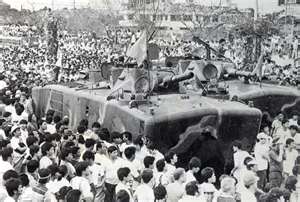 Named after the urban space in Manila where this historical watershed occurred, the EDSA “People Power” Revolution was the first democratic transition in Asia during the so-called “third wave of democratization” (Huntington 1991
View original post 1,073 more words
 Utopia, you are standing in it!
Recent Comments