Bill Rosenberg of the Council of Trade Unions is one of many economists who point out that income inequality has not been getting worse and worse in New Zealand since the 1990s. Inequality rose sharply in the late 1980s and early 90s but has remained high but nevertheless stable since then as he says in his 2014 paper of trends in living standards:
This is another symptom of the sharp rise in income inequality between the mid 1980s and mid 1990s, which remains high.
His employer, the Council of Trade Unions when it was denouncing the Employment Contracts Act 1991 as the reason for low wages growth has also drawn attention to the early 1990s as a turning point in the relationship between inequality, union bargaining power and wages growth.
As the Council of Trade Unions showed in the chart it published during the last election campaign, which I snapshoted below and also annotated, from 1970 to 1975 there was rapid real wages growth, well in excess of real growth in per capita GDP. This wages breakout was followed by some ups and downs but essentially wages in 1995 were no higher per hour from what they were in 1975. Real wages were about $24 per hour in real terms in New Zealand for about 20 years – from 1975 to 1995.
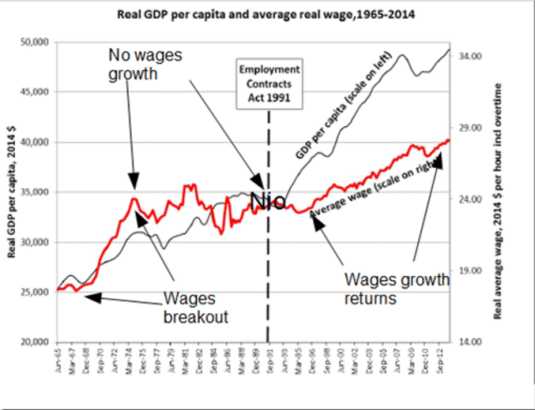
There was no real GDP per capita growth from 1975 until 1979 nor in the five years leading up to the passage of the Employment Contracts Act 1991. The period leading up to 1975 wages breakout wages was the zenith of union membership; nearly 70% of all workers belonging to a union. Less than 20% do now and less than 10% in the private sector.
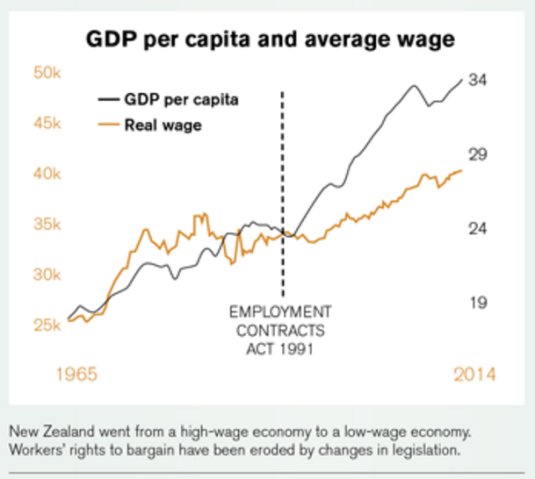
Source: Income Gap | New Zealand Council of Trade Unions – Te Kauae Kaimahi.
After staying at about $24 per hour for 20 years from 1975 to the early 1990s, following the passage of the Employment Contracts Act in 1991, average wages in New Zealand have increased steadily from $24 an hour to about $28 per hour by 2014 in one of the most deregulated labour markets in the world.
As Rosenberg, who is chief economist at the Council of Trade Unions, and the Council of Trade Unions itself pointed out, there were major changes in the New Zealand economy in terms of inequality of incomes and union bargaining power in the late 80s and early 1990s.
These changes referred to by the unions as an erosion of workers bargaining power, brought an end to wage stagnation. Steady real wages growth returned after two lost decades: next to no growth in either GDP per capita or incomes of workers.
 Utopia, you are standing in it!
Recent Comments